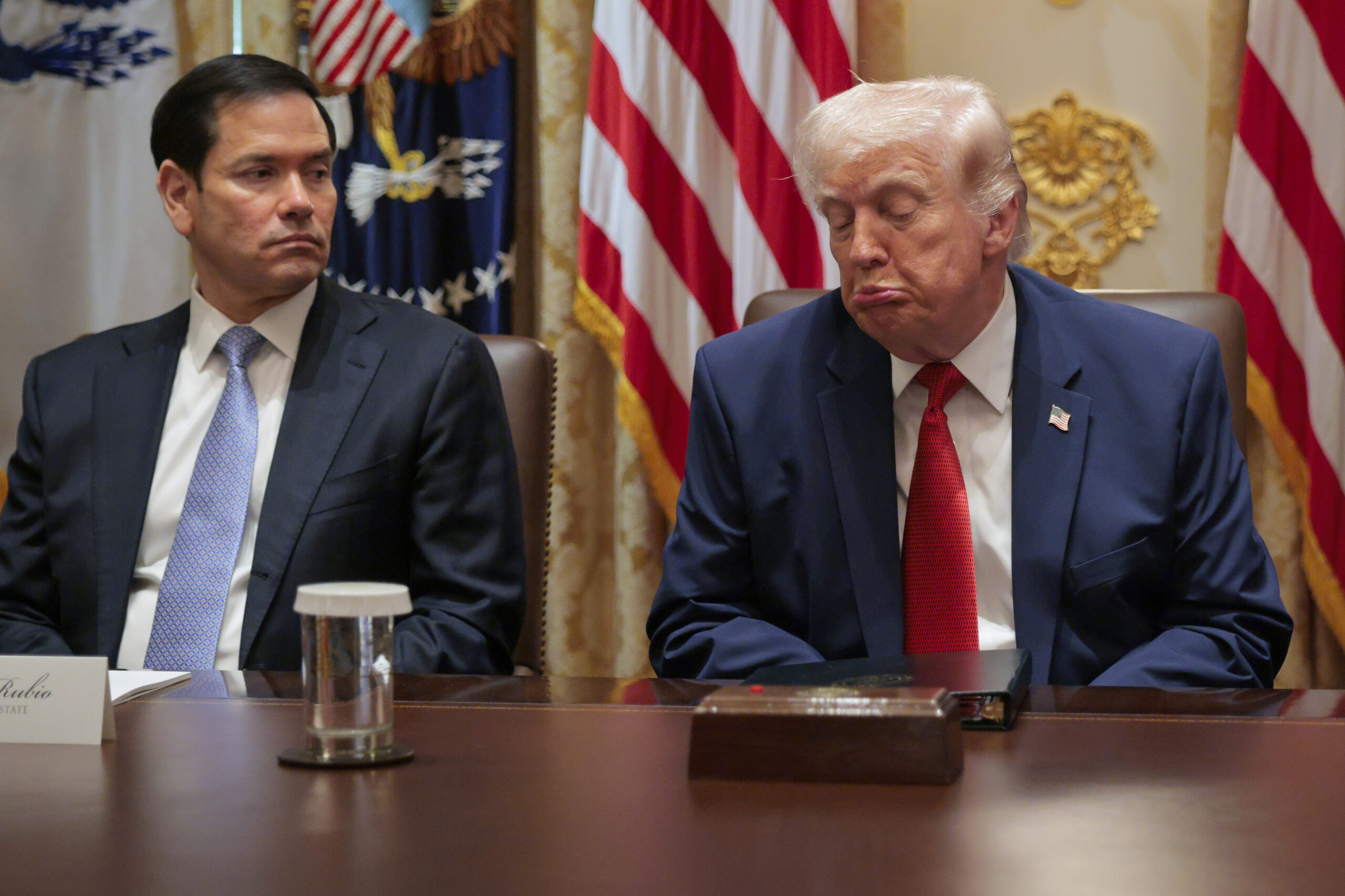
Let’s all give a hand for Marco Rubio, secretary of state, favored champion of the White House, and all-around cretinous worm. The Amazing Plastic Man—the adjective refers to his flexible principles, not his increasingly inflexible face—was hitting the airwaves this Monday morning to articulate the latest version of what the Trump administration regards as its war aims. Excuse me, military operation aims; President Donald Trump has figured out the One Weird Trick around constitutional checks on executive war powers. You just have to use the right words!
“Well, the war is—this operation, okay—and that’s what this is—is about very specific objectives,” Rubio told ABC’s George Stephanopoulos.
The president laid them out on the first night of the operation. I’ll repeat them to you now because I hear a lot of talk about ‘we don’t know what the clear objectives are.’ Here they are. You should write them down. Number one, the destruction of their air force. Number two, the destruction of their navy. Number three, the severe diminishing of their missile launching capability. And number four, the destruction of their factories so they can’t make more missiles and more drones to threaten us in the future.
Great, Marco. And why are we doing all that?
All of this so that they can never hide behind it to acquire a nuclear weapon. That was our objective from the beginning; that remains our objective now. We are on pace and in fact ahead of schedule on some of those things, and we are going to achieve those things in a number of weeks, not in a number of months.
Sneering tone aside—I assume Rubio would physically sneer, but for the Botox—this is a good enough articulation of what the administration thinks it’s up to right now. (Of course, that could change.) We’ll throw on as a coda thwarting Iranian control of the Strait of Hormuz. (“Now, they are making threats about controlling the Hormuz Straits in perpetuity, creating a tolling system and the like. That’s not going to be allowed to happen.”)
We’ll give Trump, Marco, Pete, and the boys two gold stars apiece for destroying the Iranian air force and navy. Of course, neither of those august organs was regarded as much of a threat; Iranian naval weakness has been a matter of remark for years. Diminishing the Iranian missile launch capacity—well, mixed bag. Launch volume is down, and there has certainly been serious damage to Iranian missile capacities. Yet serious stuff is still getting through and causing havoc, especially as interceptor stores in Israel and the Gulf are run down. Even with a diminished capacity, Iran can cause problems. The destruction of factories: also a mixed bag. We have certainly destroyed an awful lot of Iranian industrial capacity, but when it is literally the missile and drone programs that allowed Iran to survive the attacks and avoid regime change, it seems highly unlikely that the Islamic Republic will not try to rebuild them any time soon. This is the Chinese finger-trap: The programs we want them to dismantle are the reason they’re still there.
Subscribe Today
Get daily emails in your inbox
Short of a Morgenthau plan for Iran, these programs will be maintained and expanded after the war. (Our Israeli comrades in arms would clearly be very happy to pastoralize Iran, but the United States is unlikely to have the stomach required for such an undertaking—not to mention that the great anti-Western terrorist movements have all been born in the vacuum of state power, in post-Soviet Tajikistan, post-invasion Iraq, and civil-war Syria.) Among many worrying points about this military operation, this is one of the worst: We have spent a spectacular number of resources in the past month, but we may still well be in the position of “mowing the grass,” of having to return to degrade rebuilt Iranian capacities again. This is a very expensive, politically difficult way of doing business; a quagmire in installments is no less of a quagmire.
Finally, there is the gnarly question of the strait. For this, no marks: The strait was open when the war started, and it is all but closed now. It is doubtful that the Iranians will give up this leverage. (Around the time Rubio was taking his turn on ABC, Scott Bessent was over on Fox News touting how the number of ships going through the Hormuz is increasing; though the only ships making the passage are those of non-hostile countries, which appear to be paying a toll to the Iranians.) There have been theories floating around about some sort of operation to take Iranian oil assets to cut off revenue and force them to the negotiating table—call it closing the Hormuz to open the Hormuz—but these undertakings are difficult to imagine at just this moment. Serious journalists and analysts like Ken Klippenstein and Will Thibeau, a TAC alum, have expressed skepticism that the current level of troops in the theater can be much use for actual ground operations, either clearing the coast to secure the strait or seizing the Kharg Island oil hub. The administration is at pains to remind everyone that American oil is not primarily sourced from the Gulf (although they studiously avoid touching the whole “global market” thing and the effect of constricted global supply on American energy affordability). The president himself is saying weird, cryptic stuff about controlling the Hormuz jointly with the ayatollah. There does not seem to be a settled solution here, and the rhetorical groundwork is being laid for justifying a suboptimal ending in the Hormuz. Again, if this round wraps up with Iranian constriction of the Hormuz intact, it will invite future intervention—more grass-mowing, or weedwhacking or whatever yardwork-based analogy you prefer.
Stupendously expensive and destructive military operations every six to 18 months for the foreseeable future does not seem like an appreciably better outcome than the Bush-era occupations. Indeed, I’d go so far as to describe such a state as “forever war.” As has always been the case, any durable solution will be political and diplomatic—but that’s not this administration’s strong suit, is it?