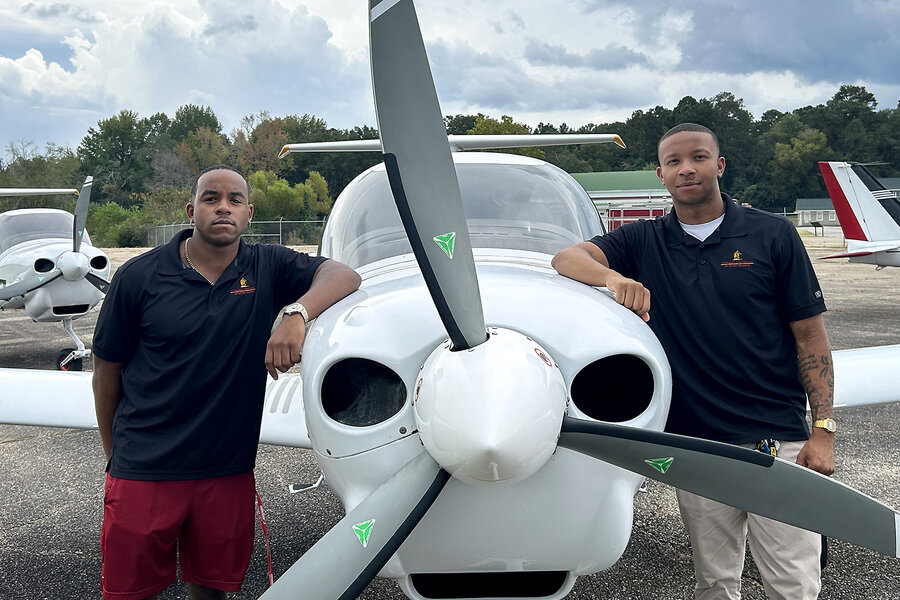
Atlanta native Damon Benson knew he wanted to be a pilot the first time he flew on an airliner as a kid. “When [the pilot] put the thrust in before takeoff, and I was pushed back into the seat, that was thrilling to me,” Mr. Benson says with a smile. “I fell in love with it then, and that’s what carried me to this point.
“I just knew that I wanted to be the person that was in the cockpit, flying [around] a kid like me that was somewhere in the back. Being able to tell them, ‘Hey, you can do this, too.’”
Mr. Benson is one of 46 aviation science students at Leadership in Flight Training (LIFT) Academy at Tuskegee University in Alabama, where training resumed this year for the first time since 1946. The training center is based at Moton Field, named for Tuskegee’s second president, Robert Russa Moton. It is where the early airmen’s skills were honed before they served as the first African American military aviators in World War II.
Why We Wrote This
Some might think that the legacy of the Tuskegee Airmen is all in the past. But there is a generation of students at famed Tuskegee University, a historically Black university, who are poised to rise to the standard of their predecessors.
One of the last members of that storied cohort, Lt. Col. George E. Hardy, who flew combat missions in World War II, died at the age of 100 last month. The organization’s national office said in a statement that his legacy is “one of courage, resilience, tremendous skill and dogged perseverance against racism, prejudice and other evils.”
Titus Sanders, the aviation science program director at Tuskegee, notes the challenges involved with the program’s triumphant return.
“For decades, Tuskegee has been wanting to return to the skies. … One of the challenges with aviation is funding, not having the appropriate amount of dollars to get the program started, to include airplanes and the infrastructure that needs to be in place,” Mr. Sanders says in a Zoom interview. “It costs about $120,000 to train a student from private pilot to commercial license in the United States, in addition to their tuition that they have to pay at the university. So a lot of individuals and agencies went into the planning and launching of the program.”

Senior Airman Malcolm Mayfield/U.S. Air Force/File
Upon completion of the program, students – made up of both men and women – will have both a bachelor’s degree in aviation science from Tuskegee University and a commercial multi-engine pilot license through LIFT Academy. It is a four-year program that can be completed in three years, and aside from the legacy of the Airmen, its focus on academic and military excellence has enticed individuals with military experience like Columbia, South Carolina, native Myles White.
“While I was active duty in the Navy, I worked with different types of aircraft. … Just working on the flight deck absolutely motivated me to do more than just loading ordnance onto the aircraft,” says Mr. White. “It’s an amazing job, and I loved it and took pride in it. But I wanted to move on to the next step, and that’s what truly inspired me to pursue the path of aviation.”
Mr. White and Mr. Benson, who are both affiliated with the Navy ROTC, briefly described the rigors of the program and their schedule. Their days start at 6 a.m., with either training or course work. Training happens in two-hour blocks, and students journey between Moton Field and Tuskegee University, which are about five minutes apart. Depending on the time that training is scheduled, they may be on base as late as 10 p.m.
Mr. Sanders, a native of Pittsburgh who began flying in the Army over 20 years ago and also serves as a pilot for United Airlines, described the four rating levels for students and prospective pilots.
“The first private pilot license will allow them to fly an airplane with somebody on board in good weather, but not get paid,” he says. “That’s done in their first year – ground school in the first semester. And in the second semester they begin to fly, and it usually takes about 70 hours to get applied time for that rating.
“Instrument rating allows a student to fly an aircraft in bad weather and through clouds,” he adds. “The private pilot can’t fly through clouds. The instrument pilot uses [tools] on the aircraft to navigate through weather, and then they’re certified.”
The final two phases of training are commercial pilot, for single-engine planes, which allow pilots to get paid, and the multi-engine add-on. Over the duration of the program, students will receive all four ratings. In late August, Isaiah Hand became the first Tuskegee student in the current program to receive his private pilot’s license.
Discussing the Airmen legacy also includes an uncomfortable truth – navigating the historical rhetoric suggesting that Black pilots weren’t smart enough to pilot an aircraft. A discriminatory 1925 Army War College report titled, “The Use of Negro Manpower in War” listed these incendiary and inaccurate anecdotes about Black soldiers: “The negro does not perform his share of civil duties in time of peace in proportion to his population. He has no leaders in industrial or commercial life. He takes no part in government. Compared to the white man he is admittedly of inferior mentality. He is inherently weak in character,” it reads. “His mental inferiority and the inherent weaknesses of his character are factors that must be considered with great care in the preparation of any plan for his employment in war.”

The criticisms and attempted erasure of Black pilots are more recent than a century ago. President Donald Trump’s attack on DEI initiatives initially led to the removal of training videos, which included the Tuskegee Airmen and other famed Black pilots from military websites. Last January, the late Charlie Kirk came under fire after this commentary: “If I see a Black pilot, I’m gonna be like ‘Boy, I hope he is qualified.’”
The criticisms and attempted erasure of Black pilots are more recent than a century ago. President Donald Trump’s attack on DEI initiatives initially led to the removal of training videos, which included the Tuskegee Airmen and other famed Black pilots from military websites. On Sept. 30, Secretary of Defense Pete Hegseth said that “this administration has done a great deal from day one to remove the social justice, politically correct, and toxic ideological garbage that had infected our department, to rip out the politics.” Last January, the late Charlie Kirk came under fire after this commentary: “If I see a Black pilot, I’m gonna be like ‘boy, I hope he is qualified.’”
Tuskegee’s director acknowledged the former and present narratives that shaped the resolve of the Airmen. Then, in true aviator fashion, he took the high road.
“We have to keep the main thing, the main thing,” Mr. Sanders says. “When you get distracted by outside entities and different ideologies, it can distract you from meeting your goal. Our goal is to finish. To make sure [students] finish on time.”
It is not a hopeless or hapless burden. Both Mr. White and Mr. Benson talked about going back to their hometowns with their aviation science shirts on and being greeted as heroes. In some ways, when Mr. Benson returns to his high school alma mater, Eagles Landing in McDonough, Georgia, he is fulfilling the promise of inspiring future generations.
“You have to commit your mind, body, soul, and time,” Mr. White says. “But knowing that it can be done, that it has been done, we can continue that tradition.”
“One of the things that I like to remind the students is while they’re at Tuskegee and while they’re in the program, that they have the luxury of looking around their classroom … and being able to see that there’s people who look like them,” Mr. Sanders says.
“Once they leave Tuskegee, they will never see that again. They will most likely always be the only Black face in the room. They have a responsibility of excellence,” he adds. “They are representative of this program, this legacy, this history and have an inherent responsibility to uphold that as they move forward in their careers.”