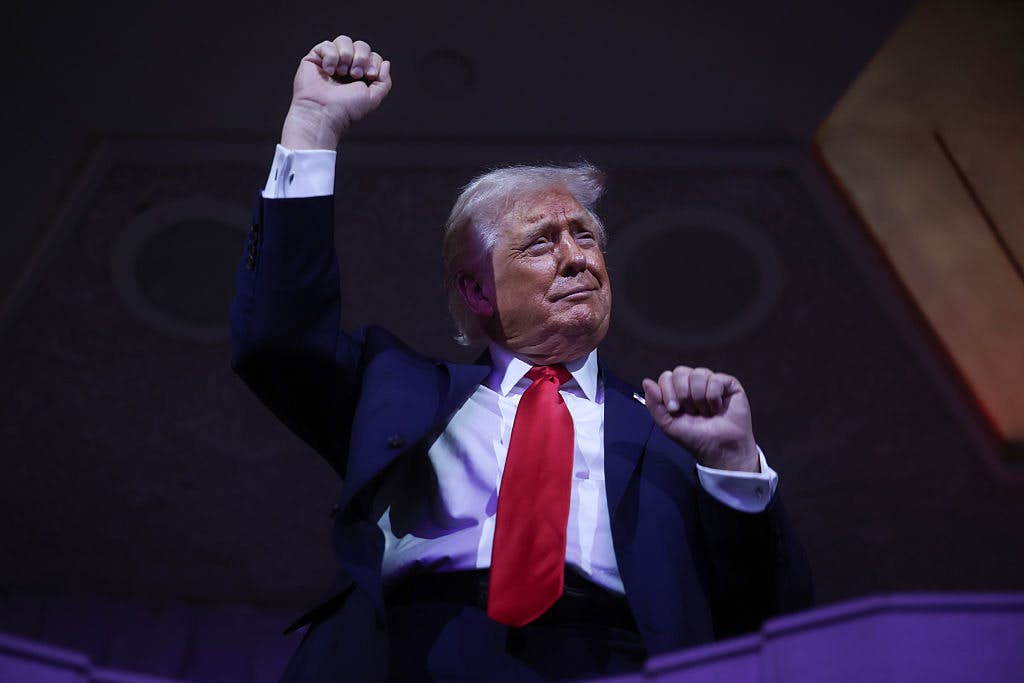

The first rule of the Trump Game, played by politicians around the world, is you do not talk about the rules of the Trump Game. The object of the game is to pretend that the President of the United States is a normal, rational statesman, perhaps an eccentric one, but fundamentally someone who is acting according to some strategy that the rest of us might one day hope to fathom. On no account are you ever to admit that he’s nasty, vain, venal, capricious and obviously unaware that his own doctors are testing him for signs of dementia.
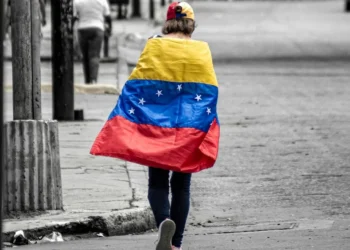
The 2026 round of the game got off with a literal series of bangs, as the US military attacked Venezuela and kidnapped its president. On Sunday morning we were greeted by the sight of Nicolás Maduro being led down a hall at the Drug Enforcement Administration in New York. The floor had been painted with the slogan “Rule of Law”, to allow Americans to walk all over it.
It’s an easy mental trap to think that a great moment implies a great cause. The abduction of another head of state, even a nasty one, feels like a big moment, a remaking of the international order. So there was naturally an attempt to suggest that behind this lay a vision for a different world order. The president himself announced he was reviving the Monroe Doctrine. If you’re a little hazy on what that is, don’t worry: Trump in his press conference had the distinct air of a man reading the words for the first time in his life.
It would be silly to spend a lot of time trying to decipher the deep thoughts of a man who is still clearly under the impression that asylum-seekers have arrived in America from actual insane asylums. As the President made clear, he’s heard that there’s oil in Venezuela, oil means money, and he likes money. Sure, Maduro’s regime was corrupt, but Trump doesn’t mind corrupt regimes, only corrupt regimes where he doesn’t get a piece of the action.
All this was a problem for British players of the Trump Game, particularly those who counts themselves among the President’s fans. It was noteworthy that Nigel Farage, smart enough to know that his fawning admiration for Trump is one of his biggest vulnerabilities with the public, chose to initiate a fascinating process of edging away.
“The American actions in Venezuela overnight are unorthodox,” the Reform leader began, carefully, “and contrary to international law.” Wow, Nigel, that almost sounds like criticism. Fortunately his next sentence brought him back from the brink. “But if they make China and Russia think twice, it may be a good thing.”
Sadly Farage had no space to explain why Russia and China would be downhearted at America announcing that big countries are allowed to do what they like to nearby small countries. Perhaps we’re supposed to imagine that the Delta Force’s next target might be Russia’s rogue leader. Someone needs to explain that Trump feels the same way about Vladimir Putin that Farage feels about Trump.
Soon-to-be-minor party leader Kemi Badenoch played the game in the traditional manner for a Conservative, reflexively unwilling to criticise any Republican leader, though she did so in her own distinctively combative manner. “There’s a lot of noise from people who couldn’t find Venezuela on a map yesterday,” her statement began, addressing the voices only she can hear. “This is clearly a fast-moving and extremely serious situation. I am not going to rush to judgement or speculate on incomplete reports.”
In other circumstances, Badenoch announcing that she wasn’t going to rush to judgement would be a sign that she was seriously ill. When playing the Trump Game, it means she has already arrived at a judgement, and found it so unpalatable that she can’t bear to say it out loud.
The Trump Game is easier if you’re in a small left-wing party. Take Zack Polanski, newly installed leader of the Green Party. For him, there’s no international crisis that isn’t ultimately about Gaza. “Spray paint a plane and they’ll detain you without trial and call you a terrorist,” he said, a reference to the Palestine Action team currently in prison (though not, in fact, without trial). “Kidnap a foreign head of state and Keir Starmer will make it clear we’ve played no part in it but will wait for the scheduled press conference in a few hours before potentially condemning it.” The second part of this was less clear than the first. Was Polanski condemning the Americans for arresting Maduro, or demanding that the Metropolitan Police storm Mar-a-Lago and arrest Trump? It might have been both.
In other circumstances, Badenoch announcing that she wasn’t going to rush to judgement would be a sign that she was seriously ill
But the person for whom the Trump Game is hardest is whoever happens to be prime minister. Keir Starmer had given a long interview to the BBC to start off the year, part of his latest — and possibly last — relaunch. Listening to the prime minister is generally a good cure for insomnia, but in this case particularly the chat was overshadowed by events across the Atlantic. Was invading other countries bad, Laura Kuenssberg asked him. “Well, at the moment, it’s a fast-moving situation,” he replied, exactly the same formulation as Badenoch used. “I want to get all the material facts together, and we simply haven’t got the full picture at the moment.”
Although, really, we had. You can make a lot of criticisms of the Trump administration, but no one can say it’s not open about what it’s doing and why it’s doing it. For months the President had said he wanted control of Venezuelan oil, and on Saturday he was delighted to announce that he’d got it. The trick, when you’re playing the Trump Game, is to ignore the words coming out of the Trump Mouth.
But Starmer, too, turns out to be capable of disarming frankness. “The relationship between the US and the UK is one of the closest relationships in the world,” he told Kuenssberg. “It is my responsibility to make sure that relationship works. And not only have I stepped up to that responsibility, I have made it my business, and I do get on with President Trump.” That, in the end, is the only rule that matters in the Trump Game.