
In March 2006, almost exactly twenty years ago, as Iraq was descending into chaos, American conservatives were split on foreign policy. Neoconservatives believed in regime change and national building — the project that had underpinned American efforts in Afghanistan and Iraq.
Some conservatives, though, were more sceptical. They were not peaceniks. Far from it! But they thought that violence should be used to avenge and deter — not in the name of grand ideological projects.
In a critical piece, Rich Lowry, the neoconservative editor of National Review, called them “To Hell With Them” Hawks. John Derbyshire, a British-American NR contributor, accepted the label. “We don’t at all mind using raw military power in pursuit of geostrategic objectives,” wrote Derbyshire:
Strike out at those who insult us and harm our interests … Do so without apology or regret. Only do so, however, with punitive or monitory intent, or to remove some plain visible threat … and do not stay around to get involved.
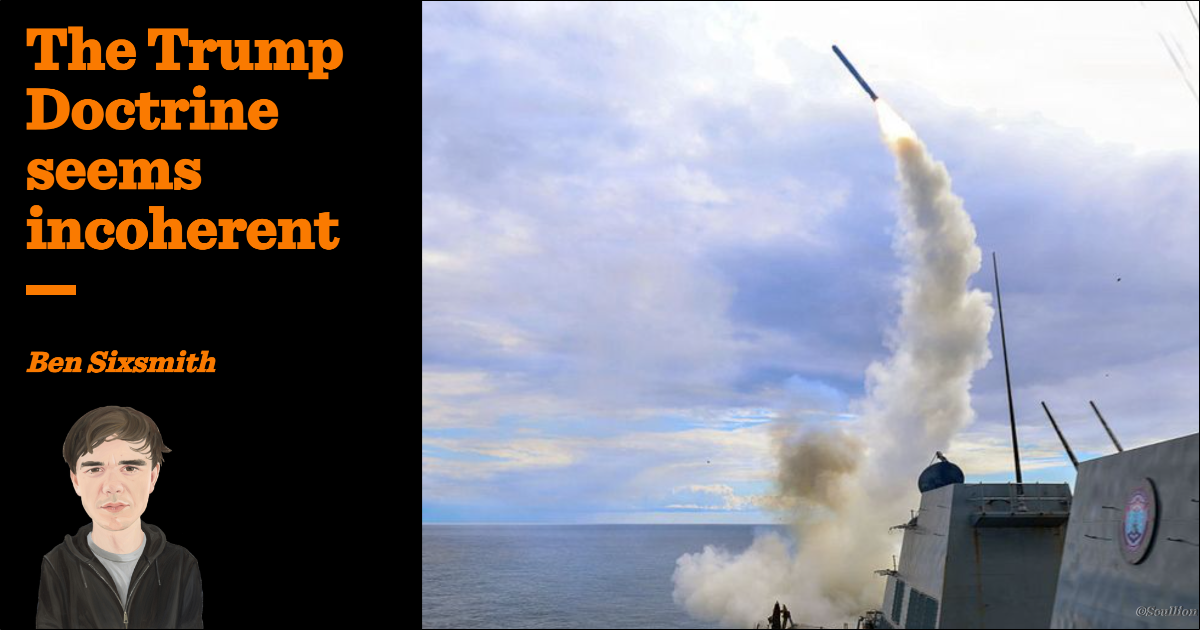
Donald Trump, in his muscle-flexing 2026 campaign of adventurism, appears to be trying to use the methods of “To Hell With Them” Hawks to achieve the aims of neoconservatives. He wants his wars to be quick, brutal and spectacular — but he wants the results to be conclusive and uplifting.
No one could pretend that the Iranian regime is the innocent victim of unprovoked aggression. It has fuelled violence across the region, as well as being a bloodsoaked theocracy which has at least appeared to be pursuing the development of nuclear weapons. America and Israel’s blitz of assassinations has the rough destructive quality that “To Hell With Them” Hawks might admire. But according to President Trump it is also meant to achieve regime change.
What is the thinking here? By what mechanisms should we expect it to happen? Libya descended into chaos after NATO airstrikes helped to topple Gaddafi in 2011, and there, unlike in Iran, there was an organised opposition. The Iranian regime is also a lot more diffuse than Gaddafi’s personalist dictatorship. Ayatollah Khamenei, who was swiftly dispatched over the weekend, might have been a very powerful man but he was replaceable.
I’m no expert — still less a prophet. It goes without saying that the Americans and Israelis have access to better intelligence than an opinion columnist in Upper Silesia. Perhaps the Iranian regime will fold, the IRGC will somehow melt away, and a popular uprising will sweep reformers into power. But there are a lot more potential outcomes. An even more hardline figure, like Gholam-Hossein Mohseni-Eje’i, Chief Justice of Iran, could replace Khamenei and secure power. Iran could descend into civil war, with regime loyalists struggling against opposition groups. (Either outcome would be liable to cause massive emigration to Europe.)
“The point of being against regime change wars,” writes the national conservative Will Chamberlain, “Was not that regime change is inherently bad but rather that our political and military leadership couldn’t pull it off in an efficient and effective manner.” Well, sure, no one is against all incidences of regime change. To use an example unencumbered by local biases, no one mourned the removal of the Khmer Rouge.
But can the Trump administration “pull it off”? “When the facts change you should change your mind,” writes Chamberlain. What facts have changed? To bask in the success of the Trump administration’s method of decapitating and dictating terms seems premature at best. Early signs have been positive in Venezuela but early is an essential adjective. Iran, meanwhile, is bigger, richer and more religious than Venezuela. Its regime resilience seems far higher — with, again, no dependence on personalist authoritarianism, and a far stronger military.
Beneath the sounds of airstrikes, one can hear the utopian babbling of neoconservatives. “The fact that we’re going to work together potentially with the Arabs to liberate the Iranian people is unbelievable,” says Senator Lindsey Graham, “I think that is coming.” One can sense the plaintive cries of “To Hell With Them” Hawks.
Again, none of this is to say that America and Israel cannot achieve beneficial outcomes in Iran. It would be arrogant to claim to know what will happen. But the hope to secure lasting success at lightning speed looks over-optimistic. You can’t have your cake and eat it and you can’t revolutionise the Middle East quickly, cheaply and painlessly.