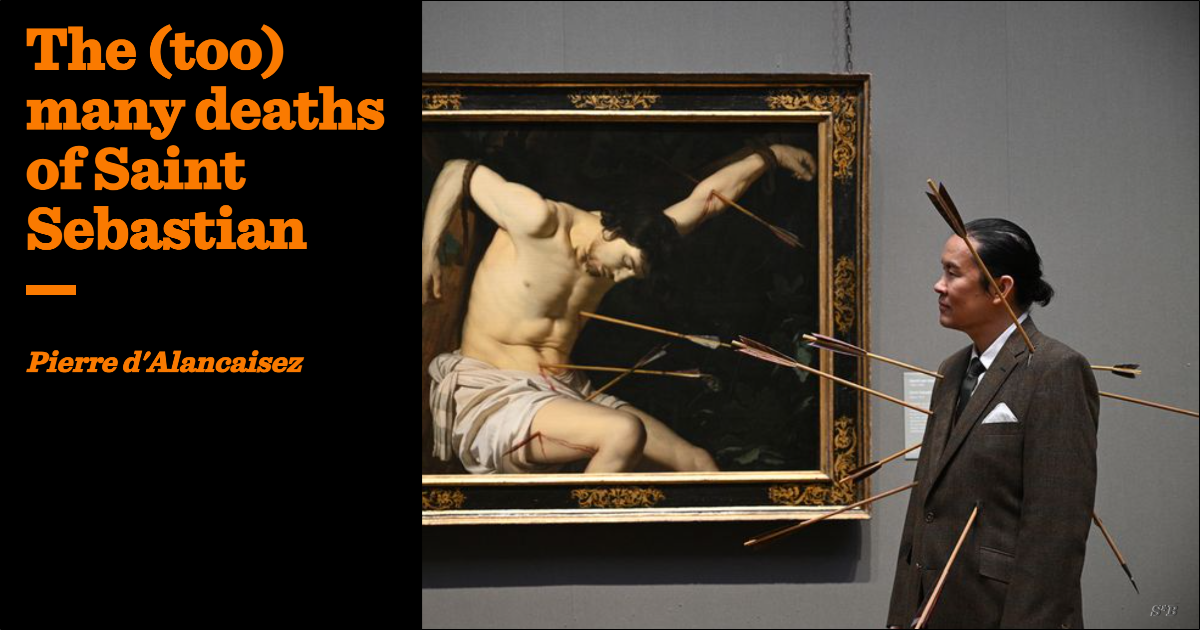

Could a visitor to the National Gallery eyeing up the Pollaiuolo brothers’ 1475 Martyrdom of Saint Sebastian — or, indeed, any of the ten or so depictions of the martyr’s body punctured by arrows in the gallery’s collection — understand how this Roman became a twenty-first-century queer icon? The wall description of the altarpiece, which alludes to the soldier’s Christian conversion, is of little help. A catalogue entry for another work, by Ortolano, foregrounds the saint’s body as a site of anatomic interest for the painter, while a text on Matteo di Giovanni’s painting illuminates the aesthetics of Sebastian’s homoerotic appeal as it hints at a translucent loincloth and the saint’s “youthful, lean, and muscly” body.
Even with this fleshly introduction, however, Dance of the Sun on the Water — Ming Wong’s filmic telling of the life of Sebastian, which is the culmination of the Singaporean artist’s residency at the gallery — is confusing at best. Presented next to the paintings on modestly sized monitors in gilded frames, the video fragments, which track a group of sparsely clad Asian actors rampaging through the galleries, intentionally recast the saint’s life in an unfamiliar register.
Wong is the master of the backhanded compliment homage remake. He came to prominence in 2009, when he presented a series of films echoing the golden age of Singaporean cinema, with himself as the protagonist, at the Venice Biennale. Since then, the artist’s attention has turned to twentieth-century Western classics: he remade scenes from Polanski’s Chinatown, Fassbinder’s The Bitter Tears of Peter von Kant, and Alain Resnais’ Last Year in Marienbad. These works, made at the height of contemporary art’s obsession with cultural and ethnic identity, appealed to audiences with a kitsch, exalted aesthetic.
Unlike his 2010 two-screen Life and Death in Venice — a sequence of fragments based on Visconti’s 1971 film, in which Wong plays both the lovesick Aschenbach and the moody Tadzio — Dance of the Sun casts multiple actors, including a woman with exposed mastectomy scars, as Sebastian. They each contribute to the story. One refuses to take part in a military exercise on account of his faith, another is punished and raped by his army commander, and they take turns firing arrows at Sebastian’s body tied at the gallery’s portico. They share in weeping at this sight, too, in an example of Wong’s narcissistic double-take staging in which the viewer imagines himself the protagonist.
The identitarian curatorial agenda that led to this work’s commissioning aside — the National Gallery has a record of faddishly reinterpreting its collection — what are the rules for the aesthetic recasting of legends? It is no progressive gotcha that Sebastian himself is largely a projection, with only a skeletal account of his life being recorded a hundred years after his death. The idea of his double martyrdom stems from the fifth century. Voragine’s Golden Legend linked the arrows that nearly killed Sebastian with protection from the plague as late as the thirteenth.
Renaissance painters recast the saint as a pictorial, ephebic beauty, as if relishing in his martyrdom an opportunity to depict the male nude in a religious context. Wong was surrounded by these images — Carlo Crivelli’s portrait of the saint with Francis and the Virgin, for example — while making his film for the gallery.
Bizarrely, it was the work of later artists, such as Gian Lorenzo Bernini’s 1617 marble, in which the saint’s frailty and suffering are palpable, that became the focus for Victorian aesthetes. Oscar Wilde noted the “divine, impassioned gaze towards the Eternal Beauty” in the multiple Sebastians of Guido Reni. By the twentieth century, the saint’s queering was a foregone conclusion. Sebastian’s suffering became a canonical reference for gay artists, such as David Wojnarowicz, whose work dealt with the plague of AIDS, reflecting on their pain.
The point of this potted iconographic history is not merely to suggest that early Christian sainthood is only loosely rooted in historical fact, but to highlight that Wong’s work is indifferent to it. Dance of the Sun has nothing to say about the Pollaiuolos’ version of the story, nor about Giorgio Schiavone’s rendering, also at the National Gallery, which has Sebastian dressed in opulent fabrics and looking decidedly feminine.
Dance of the Sun is, instead, a partial restaging of Derek Jarman’s 1976 Latin-language film Sebastiane. The displays make little of this source, as if assuming that audiences should already hold Jarman’s filmography and Wong’s method in the same regard as the institution has for Renaissance painting. That sentiment is rooted in wilful ignorance: at the installation’s inauguration, Wong erroneously projected Sebastiane as scandalous, claiming without challenge that the film was the first depiction of gay male love on screen. His venerating Jarman in such simplistic terms throws into question the seriousness of his relationship with his sources.
In the institution, this reckless misrepresentation of Wong’s slight reprisal of a cult gay film, therefore, wrongly basks in the (also false) authority of a twenty-first-century non-binary Sebastian as an art historical fact. Yet critiquing this is itself a distraction. If we concede that even historical representations of Sebastian are deceptive, Wong’s proposition is, at some level, fair game. The saint of Dance of the Sun can serve whichever gender or ethnic agenda it wishes, not merely because Wilde noted the saint’s homoerotic appeal; he can be so also because Arnobious the Younger embellished Sebastian’s story already in the fifth century.
Yet that they did does not validate Wong’s latest addition to the narrative as artistically worthwhile. Wong’s demonstrable lack of interest in the historic aestheticization of Sebastian that gave rise to Jarman’s version makes Dance of the Sun a rather slight contribution to the iconography. This is not because Sebastian has reached a semiotic saturation point. For example, Louise Bourgeois, who recast the saint as a female Sainte Sebastienne in a 1992 work on paper, substantiated her distortion of the story by nodding at the anatomic obsessions of Renaissance painters. Wong’s film, meanwhile, is a challenge to neither fifteenth-century Christian pictorial traditions nor 1970s gender norms. Rather, it is a misguided claim on that golden age of film of which Jarman is an exponent.
Wong’s cast of would-be main characters compete for the status of an icon, and none are equal to the task
Should it have been Narcissus, not Sebastian, that Wong studied in the gallery’s collection? In contrast to his earlier works, in which Wong specifically claimed centrality, the multi-character universalism of Sebastian of Dance of the Sun spreads saintly suffering too thinly. It discredits all the characters’ claims on martyrdom. Where Wong would have once played all the parts, here, he takes a backseat role, as if intimidated by some dimension of the identity politics this film takes on. Even the gimmicky display of the film in the galleries acknowledges this limitation in the work.
Wong’s cast of would-be main characters compete for the status of an icon, and none are equal to the task. Their director, who had all the mastery of Jarman to draw on, leaves them with no sensuality to fall back on. Giorgio Vasari’s sixteenth-century Lives of the Artists documented a Renaissance controversy by which the increasing attractiveness of Sebastians resulted in worshippers confessing to impure thoughts. Wong’s film, unlike Jarman’s, is anything but sexy.
Is this late-stage hyperqueer Sebastian the victim of repetitio ad absurdum? The ideology of Wong’s film neither saves nor condemns the saint. If this quasi-facsimile retelling illuminates anything, it’s that art historical continuity is essential to judgment.