The global tide of popular demand for ethical and transparent governance continues its remarkable rise this year. Bulgaria, ranked among the poorer and most corrupt nations of Europe, is the latest to feel its power.
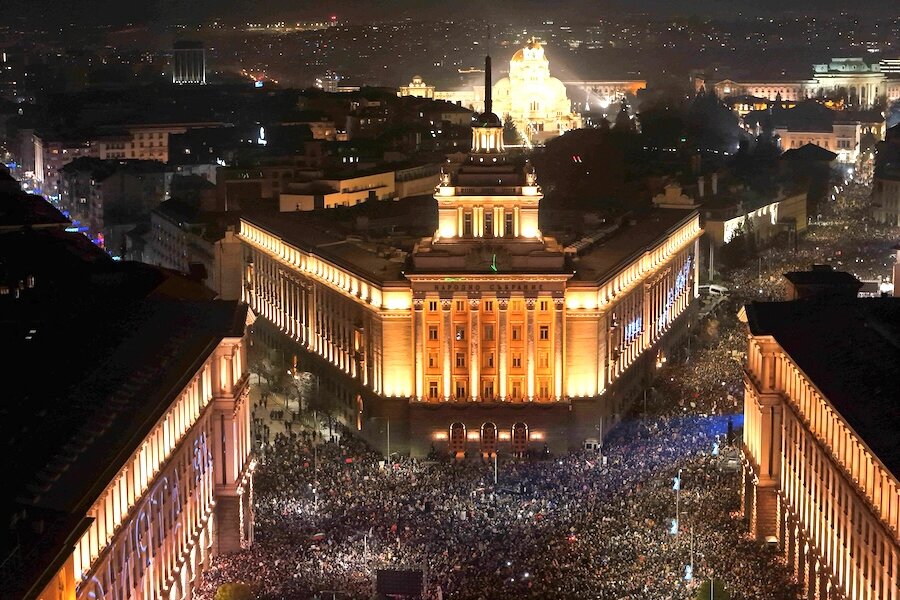
On Thursday, the morning after tens of thousands of citizens marched through the capital, the Bulgarian prime minister announced he would step down, after less than a year in office.
As in many other countries experiencing mass demonstrations in 2025, Bulgarian citizens are voicing their aspirations for accountability, transparency, and justice. And, as elsewhere, younger voters seeking a future with more opportunities and less graft have harnessed social media and online communication as effective organizing mechanisms.
“One cannot afford not to talk about politics when so many people identify with you,” Andrea Banda Banda, who has nearly 100,000 Instagram followers, told the news outlet Deutsche Welle. “Ideally, it’s much better to read a long analysis,” she said, “but memes are a super quick way to get an idea across.”
It appears the idea did get across, as evidenced by the mass turnout.
The immediate cause of the protests was a government budget plan to raise taxes and social security contributions – which a skeptical citizenry viewed as yet another scheme to channel money into politicians’ pockets. The government is seen to be under the influence of a mafialike circle of corrupt politicians and oligarchs, some of them Russia-aligned. Distrust and political dysfunction have fed into pessimism.
Nearly 75% of young Bulgarians consider emigrating to other countries, according to a survey. But the poll of 14- to 29-year-olds also found that their interest in politics had tripled from only 7% in 2018 to 21% in 2025.
Teenager Martin Atanasov, who participated in the protests, represents this increased engagement. In early December, he received a local “Awakener of the Year” award for creating an interactive map with data from more than 177,000 accidents, pointing to government inaction on road safety.
“The internal discontent of Gen Z … is starting to turn into action,” Mr. Atanasov wrote in an article on the Bulgarian site Fakti. The demonstrations do not represent “just denial and anger,” he stated, but “hope … that the country can break out of the vicious circle of distrust, improvised solutions and political indifference.”
On Jan. 1, Bulgaria joins the Eurozone, adopting the common currency of the European Union. This is likely to jolt the economy, as prices adjust upward. “The road is long and difficult,” as Mr. Atanasov acknowledges. But, he insists, “There is hope. It is up to us to protect it.”