Liverpool Street on a bustling Monday morning – the heart of London’s financial district. Office workers hurry to meetings, passers-by grab coffees, e-bicycles weave their way through traffic as normal.
Suddenly, there is a hideous buzzing overhead like that of a vast, otherworldly insect. Pedestrians see a fleeting triangular silhouette streaking across the sky, followed by a gigantic explosion. Then another, pursued by the rest of the swarm.
Dozens of Shahed suicide drones have been launched to spread terror in the capital. As smoke billows into the air, the screams and the sirens begin.
Such an apocalyptic scenario could leave hundreds dead, forcing Britain onto a war footing for which our depleted armed forces are woefully unprepared.
And with the Iranian regime lashing out wildly in the wake of this week’s strikes, there are fears that the fate of RAF Akrotiri in Cyprus – which was struck by a drone on Monday night – will visit us closer to home.
Each Shahed drone carries a payload of up to 90kg, enough to collapse a building. Having just returned from Ukraine, where they are widely used by the Russians, I know the death and destruction they can cause.
But how could those Satanic machines get through? They have a range of only 1,500 miles and Iran is 3,000 miles from Britain.
According to analysts, the answer is as old as warfare itself: via a vulnerability in our defences.
Britain has no radar facing the North Sea, meaning that a ‘shadow fleet’ of ships, manned by Russians, Iranians or eastern European mercenaries, could fire Iranian drones from their decks.
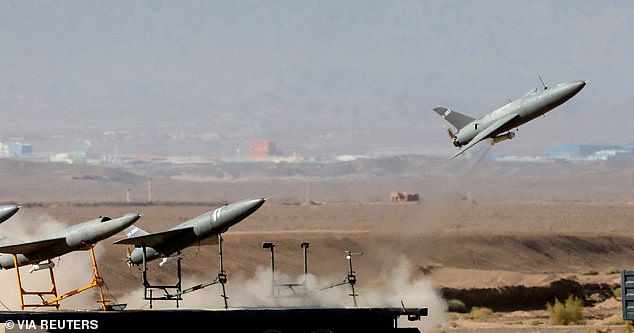
The Shahed, which has a wingspan of about eight feet and costs less than a small car, is launched using an angled rail, from which it accelerates into the air using a solid-fuel booster rocket.
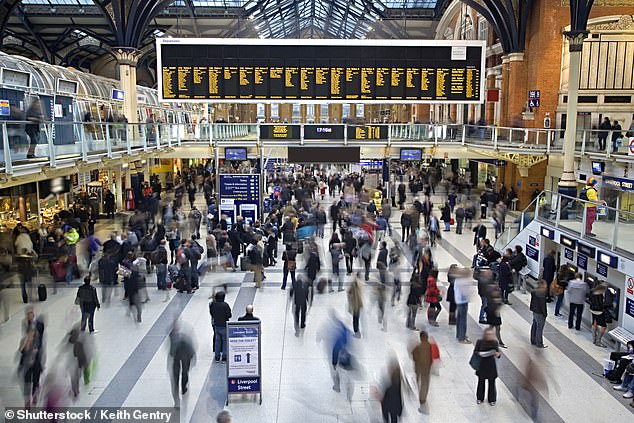
Liverpool Street Station is in the heart of London ’s financial district, where office workers hurry to meetings, passers-by grab coffees and e-bicycles weave their way through traffic
Britain has no radar facing the North Sea, meaning that a ‘shadow fleet’ of ships, manned by Russians, Iranians or eastern European mercenaries could fire Iranian drones from their decks
Once airborne, the rear piston engine takes over. This compact and self-contained system does not require a runway or catapult, making it ideal for launching from trucks and trailers – or ships. Shaheds reach speeds of only 100mph but a launch off the coast nearby would leave our Quick Reaction Alert Typhoons at RAF Coningsby in Lincolnshire little time to respond.
Unlike Israel, Britain has no Iron Dome, David’s Sling or Arrow systems, which together guard against short-range rockets, cruise missiles and ballistic munitions, not to mention Iron Beam, the laser system which Jerusalem has in development.
Last year, airports at Copenhagen, Oslo, Bremen, Brussels and elsewhere were closed after smaller drones, many thought to be Russian, entered their airspaces. Only a week ago, during a visit by the French aircraft carrier Charles de Gaulle to Malmo in Sweden for Nato exercises, Russian signals intelligence ship Zhigulevsk launched a drone towards the mighty craft.
After electronic interception by the Swedes, it crashed about three miles from its target.
But what if it had been part of a swarm? And what if it had been carrying explosives?
An irony here neatly summarises Britain’s supine posture towards the Islamist threat. In 2023, when I was editor of the Jewish Chronicle, we revealed that scientists at 11 British universities, including Cambridge and Imperial College London, had helped the Iranian regime develop technology that could be used in its drone programme.
Rishi Sunak, then the Prime Minister, announced an investigation in Parliament. It was immediately punted into the long grass by the Tories. This pathetic tale summarises the complacency of our elites. Was British drone technology deployed against RAF Akrotiri in Cyprus? Is it being used against American and Israeli forces as I write?
And will it one day be used to target us here at home? Security services are all too aware that our open society offers a wealth of soft targets, from synagogues to energy and transport infrastructure. The Iranian regime has been known to target all three.
And swarming drones are far from the only threat. Ken McCallum, director general of MI5, has warned that Iran is the ‘state actor which most frequently crosses into terrorism’, and a ‘sophisticated adversary’.
With hundreds of Iranian spies, assassins and terrorists already operating in Britain, our Government is sleepwalking into a series of atrocities from which it might never recover.
At least 20 Iranian murders and kidnappings have been disrupted by the security services on British soil since 2022. Many were the work of Unit 840, a covert group within the Revolutionary Guards, which – incredibly – has still not been banned by the Government.
One example was the ‘wedding plot’, a 2022 attempt to assassinate two journalists in London, codenamed the ‘bride’ and the ‘groom’. It was foiled by a double agent.
In 2024, the dissident journalist Pouria Zeraati was knifed in Wimbledon by two Romanian thugs recruited by Tehran. In a telling detail, Zeraati subsequently fled from Britain to Israel, where he was safer from assassins.
Last May, five Iranians were arrested on suspicion of plotting an atrocity at the Israeli embassy in London.
Our authorities have known about Iran’s evil intentions for decades. In 1999, after a tip-off from Mossad, security services busted a bombmaking factory in the capital run by Iran’s Lebanese puppet militia Hezbollah, seizing three metric tonnes of ammonium nitrate.
According to a security insider, that discovery acted as a wake-up call to MI5.
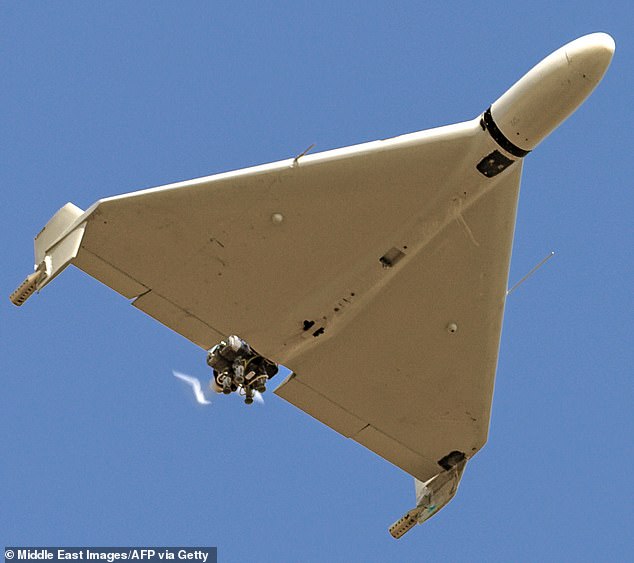
Each Shahed drone carries a payload of up to 90kg – enough to collapse a building
The Iranians have been furiously resorting to overseas terror attacks to pressure Washington and Jerusalem to scale back their campaign
After all, in 1994 a Hezbollah van carrying a 43st cache of the same substance detonated outside a Jewish community centre in Buenos Aires, killing 85 people. Most victims were Jewish, but passers-by and local office workers, as well as a Catholic priest, were among the dead.
Chillingly, the Hezbollah bomb factory in London had enough ammonium nitrate to produce 11 such devices. MI5 and counter-terror police have been ‘concentrating’ on Iran ever since.
But they haven’t done enough. And there are fears that the regime has embedded its tentacles so deeply in Britain that it is only a matter of time before something, somewhere, gets through. This week, the Iranians have been furiously resorting to overseas terror attacks to pressure Washington and Jerusalem to scale back their campaign.
On Tuesday, Israel was forced to evacuate diplomats from the United Arab Emirates after two foiled atrocities.
And on Sunday, two people were shot dead and 14 wounded at a bar in Texas by a gunman reportedly wearing an Iranian flag.
As of this week, 63 per cent of all the regime’s missiles and drones have targeted the UAE, with hundreds more fired at Saudi Arabia, Kuwait, Bahrain, Oman and Qatar as well as Western embassies and military bases in the Middle East.
According to Lord Walney, the Government’s former adviser on political violence and disruption, this strategy of targeting American allies may lead to attacks on the British homeland. ‘Iran’s wild and scattergun approach in bombing all its Gulf neighbours should be a warning for countries across the West about what could happen domestically,’ he said. ‘You’ve got a state that is desperate and does have that residual capacity to hit out. Security agencies are going to be on high alert.’
Iran’s closeness to China may exacerbate the situation. As demonstrated by Wednesday’s arrest of three espionage suspects, including the partner of a Labour MP, Chinese spies work extensively in Britain, both in the corridors of power and cyberspace. Beijing has avoided becoming drawn into the conflict but – like the Russians – has common cause with the Iranians in wishing us harm.
The threat is not just aimed at London. Scotland, where there is a 6,000-strong Iranian expat community, has long been a target, as it is perceived as a strategic weak point. Senior SNP figures have long been close to shady individuals with connections to the regime. Revealingly, during an internet blackout imposed by Tehran in January, many accounts pushing Scottish independence went dark.
This wasn’t even the first time: in 2021, Facebook shut down hundreds of nominally Scottish accounts traced to the regime.
On the streets of Glasgow, meanwhile, a string of dissidents have been threatened with guns by Iranian goons.
The sorry truth is that decades of appeasement have left Britain weakened. One of the starkest ironies of the war is that while the Ayatollah was killed at his office on Pasteur Street in central Tehran, his office at the Islamic Centre of England in North London has still not been shut down.
This week, as mosques all over the country held vigils for the Ayatollah and at least 15 Islamic student societies mourned him as a martyr, it staged a brazen vigil for the tyrant – laughing in the face of Britain.
Similarly, as the feared Revolutionary Guards are pounded by missile strikes on their home turf, our Government has failed to ban them in this country.
In fact, we allow IRGC hubs to flourish on our doorstep. Take Little Tehran, an area of Maida Vale in West London in which the Islamic Republic maintains several schools and colleges charged with spreading its malign influence into Britain.
Even the Iranian ambassador to London, Seyed Ali Mousavi, who has claimed US-Israeli strikes against Iran are ‘illegal’ and ‘criminal’, has not been expelled, raising the bizarre question of whether he will qualify for asylum in this country were the regime to be toppled.
This weekend, an annual pro-regime rally is scheduled to take place in London as normal. At past Al Quds marches, which have often turned violent, attendees have flown the flag of Hezbollah, the very outfit that attacked RAF Akrotiri, blew up the Jewish centre in Argentina and ran that bombmaking factory in London.
They have also held placards saying ‘Zionist dogs’ and appeared to praise Hamas. In 2024, police made ten arrests for public order offences.
All of this speaks of a British softness that is gleefully exploited by Islamists of all stripes, whether amateurs in their bedrooms or state-backed professionals.
Small wonder that in January, the United Arab Emirates banned its citizens from studying at British universities due to the widespread extremism on campus.
‘There has been a sustained attempt for decades to build up a soft power network to further the interests of the Iranian regime and weaken Britain’s liberal democracy,’ said Lord Walney.
‘Those conducting the Islamist infiltration exploit the basic good nature of the British people, who generally want to avoid causing offence. Across mainstream parties, people have been running for cover so they won’t be branded “racist” or “Islamophobic”.
‘This is a weapon to prevent scrutiny of this issue.’
Given the soaring tensions in the Middle East, this saturation of domestic extremism has the potential to turn deadly, as seen in the Manchester synagogue murders in October, the 2017 bombing of the Manchester Arena and in numerous terror attacks in London.
Even if MI5 can contain, for now at least, the threat of Iranian spies, radicalised lone wolves are often more difficult to track.
The 2022 near-fatal stabbing of novelist Salman Rushdie showed how an Iranian fatwa in 1989 can still inspire fanatics to act decades later.
Moreover, it matches the regime’s war strategy: after the American-Israeli assault last June, Tehran decentralised its command structures, meaning that if senior officers are killed, junior soldiers can fire at will.
This has an obvious – and worrying – implication for us. Amid the interlocking threats of drones, bombs and stabbings, after decades of complacency, nowhere in Britain is safe from the mad mullahs of Tehran and their most demented co-religionists.
The Brink podcast, presented by Jake Wallis Simons and Andrew Fox, is available now.