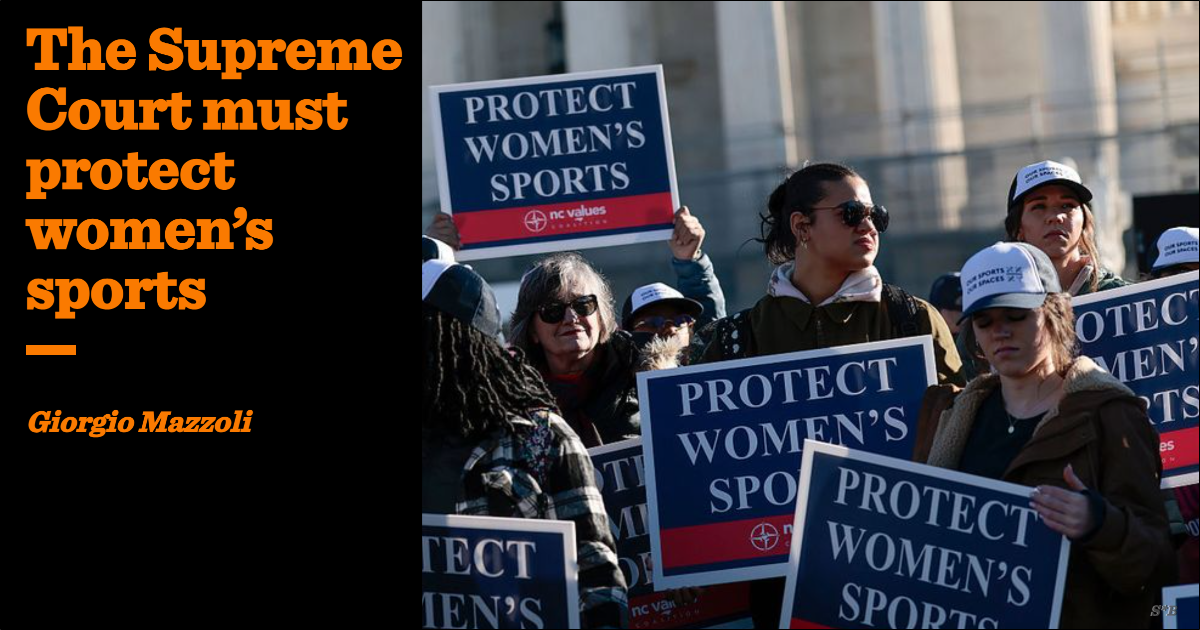
This week, the U.S. Supreme Court heard oral arguments in Little v. Hecox and West Virginia v. B.P.J. — two landmark cases that will determine whether states may preserve the integrity of female sports categories based on biological sex.
The Court weighs this question as an international tide turns decisively back toward sex-based eligibility for women’s sports. Nationally and globally, a growing number of sporting bodies have moved to reinstate such requirements following scientific reviews confirming that male physiological advantages — rooted in biology and amplified by puberty — cannot be erased. This shift has now reached the International Olympic Committee, reportedly set later this year to reintroduce unified eligibility rules restoring women’s Olympic events based on biological sex.
Scientific reviews, however, tell only part of the story. These policy reversals have also been driven by female athletes and their allies, who have testified, petitioned, and organised — often at significant personal and professional risk amid intimidation and retaliation — to raise awareness of the significant cost of denying women and girls a level playing field and to demand respect for their dignity and human rights.
Look no further than Lainey Armistead, an intervenor in West Virginia v. B.P.J. represented by Alliance Defending Freedom. Speaking at a U.N. event in late 2024, she recounted the injustices that her fellow female athletes endured after a single male competitor was permitted in women’s events in her state. Speaking of young women who had been sidelined, injured, or displaced in competitions, she urged the international community to recognise fairness and safety in women’s sports not as an abstract policy debate, but as a human rights issue requiring serious attention to prevent further harm to female athletes.
Indeed, these developments have drawn close scrutiny from the global human rights community. In an amicus curiae brief filed in this docket, the U.N. Special Rapporteur on violence against women and girls, its causes and consequences, Reem Alsalem, argues that maintaining single-sex sports categories and related spaces is a necessary, proportionate, and legitimate means of protecting female athletes from violence and discrimination, consistent with U.S. international human rights obligations. The Special Rapporteur — who had previously criticised the Biden administration’s failed attempt to redefine “sex” in Title IX and instead welcomed President Trump’s executive order ”Keeping Men Out of Women’s Sports” — revealed in a 2024 report to the U.N. General Assembly that males competing in women’s sporting events have taken nearly 900 medals from female athletes.
Public sentiment, too, has shifted noticeably toward stronger support for sex-based protections in women’s sports. In the U.S., recent polls show roughly 70 per cent of Americans agree that participation in women’s sports should be determined by sex. Internationally, a 2025 Ipsos report nearly eight in ten people across 23 countries support sex-separated sports categories. This direction is echoed by prominent athletes such as Aryna Sabalenka, the current world No. 1 in women’s tennis singles, who has publicly stated that competing against biological males would be “unfair for women,” and Sharron Davies, Olympic medalist and longtime advocate for fairness in sport.
With athletes, sporting bodies, human rights authorities, and public opinion increasingly converging, the impact of the Supreme Court’s decisions will extend beyond resolving significant constitutional and statutory questions. By upholding state laws that designate participation in female sports based on biological sex, it will also place the United States within a prevailing international consensus grounded in fairness, safety, and truth — principles that safeguard the right of women and girls to equal opportunity in the pursuit of sporting achievements and far beyond. In so doing, the Court would help bolster that momentum and secure those principles against regression.