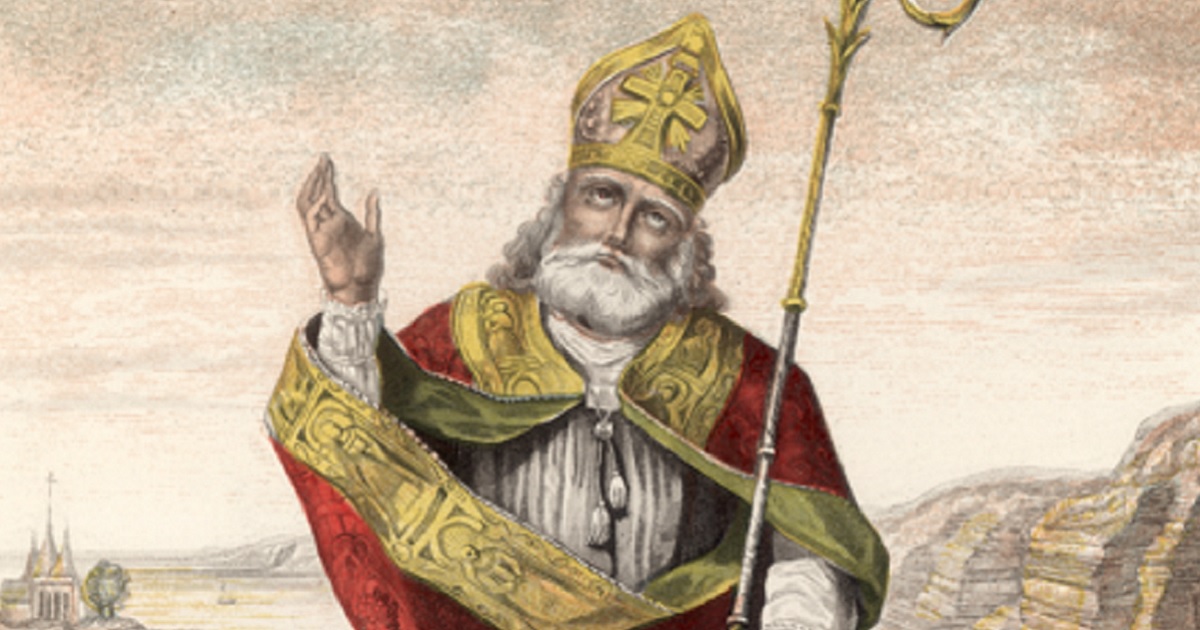
St. Patrick’s Day is, for many, a day to wear green and enjoy perhaps one too many pints of Guinness.
Most people know that St. Patrick was a real man. But fewer know about his incredible missionary work that led Ireland to Jesus Christ.
And fewer still know about how the earliest generations of Irish Christians brought the faith back into a crumbling Europe.
This incredible story is told by Jamie Bambrick — a videographer and evangelical pastor in Northern Ireland — in a 2024 video called “The Mindblowing Story Of How Irish Monks Saved Civilization.”
Bambrick described the spiritual darkness in which Ireland found itself before the arrival of Christianity.
Ancient malevolent deities, served by a class of elite priests called druids, demanded human sacrifices in various forms — Taranis was worshipped by burning prisoners of war in wicker cages, Esus was honored through hanging and impaling victims, and Teutates preferred the drowning of his victims.
But sometime around the fifth century, a Romano-British boy named Patricius — today known as Patrick — was taken as a slave to Ireland and forced to herd sheep for a druid lord.
He escaped back home, only to receive a dream telling him to return to the land of his captors with the message of the gospel.
Patrick directly challenged the pagan worship of Ireland, miraculously receiving permission from the high king to preach Jesus Christ across the island.
But Bambrick pointed out that the missionary activities of Patrick were “only half the story.”
The very same druids who had once served demons soon became the most zealous servants of the Triune God — and they led a revival across the rest of Europe.
In addition to being priests, the druids were incredibly disciplined intellectuals, memorizing vast amounts of history, law, rituals, and natural philosophy in a culture that did not have written records.
That lent itself well to Christian devotion, including the memorization of vast swathes of the Bible.
In fact, one monk named Ciaran was given the nickname “Ciaran Half-Matthew,” because his comrades mocked him for only managing to commit half of the 28-chapter Gospel to memory.
In any case, those former pagans were not merely the equivalent of ivory-tower intellectuals.
As the Roman Empire collapsed, they went on preaching tours throughout the European continent, bolstering Christian devotion in an era during which society was coming apart at the seams.
They preserved the works of antiquity, confronted heresies and rebuked corrupt church establishments.
They ventured as far as modern-day France, Switzerland, and Italy, sometimes embarking on their journeys in boats without oars so that God would place them exactly where He wanted them to start their work.
Ireland “was not just a place that became Christian,” Bambrick said. “It was a launching pad for re-establishing the faith in the Western world.”
We likewise live in an era of societal dissolution — with many even comparing our moment of history to the decadence and eventual fall of Rome.
Because the Western world has been the bulwark of global Christianity for centuries, many have even wondered what the future of the faith will look like in the coming decades and centuries with a diminished West.
But the account of St. Patrick and Irish Christianity is a reminder that God always preserves His Word and His mission in the world — often delighting to use the most unexpected means, so that He alone receives the glory.
That’s a story worthy of a toast — with a pint of Guinness, of course.
The views expressed in this opinion article are those of their author and are not necessarily either shared or endorsed by the owners of this website. If you are interested in contributing an Op-Ed to The Western Journal, you can learn about our submission guidelines and process here.

Advertise with The Western Journal and reach millions of highly engaged readers, while supporting our work. Advertise Today.