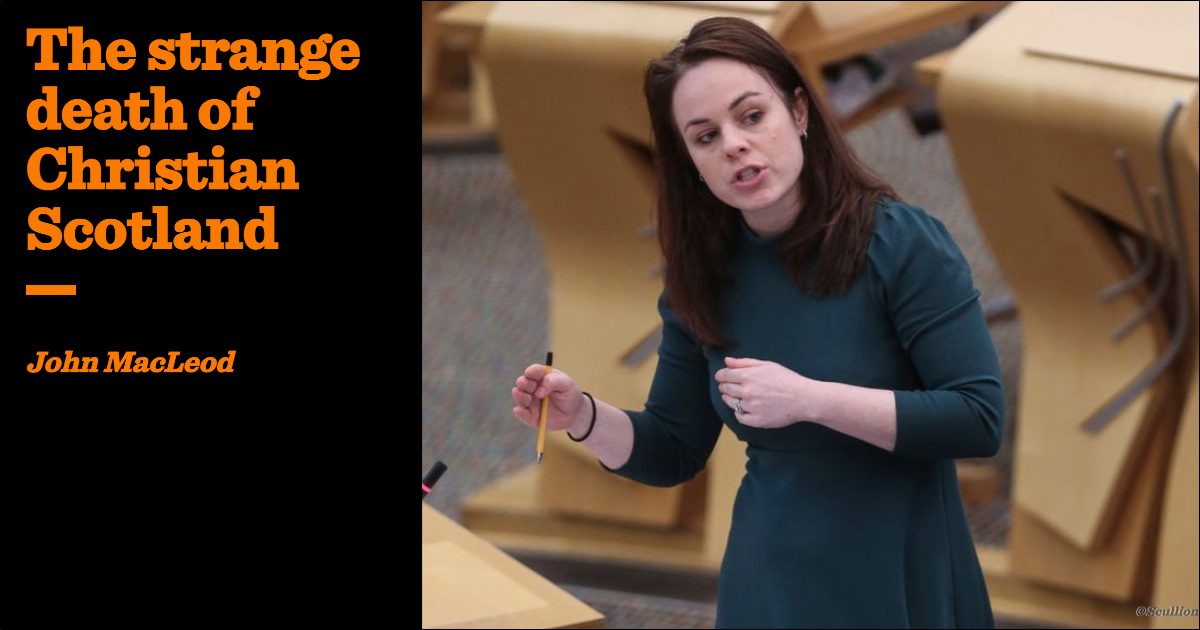
Scotland’s religious traditions have been swept away. Now, secular intolerance rules
It was a slushy day in March 1980 and, at Jordanhill College School at the leafier end of Glasgow, our school day began, as it always began, with a collective act of Christian worship.
For ten minutes we stood, boys on one side of the main hall and girls on the other. W.T. Branston, our headmaster, begowned and silver-haired, assumed the central lectern as if he were the Archangel Gabriel.
The hymn — he had a weakness for particularly martial, violent numbers, like I Feel The Winds Of God Today or Fight The Good Fight With All Thy Might — was announced, and sung. He then led us in warm, ex tempore prayer, concluding with the communal Our Father. Some quavering Sixth Year then read the lesson — from the leaden translation of the New English Bible — before Mr Branston gave the announcements of the day.
Mr Branston was an extraordinary man. One of the very few I have ever known who would assuredly have reached the top of any chosen profession.
At his appointment in 1956, the youngest headmaster in Scotland. Handsome, with a rich, resonant voice. A young naval officer in Hitler’s war. An elder of the Kirk. A gifted singer — he sang in a host of choirs, from the Scottish National Orchestra Chorus down — an accomplished actor, a frequent broadcaster, and who sat on untold boards and committees, from Sandhurst to the Church of Scotland.
No bigot, in his free time Branston worked hard for the YMCA — with the homeless, addicts, the marginalised and lost — and, in 1979, expressly sanctioned a poem in the school magazine slamming what we would now call homophobic bullying.
Scotland’s Christian character was already in advanced collapse
Yet that March 1980 morning the Scotland in which he had been born — the social order for which from 1939 he had actually fought — was on borrowed time. Kids were already tittering cynically during those morning prayers. Scotland’s Christian character was already in advanced collapse.
Not that many had noticed: the national Kirk was still a body of serious clout. Decades back, folk said admiringly that its General Assembly was the closest thing we had to a Scottish Parliament. Certainly, the papers devoted entire pages to coverage of its proceedings; fat outside-broadcast vans laid on unfiltered afternoons of live television coverage.
Sometimes, these could be sensational. In 1976, to some uproar, Glasgow’s new Catholic prelate, Archbishop Thomas Winning, was allowed to address the fathers and brethren. Four decades back, we tuned in as the General Assembly held one of its most extraordinary debates — should the Kirk proceed to the ordination of a man who, many years before, had murdered his mother?
The Kirk’s most eminent ministers — Charles Warre, James Stuart, Andrew Herron and Maxwell Craig, R Leonard Small and the irrepressible James Currie among them — were household names.
Every year, BBC Scotland cleared a few minutes in its Hogmanay schedule for the latest Moderator to address the nation; late every night, for five minutes, some cleric (usually of the national Church) could address us on STV’s “Late Call.”
In our great cities, its places of worship were on every street corner. In rural and smalltown Scotland, the Kirk was at the centre of local life; its clergy had the run of every nondenominational school and, in 1956 and in the wake of a notable revivalist tour by Billy Graham, Church of Scotland membership peaked at 1.32 million.
In other words, about 40 per cent of Scotland’s entire adult population was a signed-up Kirk communicant. Yet, within twenty years, the Church of Scotland shed two-fifths of her membership. In the new century, fighting for relevance or even an audience, the Kirk has slid through obscurity to the brink of oblivion.
Its financial deficit is now £6.5 million. It is poised to close a third of its churches and sell off more than 400 buildings. There is an acute shortage of ministers. Every new pastoral vacancy invites the automatic attentions of the Board of Parish Reappraisal — linking, merging and shuttering.
All over Scotland, we are increasingly familiar with the ex-Kirk. The concert-hall, the quirky theatre, the urban nightclub, the dinky apartments or country manor.
At every turn, it seems, Jesus has left the building. Even the Church of Scotland’s magazine has folded. Life and Work had been in print since 1879. In 2024 it had an operational loss of £250,000. Its print circulation, by Christmas that year, was just 5,612 — most of that for Sunday parish distribution and most, one suspects, ultimately binned.
In parallel, too, Scotland’s Roman Catholic hierarchy was once widely feared by our politicians and especially the Labour Party. In February 1974, the bishops’ emphatic denunciation almost certainly foiled the brilliant Jimmy Reid’s bid for election as Communist MP for Central Dunbartonshire. Yet, humiliated by the Cardinal O’Brien scandal in 2013, Mother Church now barely whispers in the background.
The collapse of religious observance in Scotland genuinely bewilders scholars. Callum Brown, of Glasgow University, has described it as “cataclysmic.” Hugh McLeod, professor of church history at Birmingham University, calls this era a “rupture in religious history as great as that brought about by the Reformation.”
“Scotland,” Iain Macwhirter reflected in an engaging book about our little land just before the 2014 referendum, “has had a history of militant Christianity from the Covenanters to the Disruption, and had an education system largely shaped by the Kirk. It is hard to believe that all this could disappear, in historical terms, overnight. And yet it did …”
Some reasons are prosaic. Television, first broadcast in Scotland in 1952, laid on alternative Sunday entertainment. Most wives and mothers — who traditionally marshalled their man and their weans for Sabbath public worship — are now in full-time employment.
There was also, from late Victorian times, decorous theological collapse. The Church of Scotland is, in fact, not yet a century old. It was born in 1929 by the Great Union of the old Established Church – in which Mr Branston was brought up – with the majority of the United Free Church of Scotland.
That 1900 union had itself been engineered by two Declaratory Acts that had greatly loosened credal subscription. Ministers and office-bearers no longer committed themselves wholesale to the tenets of the Westminster Confession, but merely to the “substance of the Reformed faith”. This, conveniently, no one ever defined. Those in the know eye-roll whenever John Reith, daunting Scots-born father of the BBC, is mocked as a “Calvinist.”
He had been raised in a Free Church manse, yes; but his mother — as the old lady made plain to her famous son in a 1931 letter — did not even believe in the Resurrection. “Lord Reith’s father,” Rev James Bulloch wrote in 1978 in a history of the Kirk, “belonged to the generation of Free Church ministers who turned their backs on Calvinism…”
The slack was taken up by two protesting Highland remnants — the Free Presbyterian Church of Scotland, launched in 1893 in protest against the Free Church’s Declaratory Act, and — often confused with it — the Free Church of Scotland, a minority who refused to enter the Union of 1900 and whose claim to be the lawful, continuing Free Church was finally vindicated by the House of Lords.
Before the politicians, amidst confected United Free Church uproar, stepped in to rob the minority of most of the churches, manses and money. Not a single Highlands and Islands MP protested on its behalf.
Yet the vast majority of Scots were borne away in the Kirk of 1929, which did not meaningfully believe in anything very much — save for vocal contempt of Irish Catholic immigrants — and its travails of late have been what you might expect to befall any vague, blobby body that is little more than the Liberal Democrats with hymns.
It was only in 2023 that the moral and societal cost of this national spiritual collapse was made manifest in the monstering of Kate Forbes.
When Nicola Sturgeon, amidst assorted humiliations, threw in the towel as First Minister and leader of the SNP, the MSP for Skye, Lochaber and Badenoch quickly emerged — to the horror of Nationalist elites who had staked their hopes on the preening Humza Yousaf — as the favourite to succeed her.
Forbes — tiny, quietly brilliant, pro-business, pro-North Sea hydrocarbons extraction, thoughtful and gracious — would have been the most formidable Nationalist leader their opponents could have faced.
The mass of her front-bench colleagues, the poisonous Scottish Greens, and so on swiftly set about to destroy her. This took place with the active, enthusiastic participation of prominent commentators who served as their useful idiots.
Forbes is a communicant member of the Free Church of Scotland — conservative, evangelical and — in the tradition that a Christian must “witness” for their faith — with a disconcerting tendency to give straight answers to straight questions. Almost unheard of in professional politics.
Her personal views on gay marriage, abortion, sex outwith wedlock and so on — which would have been wholly unremarkable to Mr Branston and his generation — were slammed by one circus clown in a Glasgow newspaper as “jaw-dropping moral opinions.”
Few dared to point out that Huma Yousaf, an observant Muslim and who had actually been an MSP at the time, had quietly dodged the critical Holyrood vote on same-sex marriage and with a less than convincing excuse.
By February 2023, all reason had fled the room. Kate Forbes’s “failure to embrace equality or to adequately separate Church and State,” railed Dani Garavelli in The Herald, “should, I believe, preclude her from leading any political party, and especially a party which so self-consciously brands itself as progressive.
“Forbes’ unwillingness to separate herself from the tenets of the Free Church — even when it comes to legislating for Scotland as a whole, and even if it wrecks her shot at the leadership — is what shocks… ”
“I don’t even know where to start,” howled Jean Johannson in the Daily Record. “All I can think of are the many beautiful gay weddings I’ve attended in my life and I can’t believe that anyone would oppose them. As for having babies out of wedlock — it’s 2023 …”
John Swinney, no less, declared, “I’m a man of deep Christian faith but I do not hold the same views. Kate is perfectly entitled to express her views, but party members are equally entitled to decide if someone who holds those views would be an appropriate individual to be SNP leader and First Minister.”
The die was cast, even as the Scottish Greens — then in coalition with the Nationalists — piled in.
“We will only vote for the SNP’s new leader to become First Minister if they are committed to the politics of cooperation… If they agree that trans rights are human rights and that our trans siblings cannot be used as political fodder by Westminster,” stormed Lorna Slater.
“These are fundamental issues for us. They are non-negotiable.”
Incredibly, amidst this pile-on, avalanche-journalism and some disturbing aspects of the SNP’s internal election-mechanism itself, Forbes almost won, denying Humza Yousaf the overall majority.
Even as he summoned imams for rites of celebration at Bute House, he spitefully tried to demote the Finance Secretary. Forbes denied him that satisfaction and retreated regally to the backbenches. In scarcely a year, the empty suit that was Yousaf blew himself up and Forbes was, once again, the favourite for First Minister.
Cue renewed feeding-frenzy, of which the most ridiculous instance was a deranged Kenny Farquharson column in The Times. “Kate Forbes is unfit to be first minister of a 21st-century Scotland. A 1920s Scotland, maybe. A 1950s Scotland, perhaps. But not Scotland in 2024…T he problem is not faith, per se. The problem is the way her particular faith intersects with our public polity…”
Kenny Farquharson concluded, absurdly, “The problem is not her beliefs. The problem is her opinions…”
To Farquharson’s evident bewilderment, there was a furious backlash. One Free Church minister — pointing out that religious belief is a “protected characteristic” — reported him to the police.
The pushback on social media was such that Farquharson shuttered his Twitter account.
Kate Forbes was installed as Deputy First Minister as Swinney took the throne (though the Scottish Greens howled still). But the personal cost — the emotional attrition — had been high, especially for a young mother. In August 2025, Kate Forbes announced she would not stand for another term in the Scottish Parliament.
Mr Branston, in the end, was granted every gift save length of days. On a chilly day in December 1984, still but sixty-six, out on his bowler-hatted elder’s rounds in Bearsden to distribute communion-cards, he had just paused to warm himself by a parishioner’s fire when, without sound or alarm, he collapsed and died.
Morning prayers at what is now Jordanhill School ceased decades ago. The only mainstream Scottish state-school never to have been run by a local authority, it annually notches up the best examination results in Scotland.
Andrew Neil has pointed out how many parents prominent in Scotland’s right-on, policy-forming and opinion-leading elite have happened to move into its G13 catchment-area.