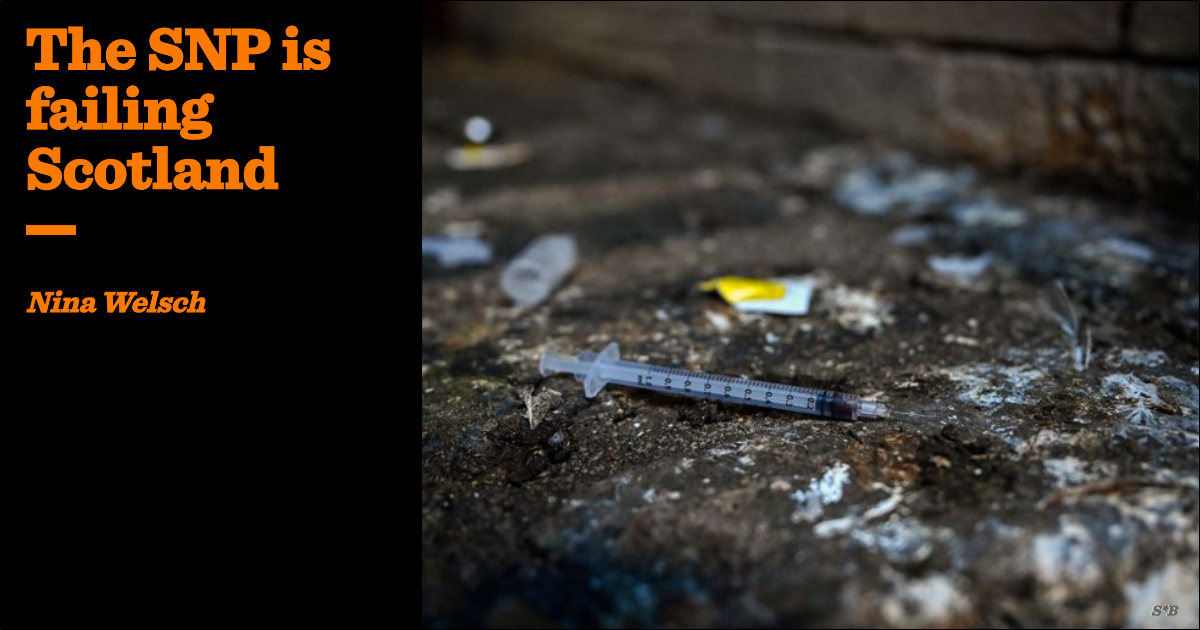
A good test to determine if one’s anger at a decision by a political party one dislikes is just knee-jerk bias or sound criticism is if some of said party’s biggest cheerleaders are emphatically condemning it as well. Recently in Scotland, the Right To Recover bill, which aimed to take drastic action to improve the prevalence of drug and alcohol addiction in my country, was voted down by the SNP and Scottish Green Party, to the shock of many. 80 per cent of the Scottish public had supported the bill in consultation. MSPs from the Scottish Conservatives, Labour Party and Liberal Democrats, unanimously backed it 52-63.
Neil Mackay, a journalist for The Glasgow Herald who is generally heavily sympathetic to the progressive pro-Independence faction of Holyrood, pulled no punches in his recent column. “Holyrood had a chance to change the story on Scotland’s miserable relationship with addiction this week – and blew it.” he writes, observing that “the vote split depressingly along constitutional lines.” He is steadfast in the belief the SNP and Greens opting to kill it at the first hurdle was motivated significantly by shallow party tribalism. The bill after all, was conceived and tabled by former leader of the Scottish Conservatives, Douglas Ross.
I agree wholeheartedly with Mr Mackay’s assessment and despair at the mockery this makes of devolution. Scotland infamously has the highest rate of drug-related deaths in Europe, a statistic that shames the country. This was an opportunity to actually make radical use of devolved powers and squandering it has only given credence to the sentiment that a separate Scottish Parliament is, and always was, a waste of time, money and space.
The bill wasn’t perfect, to put it mildly. In its drafted form, it would make it a statutory right for Scots who were diagnosed with drug or alcohol addiction to receive treatment within three weeks. These services could include rehab, community programmes, hospitalised detoxing, prescriptions and any other method of treatment recommended by a health professional. By far the most reasonable objection to this is that financially, legally and practically that would put immense pressure on already stretched services — and potentially result in a nightmare string of lawsuits against medics and NHS services if the timeframe was not met. I will gladly concede that a three-week guarantee for treatment does not sound implementable or feasible as things stand.
Yet other objections are more spurious. Several SNP and Green MSPS expressed concerns that a medical diagnosis for addiction being required for a right to treatment might stigmatise the condition further, thereby making it less likely that individuals will seek help. Considering so much of stigma around drug dependency and alcoholism stems from the false belief it isn’t an illness, but rather sheer lack of willpower and selfishness of the individual, then recognising it formally as a medical problem, if anything, would lessen the cultural stigma for those suffering. The unconvinced in this regard would at least, surely, concede Scottish Conservative leader Russell Findlay’s remark that perceiving yourself as stigmatised by some is nonetheless better than “being killed by drugs”.
Concerns were also posited around it being potentially exclusionary to people struggling with addiction but who don’t meet the threshold for a medical diagnosis. As so often when “inclusion” pops up as the basis for argument nowadays, this appears to be based on the premise “let’s make perfect the enemy of common sense”. Alcohol Use Disorder can mean a woman who is bed-bound and chronically malnourished in a filthy room littered with empty bottles, and whose children are one missed breakfast away from being taken by social services. Alcohol Use Disorder can also be a woman who, after putting her fed and happy children to bed, consumes a bottle of wine each night in the secrecy of her kitchen to cope with anxious thoughts and marital dissatisfaction. Both these individuals are deserving of support but it’s quite clear for whom said support is approaching a matter of life or death. Triaging is perfectly sensible.
It’s a painful reality, but tragedies are unavoidable. There are squeaky-clean-seeming citizens who take ketamine at parties occasionally then end up fatally overdosing. On the other side, there are chronic cases who may spend a lifetime being offered every resource available to help them stop abusing drugs or alcohol, but who will never break the habit, instead breaking everyone’s hearts and banks until the bitter end. A triage system for addiction would have cracks but what alternative structure is being proposed? Because the system we have currently in Scotland is failing.
For all its big and small flaws, the vote should have passed for the simple reason that this was only stage one — an attempt to agree on “general principles”. Labour MSP Dame Jackie Baillie, who voted in favour, did so in the full acknowledgement that amendments would be needed at later stages. Many who supported it would have known this. If after 1001 amendments, the bill still proved unworkable, that would be a different story. Killing it outright, though — and with this, the opportunity to try and save people’s lives — comes across as sheer, cynical Anti-Tory sectarianism on the part of the SNP and Greens. The Right To Recover bill was not only more useful than just about anything the nationalist progressive alliance have dreamed up in the last ten years, it was more radical and, dare I say it, progressive. And a Tory was the orchestrator? Of course the SNP couldn’t endorse it.
For a decade, we have been gaslit with the rhetoric of exceptionalism
The Scottish Government’s incompetency and lack of priority for the actual needs of Scots feels almost too obvious to mention now. The killing of the Right To Recovery Bill, however, has cast a particularly stark and grim light on just how little our established party thinks of the Scottish electorate who don’t think the sun shines permanently from underneath their proverbial kilts. For a decade, we have been gaslit with the rhetoric of exceptionalism to give the false impression the everyday needs of “ordinary” Scots are given a damn about.
More bleakly, the SNP are very likely to win the 2026 Holyrood election. This will be due to apathy rather than any kind of enthusiasm. Still, a majority is a majority, and — as confirmed by First Minister John Swinney at the recent SNP conference — should the party achieve this, it will be used as a mandate to — hold your gasps — push for a second Independence referendum. This is i) something a minority of Scots support in the foreseeable future (independence sympathisers included) and ii) about as likely to be granted in the next five years as Fife council getting a permit to build a Disneyworld park.
In a way though, part of me hopes a second independence referendum is granted imminently. On one condition: the ballot is not simply “Yes” or “No” but rather leaving the UK or staying and abolishing Holyrood altogether. Because as sad as it makes me, a deeply patriotic Scotswoman, the latter is a debate that sorely needs having. If it’s what it takes to free Scotland from this constitutional impasse and the catatonic government responsible.