Last week, I wrote about the news — disappointing but perhaps not wholly surprising — that the quiet revival is likely even quieter than it was hoped to be. The sea of faith has receded from across Europe, and it has not yet come crashing back to Western shores. But what have the waters left in their place?
For one thing, the Christian faith is alive and well — in pure, fast flowing rivulets of faith that run through every town, city and village. Walking along the Camberwell Road on Sunday, I was handed a palm cross as a Palm Sunday procession passed joyfully by. Yet as Christians prepare for Holy Week, reminders of how narrow the river of faith really is are everywhere.
It’s precisely at the times that Christianity looms largest that public indifference looms largest. Dry January and new year’s resolutions displace Lenten fasting. On the same day I was being handed a cross in South London, my girlfriend was having to wade her way through the Florence marathon — in a city where Holy Week would have ruled the streets for over a thousand years, the cult of the self now dominated.
Yet the secular realm that has eclipsed the rhythms of the traditional Christian year is nothing like the world that atheists and materialists have long promised and prophesied. Far from a time of non-stop technological innovation and rational discourse, we live in an age of stagnation and bitter social division — one fuelled by unbridled emotion on both sides of the culture war.
What has followed the retreat of religion is not rationalism, or any other atheistic ideology, but rather nothing at all
More than anything else, what has followed the retreat of religion is not rationalism, or any other atheistic ideology, but rather nothing at all. Vague spirituality and a surge in interest in magic, witchcraft and astrology point to both continuing spiritual yearning, and the retreat of rationality in the absence of traditional Christian ideas about the knowability and reasonableness of God’s creation.
Christianity finds itself in a strange position. Many church leaders, coming from a generation of churchmen wedded to liberal respectability, are ironically more committed to secular, centre left ideals than the irreligious. At the same time, Christianity is gaining significance well beyond what church attendance alone would suggest, as it is invoked as a potent cultural signifier by populists, conservatives and nationalists.
So basic and central was Christianity and the classical tradition that it mediated to Western culture, that its neglect has functioned as a kind of cultural lobotomy. Our capacity for collective action has dwindled, even as individual genius is scorned.
So much of what defines us as human beings — our curiosity, our capacity for awe and wonder, the insatiable desires that move us — are fundamentally religious urges. We look at the world and seek order and meaning. This basic spiritual urge, which is at the root of science and art alike, cannot be satisfied or carried out in the privacy of an individual life. Our capacity to articulate our own most foundational longings relies on the poetry and grammar of millenia of inherited culture, and is realised in the particularity of the spiritual life particular to our history and geography.
Thus whatever we believe, politically or theologically, we are by our nature beneficiaries and recipients of a culturally specific national religious “language” which makes available to us the thoughts and feelings of our ancestors, and allows us to creatively respond and react, in turn allowing us to collectively shape our future as a society.
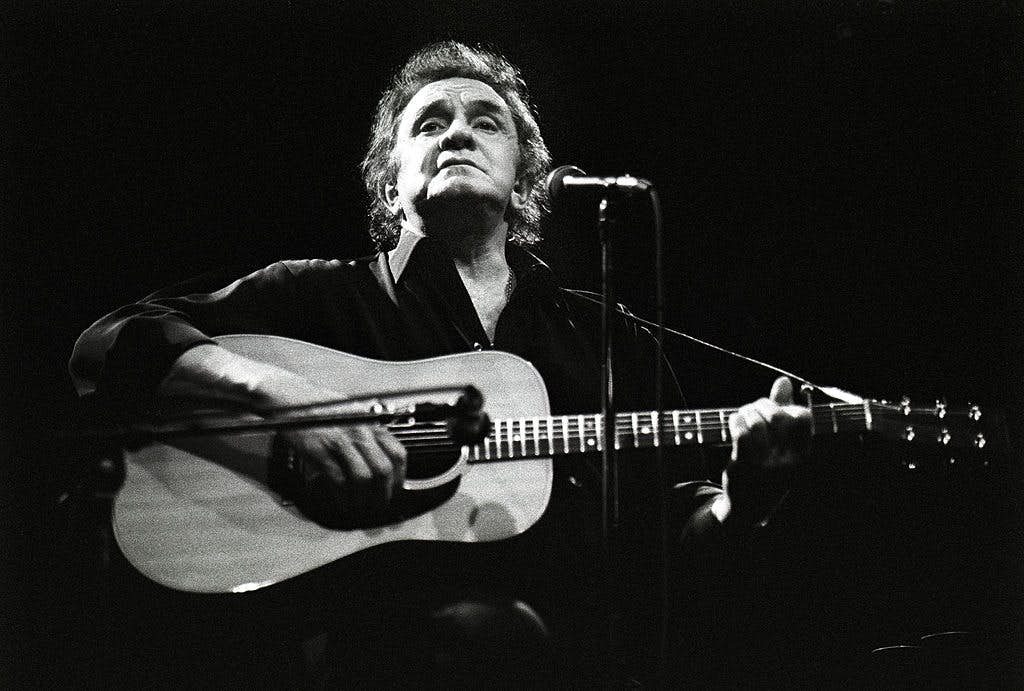
These thoughts were brought to me powerfully by one of my favourite songs — “The Man Comes Around” by Johnny Cash. It’s a remarkable song, with a remarkable backstory. Released only a year before his death, in 2002 when Cash was an old man, it was the fruit of an improbable musical resurrection. After years in the musical wilderness, music producer Rick Rubin, known for his work with rappers and heavy metal bands, formed an improbable partnership with Cash, who produced much of his best work in the twilight of his life and career. Rubin, a secular Jew with an eclectic spirituality, got on remarkably well with the evangelically Christian Cash, and the pair would “take communion” together every day, with Cash describing the eucharist over the phone to Rubin.
The song itself is suffused with the words of Job, Acts and Revelation, but its origins, strangely, were in a vision. Cash dreamed that he was in Buckingham Palace, where he met Queen Elizabeth, who turned and said to him “Johnny Cash, you’re a thorn tree in a whirlwind”.
Cash is a late flowering of a very old tradition: the popular musical and religious imagination of the English-speaking peoples, and it’s nowhere more evident than in that song. From “terror in each sip and in each sup”, to “it’s hard for thee to kick against the pricks”, the poetry of the King James Bible vibrates through his music. At once sinister and joyful, sublime and homespun, it’s a song about the end of the world and it is impossible not to feel a chill as Cash sings of “measured hundredweight and penny pound/When the man comes around”.
I love it because it is a 21st century song plugged directly into the crackling electricity of the soul of English religiosity. Yet this sense of living tradition is all too neglected, even within English Christianity itself. Whilst Cash made religious music suffused in the Gospel tradition and Irish folk music, all too much contemporary church music is of the “Praise and Worship” variety, generally a pretty poor shadow of contemporary pop with a lot of Jesus thrown in. Whilst the treasury of the Anglican choral tradition lives on, there is a broader social rupture between tradition and modernity, as well as elite and popular forms of culture.
In the public realm, many are all too eager to subordinate Christianity to transitory secular political movements of right and left, yoking the faith either to rootless cosmopolitanism or crude ethnonationalism. But as a figure like Cash embodied, Christianity is both particular and universal. Christians can neither neglect the deep claims of belonging and self-imagination of those who are ethnically British, nor exclude non-white Britons from an English-speaking civilisation they shape and embody.
Yet cultural belonging is not automatic or arbitrary. It comes neither from genetics nor from official documents. It stems from the living bonds of culture, connecting history and geography, kin and kith, heaven and earth. It can be gained through friendship and education, and it can be lost through cultural forgetting and atomisation.
For Christians, contemplating the passion this Holy Week, sheltering in the shade of Job’s thorn tree, we have some sense of what human culture, including our own particular one, is for and about. Like the living tree in the Anglo-Saxon poem The Dream of the Rood, it is the raw material brought to life by a holy purpose, crying out: “I was reared as a cross: I raised up the mighty King,/ the Lord of heaven; I dared not lie down.”