As prime minister, David Cameron would have a lot to do with the Queen and her family during some of her happiest years.
Yet there was an awkward moment early on when he had to sack the Duke of York from his role as an ambassador for British trade in 2011.
By this point, The Mail on Sunday had revealed that the Duke had not only maintained his friendship with a convicted American sex offender called Jeffrey Epstein, but had stayed at the financier’s New York home since Epstein’s release from prison.
A photograph then emerged of the Prince with an arm around a teenage girl who had been abused by Epstein. Thus began Andrew’s slow 14-year descent to ex-royal pariah status.
‘I think I was responsible for gently saying to Her Majesty that he had to stand down as a trade envoy,’ Cameron recalled. ‘It was all pretty much fixed. But I was just to reference it for the official log. The Queen was worried about him but she could see the logic.’
It was not just the Duke’s Epstein connection which was the problem. ‘It had been getting embarrassing,’ Cameron recalled.
‘Andrew kept turning up to things and making terrible remarks. I’d seen it myself at Davos [the World Economic Forum], where he was going to his receptions and was just a bit crass. He had his way of doing things and it wasn’t what you wanted. He was very good with all the tyrants but he started being opinionated, saying we were too squeamish about dealing with these people. His speeches would always just have three or four inappropriate things.
‘Unlike the rest of the royals, who were very good at knowing where to stray and where not to stray, he was straying all over the place.’
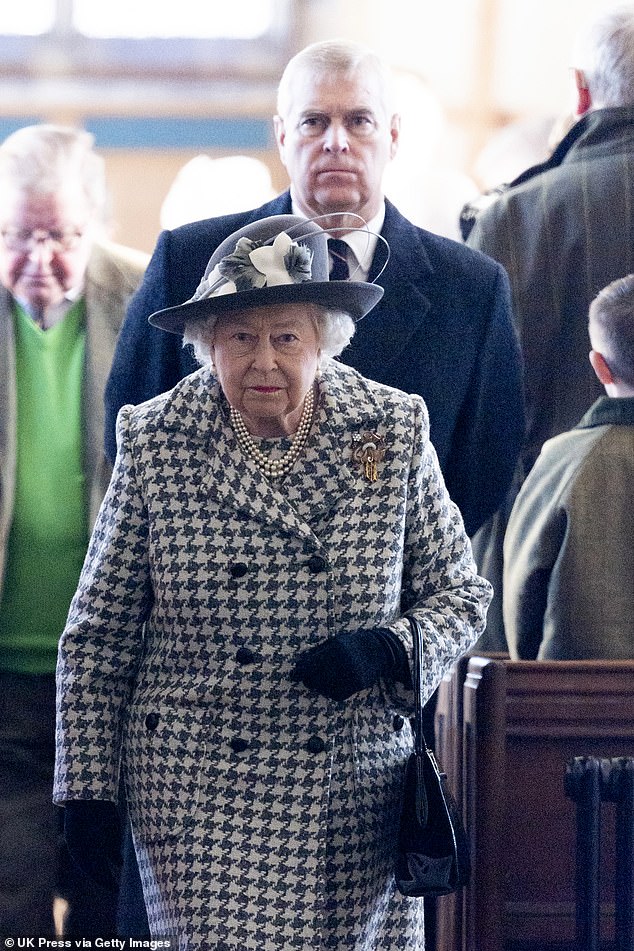
The Queen walks ahead of Andrew Mountbatten-Windsor at St Mary the Virgin church in Sandringham in 2020
Andrew was at the peak of his oafishness at this point, exemplified by his behaviour just weeks before his 2011 demotion. An eminent public servant was arriving with his family and several hundred other guests on their way to an investiture at Buckingham Palace.
‘We were walking across the quadrangle and suddenly this blue Bentley appeared and did a handbrake turn, throwing up gravel over other people’s cars,’ a family member recalled.
‘Someone said, “I bet that’s Andrew.” And sure enough it was. And everyone was talking about it as we went in because it had just spoiled things. He lived at Buckingham Palace, whereas we were just the little people going in there for our big day. And he just had to make it all about him.’
There had been a similar episode at Windsor a few years earlier, when grooms from the Royal Mews had been riding some of the Queen’s horses on the estate.
One had waved a firm hand at an approaching car which was revving its engine aggressively. It pulled alongside and, through the window, the Duke of York bellowed at her: ‘Who the f*** do you think you are?’ He then demanded her name. ‘What’s more, he even took it up with the Queen – in person,’ a former member of the Household recalled. Nothing was done.
At home and abroad, similar stories would do the rounds (and continue to emerge). One British diplomat in Moscow would remember a trade-related visit by the Duke, during which his top priority seemed to be the acquisition of a fur hat: ‘He had a selection of them delivered to his hotel late in the evening – come to think of it, by some very pretty shop assistants.’
The birth of Prince Andrew on February 19, 1960, has sometimes been likened to the start of the Queen’s second family. The baby’s name was another fillip for Philip, being that of his late father. So, too, was the Queen’s plea to the government shortly before the birth, when she told the prime minister, Harold Macmillan, that she wanted to change the family surname, for all those born in the future through her own line, to Mountbatten-Windsor.
No one could possibly have imagined that, decades later, the princely child who had been the catalyst for the new surname would be the first to be a plain ‘Mr’ Mountbatten-Windsor.
It has long since become received media and public wisdom that Andrew was the Queen’s ‘favourite son’. One family friend put it slightly differently: ‘He’d been this wonderful baby after the ten-year gap with her older children. He wasn’t sensitive like Charles but, rather, all things that her husband had been – a straightforward, handsome naval officer. On the other hand, he was a seven-year-old who never grew up.’
Some of these childlike tendencies could be almost endearing, like his collection of teddy bears. Others suggested more deep-rooted issues. ‘He never drank alcohol and always stuck to room-temperature water,’ the friend continued. ‘Fair enough, but I once asked him why and he answered like a child: “I tasted it once when I was a teenager and I didn’t like it.” That’s why the Queen would always worry about him.’
Following Andrew’s marriage to Sarah Ferguson in 1986, the Royal Family appeared to be in full bloom, with another young glamour couple at the monarchy’s disposal. The Duke of York would continue his career in the Royal Navy while the Duchess built a portfolio of charities. Like Lilibet and Margaret six decades earlier, there would be a new pair of York princesses: Beatrice, born in 1988, and Eugenie, born in 1990.
Rumours of cracks in the marriage were confirmed in January 1992 when a batch of photographs surfaced in the Press showing the Duchess of York holidaying with an American oil executive, Steve Wyatt, who was clearly more than just a good friend.
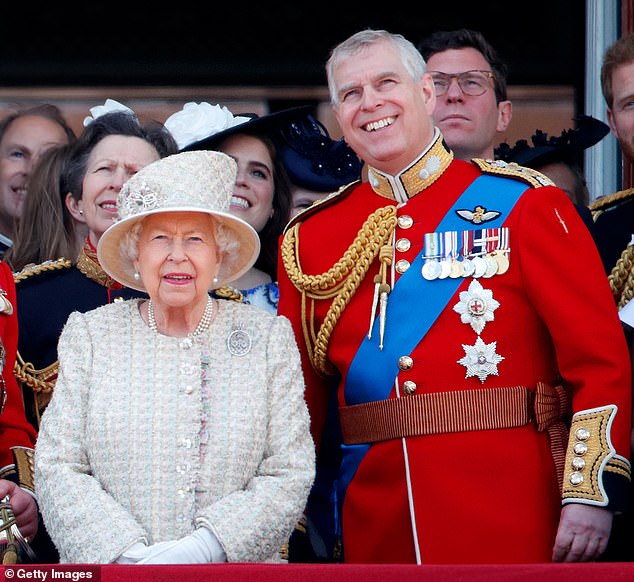
Mother and son look skyward as a flypast soars over Buckingham Palace in 2019 for Trooping the Colour
The Duke and Duchess started consulting divorce lawyers. In March, news leaked that the Yorks were formally separating. It was not only personally painful for the Queen but constitutionally embarrassing too, as the story bumped the forthcoming general election off the front pages.
This was what the Queen would call her ‘annus horribilis’, the year of royal marriage breakdowns, media batterings and a terrible fire at Windsor Castle.
Few moments caused her more pain, however, than the morning of August 20. The royal party – including both the newly separated Yorks – came down to breakfast to find that the Daily Mirror had nine pages of intimate photographs of a topless Duchess and her ‘financial adviser’, John Bryan, by the swimming pool of a villa in the South of France.
A French paparazzo had been able to take the images at leisure despite the presence of two police officers protecting the Duchess’s daughters.
The Yorks finally divorced in 1996, though they would remain close for the sake of their daughters. The Duke’s career in the Royal Navy came to an end in 2001. ‘We did press the Navy very hard to keep him on but they couldn’t find a suitable role,’ a senior royal aide now admits.
That was the start of his appointment by Tony Blair’s government as an unpaid trade envoy for the UK. The Duke would make trade missions across the former Soviet empire, and became so friendly with the oil-rich republic of Kazakhstan that, in 2007, the president’s son-in-law agreed to buy the Duke’s former marital home, Sunninghill Park, for £3million more than the asking price.
Even after being removed from the envoy role in 2011, the Duke of York had continued pursuing questionable business dealings with questionable regimes. However, he had also developed a successful programme for business start-ups called Pitch@Palace, which had gone some way to rehabilitating his tarnished image.
Then, early in 2019, the spectre of Jeffrey Epstein loomed once more when the Duke was named in a new court action. In July, the paedophile was behind bars again facing new charges of sex trafficking. In August, he committed suicide, though there would be plenty of theories that he had been murdered.
The BBC’s Panorama was now working on an investigation that would include an interview with Virginia Giuffre (nee Roberts), an Epstein victim who claimed she had been forced to have sex with the Duke when she was 17.
Rather than respond to Panorama’s request for comment, the Duke decided it would be better to tell his own story to the BBC’s Newsnight programme – and interviewer Emily Maitlis.
Over the course of 45 minutes, in November 2019, he insisted that he had ‘no recollection’ of meeting Roberts and produced a bizarre series of alibis and excuses to debunk her story.
Quite apart from the technicalities, it was the lack of self-awareness that made it such gripping television. Bordering on tragic was the fact that he thought it had all gone rather well, and called the Queen to tell her so.
Within the family and the Royal Household, there was cold fury that he had gone against all internal advice and had somehow obtained the Queen’s consent to bring cameras into the Palace. ‘Everyone in his office had been told that this should not happen,’ said a senior official of that period.
‘The Duke had an overriding belief that he was better than the rest of us,’ said the Lord Chamberlain, Earl Peel.
‘His self-confidence and entitlement was off the scale.’
The Duke’s charities, some of which had very long royal connections, were now disowning him. In tandem with the Prince of Wales, the Queen could see no alternative to Andrew’s removal from public life. After all, public duties only work when the public wants to see someone, as they manifestly did not in this case. The only concession would be that he could frame it as his own magnanimous decision, which he did.
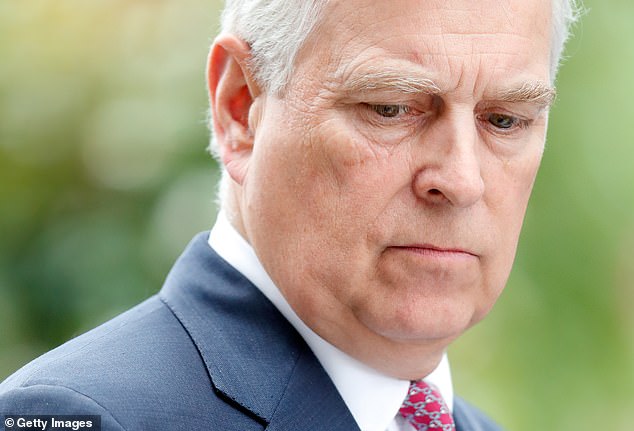
The former Duke of York has been embroiled in scandal over the past few years owing to his association with disgraced financier Jeffrey Epstein
Preparing Andrew’s letter of resignation, said one of those involved, was ‘the worst’ moment that they could recall for the Queen. ‘She was very, very down. She was very stoical. She understood the need. But it was very, very painful.’
Around the Palace, memories were still fresh of a recent physical altercation after the Duke demanded that the Master of the Household, Vice Admiral Tony Johnstone-Burt, accommodate an event for his Pitch@Palace.
‘It was a routine household matter. The Duke wanted to have a reception and there wasn’t any room. It was as simple as that,’ recalled a senior member of staff. ‘Tony said he’d have to wait his turn like anybody else and the Duke went for him.’ It was not just an outburst of expletives and a jab of a finger but what one member of staff described as a ‘kinetic’ blow. Even by Andrew’s standards, it caused astonishment.
Johnstone-Burt had been a helicopter pilot during the Falklands war, like Andrew. He had then gone on to a very distinguished Royal Naval career, rising to captain of the carrier HMS Ocean and commanding Joint Helicopter Command before becoming a popular, long-serving Master of the Household.
His department included more royal employees than any other and had established protocols for workplace incidents. Johnstone-Burt reported the matter to his boss, the Lord Chamberlain, Lord Peel, who raised it with the Prince of Wales, who in turn raised it with the Duke.
The Lord Chamberlain then received a call from Andrew, who was unapologetic. ‘I gather you’ve been calling people and causing problems,’ he said.
So Lord Peel went to see the Duke in person and made it very clear: ‘I’ve been told you’ve been treating members of the Household in a wholly inappropriate way. It’s got to stop.’
The incident with the Master of the Household was not formally raised with the Queen, since it had been raised with almost everyone else. The Duke’s behaviour was so alarming that it stirred Prince Philip from his retirement to write a letter of apology to Johnstone-Burt. Andrew was prevailed upon to write one himself (described by one member of staff as a ‘sorry – not sorry’ letter).
When the matter did reach the Queen and a senior member of staff tried to downplay it to spare her blushes, she was unfazed. ‘Oh, I’m sure he did it,’ she replied. ‘That’s the sort of thing he does.’ There would be no further manhandling of staff. The episode would also explain why, as Andrew found himself ostracised from public life, he was so bereft of Palace allies (and also why royal staff still talk about the 2013 BBC comedy drama Ambassadors, featuring a boorish minor royal trade envoy called ‘Prince Mark’).
In private, however, Andrew still had the Queen’s ear. ‘She was always worried about him. She saw him as vulnerable and felt he had been manipulated by bad people and she took him at his word,’ said one long-serving member of the Royal Household.
‘He was like his father in that he could be rude to people, but he was just not as intelligent. He’d be at a telecoms event and he’d ask “What’s Orange?” and everyone would go: “What did he just say?” He created a character that allowed him to survive in the circles he mixed in, which was this rude, blustering, boring man.
‘But I’ll also say that it’s so incongruous, this idea of him chasing young girls. Because he did have girlfriends but they were all age-appropriate. He sometimes went to nightclubs but he did not drink, he did not take drugs. There was nothing predatory about him.’
One friend of both Andrew and his nemesis during the Epstein years recalled that the Prince was particularly fond of a friend of Epstein who was certainly not underage. Indeed, Andrew was only four years older than CNN business reporter Felicia Taylor (the daughter of actor Rod Taylor; she died in 2023 aged just 59).
‘Felicia came to stay at Royal Lodge when Fergie and the girls were away,’ said this source, adding that Epstein would mock the Prince behind his back while simultaneously using him to open doors: ‘Jeffrey used to make fun of Andrew and say how “dumb” he was. He told me he was taking Andrew on the planes to meet these dictators and do business deals. Andrew would mean they would get into receptions and meet people and Jeffrey would do a deal and he said he gave Andrew a cut.’
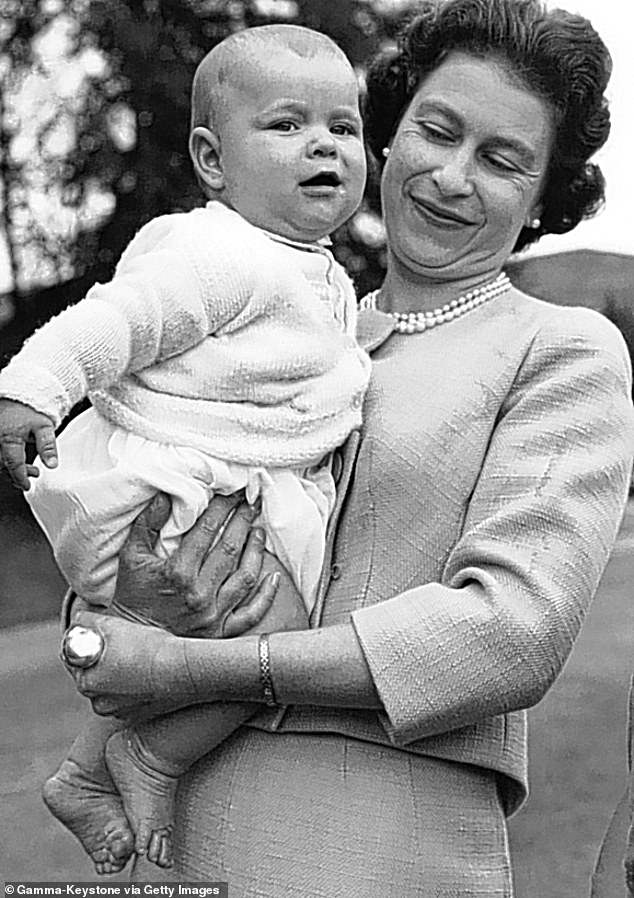
Queen Elizabeth with baby Andrew at Balmoral in 1960 – the year of his birth
The same friend remembered meeting Andrew at Royal Lodge during his annual New Year ‘retreat’, when he would have the house to himself while his ex-wife and daughters were on one of their winter holidays.
He was undergoing various rejuvenating and cleansing therapies in the basement. Andrew told the friend that this was ‘what [Princess] Diana had told him to do so that he could then go back to his partying’. Or, as Andrew put it in an email to Epstein: ‘This week is all about me; for one week of the year it’s great, time to put something back into me before the rest of the world starts sucking it out in all their greed and demands.’
As the former royal staffer put it: ‘He can talk about golf and helicopters but he can’t talk about anything else. He doesn’t read. He doesn’t have many friends and he never grew up. He was a sitting duck for someone like Epstein.’
The Queen was not blind, however, to the wider problems raised by Andrew’s living arrangements. In her final years, she had come to the conclusion that Andrew should no longer live at Royal Lodge. Both his daughters had married and left home and the Queen was now paying the costs of maintenance and security. There could be no use of public funds to secure the home of a man with no public role.
‘I remember the Queen looked out of the window and said: “Andrew to Frogmore and William to Royal Lodge.” That was the plan,’ a lunch guest from that time recalled. She had loved Royal Lodge as a child and wanted a new generation of royal children to enjoy her little Welsh cottage and the swimming pool.
The only problem with her plan was that William and Catherine did not want to live there. For now, the Cambridges preferred Adelaide Cottage, a much more modest four-bedroom home often occupied by courtiers and currently used by the Queen’s cousin, Simon Rhodes, a great-nephew of the Queen Mother.
When Rhodes was informed that the Duchess of Cambridge and her mother would like to come round with a tape measure, say friends, he realised that his days were numbered. It also meant a stay of eviction for the Duke of York.
Since the death of the Queen, the King has shown a surprising capacity for both tolerance and severity. After her death, many had expected that the then Duke of York would be ostracised; but the King took a conciliatory approach as he attempted to persuade his brother to downsize, cut costs and move to Frogmore Cottage, former home of the Sussexes.
When his brother refused, the King cut his living allowance. When it transpired that Andrew’s account of severing ties with Jeffrey Epstein was manifestly untrue, the King stripped him of all titles and honours and banished him from Royal Lodge to a farmhouse on the Sandringham estate – just as an exhaustive cache of irreparably damning Epstein emails and photos were being released by the US Department of Justice.
The decision left other members of the family actually fearing for Andrew’s health, especially after one of his final visitors at Royal Lodge found him babbling that being Duke of York had simply been ‘an avatar’ and that he could now discover ‘the real me’.
Another visitor was treated to a half-hour lecture from him on how to make the perfect cup of tea.
By the spring of 2026, the release of millions more court documents showed the extent of Epstein’s closeness to Andrew, the ex-Duchess and even the couple’s daughters. When Andrew – like the disgraced Labour peer Lord Mandelson – was accused of forwarding confidential UK government reports to Epstein (while he was still UK trade envoy), demands for a full investigation intensified.
In February he was arrested, marking a new low point for the modern monarchy. While it confirmed the King’s prescience in defenestrating his brother, it raised more questions about how Andrew had been allowed to behave so badly for so long in the past.
Withering power of ‘The Look’
All of the Queen’s staff dreaded ‘The Look’ – a silent signal of displeasure towards those who crossed an invisible line, usually involving over-familiarity, incompetence or plain rudeness.
As Tony Blair observed: ‘She can be matey with you, but don’t try to reciprocate or you get “The Look”.’ One prime minister on the receiving end of it was New Zealand’s Helen Clark, during the Queen’s Golden Jubilee tour of the Pacific in 2002.
The centrepiece was Clark’s black-tie banquet. The Queen duly arrived in a white evening gown of lace and pearl, plus tiara. She was met by her hostess wearing trousers. ‘The poor Queen turned up as planned in a full ballgown and tiara, and Helen Clark tried to score points,’ recalled a member of the entourage. ‘It was just rude and rather embarrassing.
‘The Queen did not get angry or say anything. But she understood very well when people were point-scoring. She was quite sanguine about it.’
Adapted from Elizabeth II by Robert Hardman (Pan Macmillan, £22) to be published April 9. © Robert Hardman 2026. To order a copy for £18.70 (offer valid to 18/04/26; UK P&P free on orders over £25) go to mailshop.co.uk/books or call 020 3176 2937