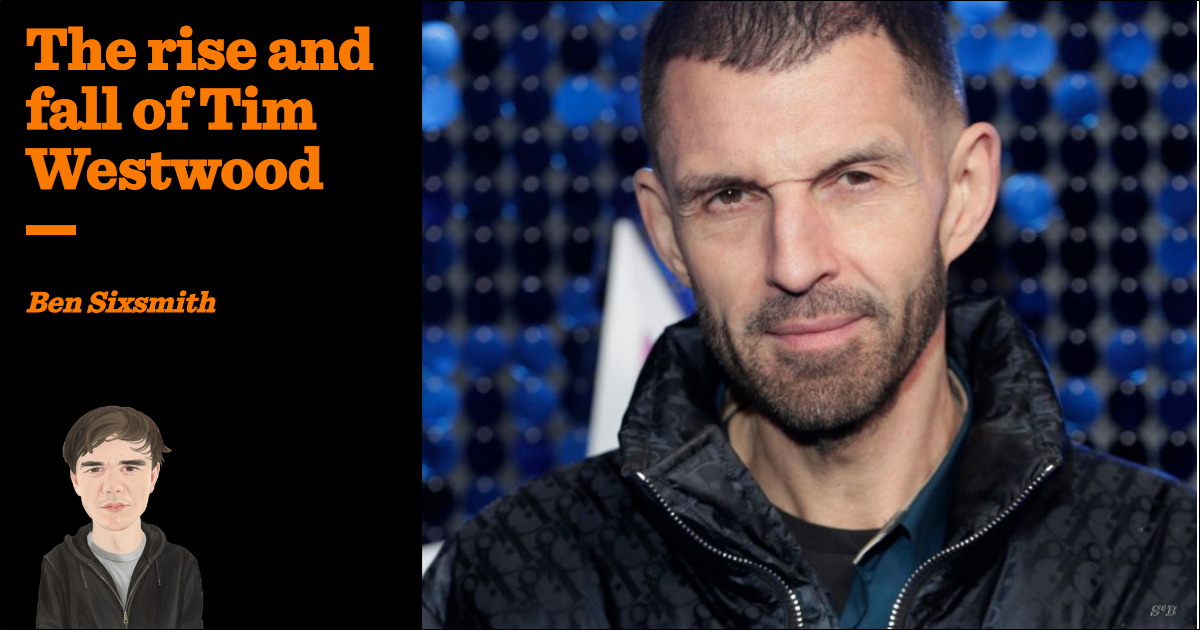
Former BBC Radio DJ Tim Westwood has been charged with four counts of rape, nine counts of indecent assault and two counts of sexual assault. His alleged crimes range between 1983 and 2016.
Westwood was previously the subject of the documentary Tim Westwood: Abuse of Power, which featured six black women accusing the 68-year-old of sexual misconduct. The BBC has admitted that it “fell short and failed people” in missing opportunities to address “bullying and misogynistic” behaviour.
Obviously, Mr Westwood has the chance to plead his innocence in court. Still, whatever the verdict, it seems very likely that one of the more bizarre careers in the British media has ended.
Westwood was born in Suffolk in 1957. His dad was a priest who would go on to be the Anglican Bishop of Peterborough. Westwood, though, was made of very different stuff. He moved to London, where he was passionately interested in the music of Black Britons: reggae, jazz-funk and, ultimately, rap.
Nothing wrong with that, of course. You like what you like. But Westwood was clearly not just a fan of the music. As he became a more successful radio DJ, and began to give an essential platform to black musicians, it was obvious that he wanted to be them. Listen to him at the beginning of his career and he sounds very much like what he was: a vicar’s son who grew up in Norwich. Listen to him later, though, and he was talking with a bizarre combination of Black British vernacular, Jamaican patois, and American hip-hop slang. There’s nothing wrong with being an individual. Hell, it’s great to be an individual. But there was too much effortful contrivance behind the wiry middle-aged Englishman’s urban persona.
This became truer the older that Westwood became. In 2000, he insisted to the Guardian that he was 27. He was actually in his forties. Perhaps it was the sheer absurdity of Westwood’s persona that made him such a success. The preposterousness of a pale, emaciated man old enough to be a grandpa shouting “YO DAWG” at 20-year-old African-Americans made him a meme before “memes” were a thing. (Sacha Baron Cohen partly based Ali G on him.)
Still, no one could have doubted his dedication to hip hop and rap, for which he was a tireless and influential advocate in the British media. Even a shooting in 1999 didn’t slow him down. Westwood said with pride, later, that he “didn’t snitch”. Brave, perhaps — but also stupid. Why should you not tell the police about people who are trying to kill you?
With the emergence of the UK drill genre in the 2010s, British rap lyrics became a lot more violent. The rappers themselves were adolescent gang members aiming threats and insults at each other. Westwood, who was approaching the age where he could have applied for a bus pass, surrounded himself with the teenage criminals. His “crib sessions” were full marijuana smoke and lyrical intimidation.
“The artists featured on TimWestwoodTV are rap groups,” Westwood told the Daily Mail in 2018 after a young rapper he had featured was shot to death, “And we have absolutely no knowledge of any alleged gang affiliation.” This is nonsense. “Shout out my drillers in the back,” yells Westwood before one crib session, “Shout out my plugs”. “Drillers”, in street slang, are gang members who commit violence. “Plugs” are people who deal drugs. There is simply no way that Westwood was naive enough that he thought he was “shouting out” people who operate pneumatic drills and devices for connecting your appliances with mains electricity. “We’ve got the drillers in here, baby,” he yelps before another session, “Free the mandem!” Did Westwood think the “mandem” had been convicted of petty crimes? Shoplifting, perhaps? Driving without a license?
There is something funny about being Alan Partridge with an MLE accent but there is also something deeply sad about it
When the Times accused Westwood of profiting from crime, a spokesman for the DJ claimed, plausibly enough, that the “crib sessions” were operating at a loss. But what seems quite obvious is that Westwood was profiting from his association with gang members less in financial terms than in terms of his identity. The DJ who was obsessed with “keeping it real” could vicariously experience street life at its most dangerous and intense.
There is nothing wrong with trying to transcend your roots, or to be an individual. It can be a very impressive thing to do! But creating a bogus persona, and doing so in a manner that exploits the pain and dysfunction of less fortunate people, is rather more squalid. There is something funny about being Alan Partridge with an MLE accent but there is also something deeply sad about it. That Westwood’s act was so successful means that it might have been symptomatic of a loss of confidence in English culture — and a hunger for something more macho and cutting edge.
Westwood will be in court later this month — and his guilt or innocence will be determined. If he is guilty, the BBC and the music industry at large will have some questions to answer. Either way, though, Westwood’s career asks some pretty strange questions of modern Britain as a whole.