Alarmed right-wing commentators are misunderstanding a massive problem for British politics
Memories in SW1 are remarkably short. Last week, after the Green Party won a remarkable victory in the Gorton and Denton by-election, Westminster was abuzz with talk of the terrifying emergence of “sectarian politics”. People were aghast that the Green Party had campaigned in Urdu, or that Muslim voters had turned out in droves for a left-wing candidate who flies totally in the face of their apparently socially conservative values.
I’m delighted that people have noticed — but where have they been for the past few years?
Back in February 2024, George Galloway won a by-election just up the road in Rochdale, having run a campaign dedicated to the Gaza issue. His campaign literature spoke of the ummah, and deployed Arabic phrases with reckless abandon. Westminster noticed, and then promptly forgot.
In Blackburn, at the local elections a few months later, independent candidates romped to victory in Blackburn’s most Muslim wards. At the General Election in July 2024, explicitly sectarian candidates won seats in Blackburn, Birmingham, Leicester, and Dewsbury, using the exact same playbook. Westminster noticed, and then promptly forgot.
At the May 2025 Local Elections, the same trend again, with Muslim independents picking up seats across South Lancashire. Maheen Kamran, an 18-year old Muslim elected in Burnley, promised to end the “free mixing” of men and women. Westminster was outraged — and then, as with each previous occasion, promptly forgot.
The post-October 7th discovery of political consciousness amongst British Muslims is no longer an emergent trend. This process did not begin in October 2023, but events in Gaza have now fully crystalised a sense of ethnic fellow-feeling amongst British Muslims. This is now a fact of British political life, as predictable as a Tory Party sex scandal or a Peter Mandelson resignation.
There has been no shortage of commentary on sectarian politics, or ethnic voting blocs, in recent years. The august pages of The Critic alone have featured dozens of articles on the topic. The British political establishment, and particularly those on the political right, have no excuse for failing to recognise and understand this issue.
But, as soon as day follows night, memories in Westminster are short. Nascent interest in “sectarian politics” is soon replaced by the next flavour-of-the-month issue, pushed aside by the uncompromising march of the 24-hour news cycle. For most of our political class, the rapid fracturing of our society into ethnic blocs is interchangeable with the latest expenses scandal or ministerial gaffe.
The fleeting attention that this issue receives is most likely the reason that so many commentators, even well-intentioned ones, don’t actually understand how the British Muslim community operates.
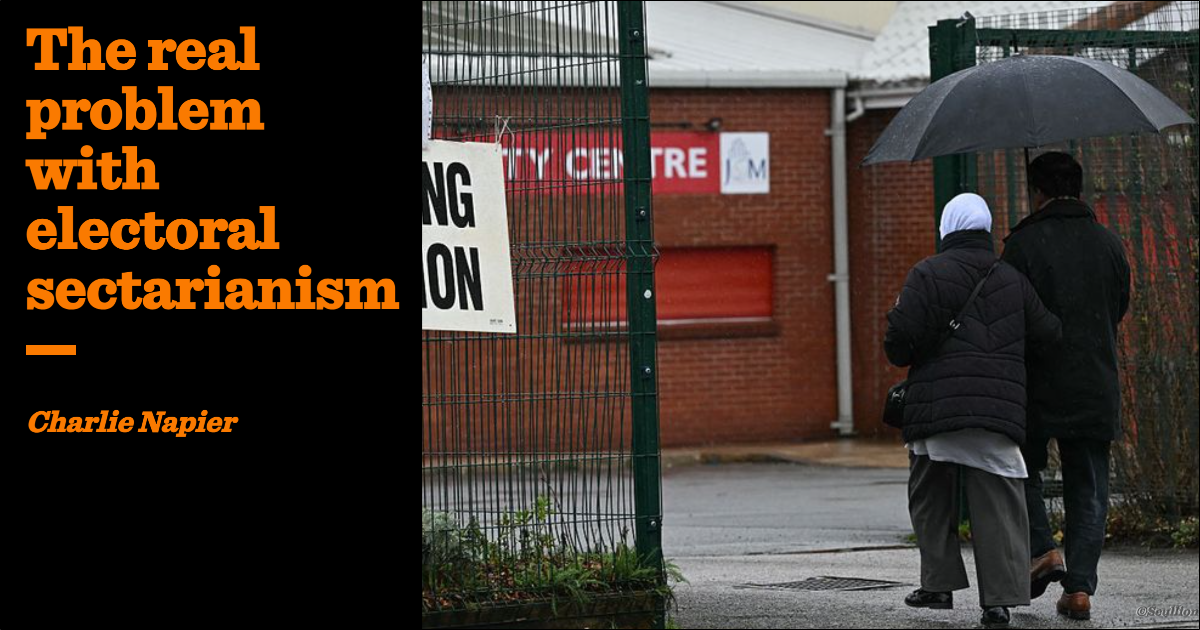
This past week, for example, we’ve seen figures within Reform promote concerns about “family voting”. As far as they can see, the problem in Gorton and Denton is that too many Muslim husbands told their Muslim wives to march to the polling station in order to vote for the Greens.
But are we really supposed to believe that, unshackled from the oppressive bonds of their cousin-husbands, the Pakistani women of Gorton and Denton would have enthusiastically cast their ballots for Matt Goodwin?
Individual interests are subjugated to the perceived interests of the clan, or tribe, or ethnic group
This obsession with “family voting” is derived from a fundamental failure to understand how individuals behave in the context of clan-based cultures. In much of the world, the default mode of political engagement is fundamentally anti-individual. The question of individual interests or preferences doesn’t enter the conversation. Instead, individual interests are subjugated to the perceived interests of the clan, or tribe, or ethnic group.
“Family voting” is one localised manifestation of this problem, but it is not the problem, and it isn’t simply a symptom of the sexism inherent in Muslim societies. Muslim husbands may well have told their wives how to vote, but those Muslim husbands will themselves have been told how to vote by imams, or older relatives, or “community leaders”. Once those senior figures decide where the interests of their ethnic group lie, everything else is simply a question of mobilisation.
This descriptive failure comes, in turn, from a failure to recognise the true nature of the problem. This problem is often described in primarily doctrinal or religious terms — “Islamism”, “Islamic politics”, “sectarian politics”.
The truth is that this is really about ethnic politics, and particularly about ethnic politics in the context of a clan-oriented society, in which the tribe is the base unit of political organisation, not the individual.
Most of the Muslims who went out to vote in Gorton and Denton probably have no strong views on Islamic theology, and nor are they likely to be conversant with the works of Sayyid Qutb. In fact, amongst younger Pakistanis in Britain, private consumption of alcohol and illicit sexual activity are fairly commonplace. These voters identify with an idea of being “Muslim”, but levels of religiosity and social conservatism vary widely.
This is because, at its heart, “Muslim” in the British context has largely become an ethnic and/or cultural identity. These voters — young or old, venal or pious — see that they have more in common with one another than with the British mainstream. They have a shared interest in certain foreign policy goals, in protecting institutions like cousin marriage, and in maintaining the soft touch approach of the police towards Muslims.
They may harbour uncomfortable assumptions about gay people, or women, or Jews, but this has less to do with active belief in Islamist ideas, and more to do with latent cultural norms which, by virtue of the strength of their clan-based system of organisation, have not been penetrated by the relative liberalism of wider British society.
It is impossible to understand any of this if we apply our own norms around individual agency, or cultural norms, to Muslim voters. The British, and especially the English, have been fairly unique throughout history for their relative emphasis on individual agency and self-interest in the political arena. We have, over multiple decades, imported people who approach political activity from an entirely different set of starting assumptions. Unless and until the mainstream British right can get to grips with the realities of ethnic politics, their well-intentioned efforts to solve the problem will come to nothing.