Exactly where the South ends and North begins is a debate that has peeved England for decades.
But the age-old question has seemingly been answered.
According to the largest survey of its kind, which quizzed 46,000 adults from up and down the country, the North’s boundary extends from Shrewsbury to Grimsby.
Meanwhile, the South’s stretches from the Severn to Great Yarmouth.
Respected pollsters YouGov asked residents in every county where they feel like they truly belong.
Perhaps unsurprisingly, residents in three regions usually regarded as northern, North East, North West and Yorkshire and the Humber, voted 91-95% in favour of being northern.
Whereas the South East and South West came in at 94% and 89%, respectively, with the opposite loyalty.
Things get more interesting in the West Midlands, where 78% say they neither live in the North nor the South.
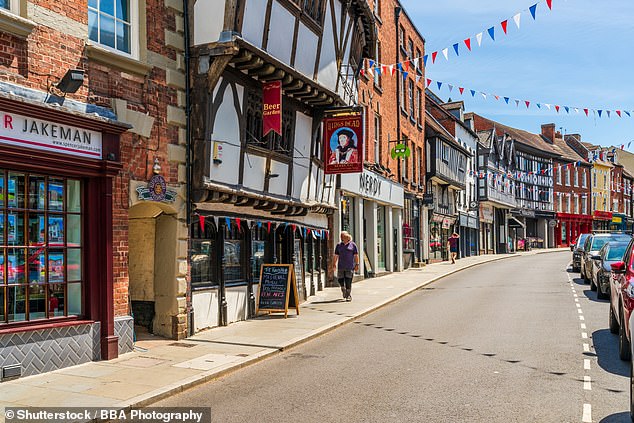
According to the largest survey of its kind, which quizzed 46,000 adults from up and down the country, the North’s boundary extends from Shrewsbury (pictured) to Grimsby
That feeling is replicated by 69% of those in the East Midlands, while only a fifth of East Midlanders (22%) see themselves as living in the North.
The East region is similarly not unified on where it sees itself, with 28% saying they are in neither north nor south, while 67% identify as southern.
Digging down further into the county data, it shows the majority of those living in the northern-most areas of the Midlands see themselves as living in the North.
This feeling is most notable in the High Peak area of Derbyshire, where 94% of residents consider themselves to live in the North, putting it on a par with areas in the northern heartlands.
And three-quarters of those in the Bassetlaw district of Nottinghamshire (75%) also feel like they live in the North, as do 55-58% of those in north Shropshire, the Newcastle-under-Lyme and Moorlands areas of Staffordshire, and the parts of Derbyshire around Chesterfield and Bolsover.
Feelings of Northern-ness do continue a little further, with 30-39% of those who live in the central parts of Derbyshire, Lincolnshire, Nottinghamshire and Staffordshire seeing themselves as living in the North.
In contrast to Northern identity stretching into parts of the Midlands, there’s seemingly less desire to lay a claim to being Southern.
Beyond the 21% of people living in Northamptonshire and 12% in Herefordshire, few in the Midlands see themselves as living in the South.
And the data shows that those living in the Anglian part of the East of England reject the idea of being in the South.
Few people in the South East and South West regions of England reject the ‘Southern’ label, although residents of Milton Keynes prove a notable exception, with a quarter (25%) feeling they’re neither in the North nor the South.
Pockets of neither-ness do, though, continue further into parts of the South, with 14% of those in Gloucestershire and 12% of those in Essex feeling where they live is neither in the North nor the South.
Perhaps indicative of their distinct identity, 10% of those in Cornwall, England’s southernmost county, see themselves as not part of the South of England.
The findings could finally settle the raging debate of where the north-south divide, which some have argued dates back to the Vikings.
Studies have tried and failed to definitively declare the driving force behind the geographical barrier, which can be seen in health, poverty, inequality, house prices, political voting patterns and public investment.
The subjective debate can be both the subject of serious analysis and light-hearted jokes.
Some have even argued that the divide lies at the point at which ‘hello’ becomes ‘ey up’.
Others believe it is down to what condiment you like your chips with: curry sauce or ketchup.
While there is a school of thought that believes the line is drawn in places where high streets more often have a Greggs bakery, and which have a Pret A Manger.