Unbearably itchy skin, angry red patches and a huge dent to self-confidence are just some of the symptoms of psoriasis – a condition that now affects nearly 2 million people in the UK.
And figures show it’s on the rise. The number of Britons living with the skin complaint has risen nearly ten per cent in the past decade. And yet the understanding of it among the wider public has not advanced nearly as much.
Experts have found that the condition can take a significant mental toll.
Around 40 per cent of sufferers admit they avoid dating, social events or even just shaking hands because of anxiety about visible skin patches. And not without reason, it seems. According to a 2024 survey, more than half the population would feel uncomfortable dating someone with psoriasis, while more than a third say they would hesitate to shake hands or share a meal with a sufferer. Often, experts say, this is due to the misconception that it is contagious.
What’s more, psoriasis can lead to other serious health issues. Around a third of patients will go on to develop psoriatic arthritis – a painful inflammatory joint condition.
In 2019, the reality TV star Kim Kardashian revealed she had been diagnosed with it, leading to severe pain in her hands that meant she was unable ‘even to pick up a toothbrush’. She also posted pictures of red patches on her face and leg.
Those with longer memories will recall Michael Gambon’s depiction of The Singing Detective in the mid-80s, alongside Joanne Whalley as Nurse Mills, and his psoriatic arthropathy condition that made such an impact on screens in the mid-1980s.
Among other more long-term health worries for psoriasis patients is the fact they are nearly 50 per cent more likely to suffer a heart attack or stroke. Yet research has found that the NHS is routinely failing to effectively treat it, with some sufferers waiting up to 15 years for a diagnosis.

Reality television star Kim Kardashian revealed she had been diagnosed with psoriasis seven years ago
And even when patients do get seen, it appears they often get the wrong treatment.
Last month, Dr Ellie Cannon, The Mail on Sunday’s resident GP columnist, wrote that she was worried the Health Service was failing to get the right drugs to patients. We received countless letters from psoriasis sufferers who had struggled for years – some even for decades.
One 85-year-old said he first developed the scaly patches in 2000, which spread to cover his scalp, lower back and bottom. However, he has never been offered prescription drugs on the NHS.
Another, a 79-year-old who developed psoriasis in his teens, said his body was ‘covered’ in patches, and he had never found a treatment that worked. And a 69-year-old woman, who sufferers with psoriasis on her scalp and elbows, said the creams provided by her GP had only made things worse.
Now experts claim that lifestyle factors are a common trigger for the condition, meaning simple changes, especially around diet, could drastically improve symptoms.
Prof Christopher Griffiths, a dermatologist at King’s College London and one of the world’s leading psoriasis experts, says: ‘I’ve been researching psoriasis most of my career and it’s clear that lifestyle changes, in combination with the drugs we have today, can lead to impressive improvements.’
So what is psoriasis – and what can be done to tackle it?
Psoriasis is triggered when the immune system overreacts, sending inflammation signals that cause skin cells to grow too fast. This rapid cell growth leads to red, scaly patches of skin that are often itchy and bleed when scratched.
Experts say that certain people are genetically predisposed to psoriasis, meaning it runs in their family. However, they add, those who carry the psoriasis gene do not always develop the condition.
Instead it seems that, for most people, psoriasis is ‘triggered’.
‘Genetics plays an important role but there is much more to it,’ says Prof Griffiths. ‘We know that the psoriasis is normally set off by something.’
Studies show that one of the main triggers is age. This is because, later in life, the immune system becomes increasingly dysfunctional, raising the risk of autoimmune conditions, of which psoriasis is one.
Likewise, certain medicines typically given to older patients, such as blood pressure tablets, have been shown in clinical trials to increase the risk. Britain’s ageing population may therefore in large part explain the rise in cases. Experts say the increase is also likely, in large part, due to psoriasis patients living longer.
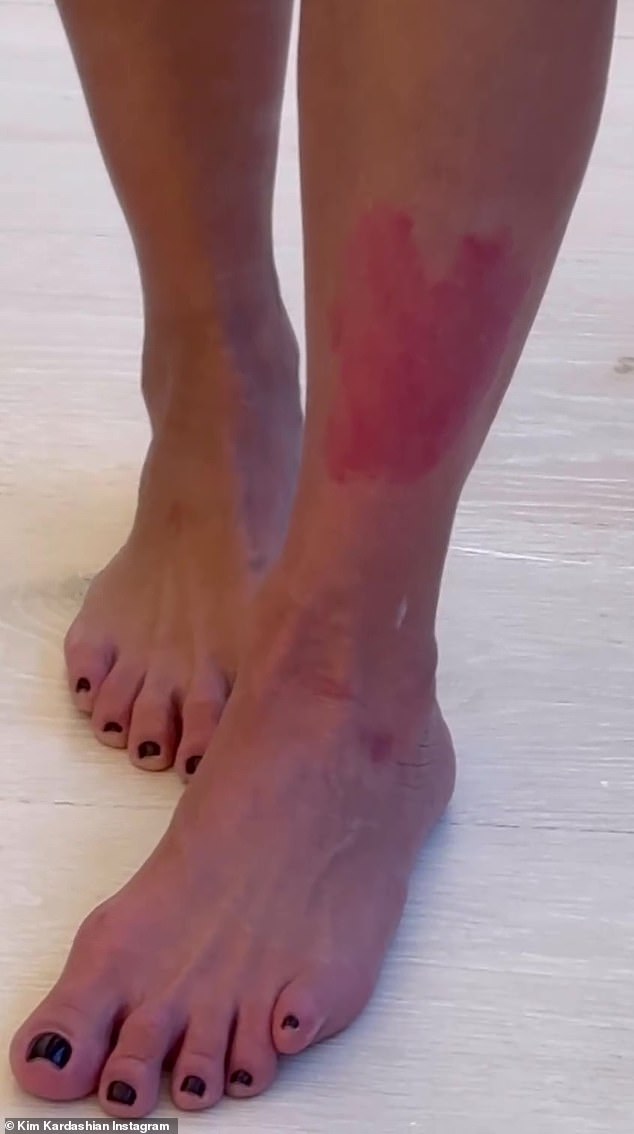
The painful condition left red, blotchy marks on Ms Kardashian’s legs when flare-ups struck
Research shows the inflammation triggered by the disease can, over time, damage blood vessels, raising the risk of deadly heart disease. But in recent years, treatment advances for these heart problems means fewer patients are dying.
However, other triggers are unrelated to age. Studies have linked strep A – also known as strep throat – a bacterial infection that mainly affects children, to psoriasis. Studies show that those who get strep A early in life are around seven times more likely to develop the condition.
That said, the majority of psoriasis triggers appear to be lifestyle factors, meaning behavioural changes can either prevent psoriasis or, crucially, reduce its severity.
Exposure to sunlight has emerged as one of the strongest indicators of whether a patient will develop the condition or not. People who live in the upper northern hemisphere are significantly more likely to develop psoriasis, making Europeans more prone than those in the Middle East or Asia.
Even within the UK, the impact of sunlight can be seen. According to research, those living in Scotland are roughly 30 per cent more likely to get psoriasis than people in the south of England. It is still unclear why sunlight has such a profound impact.
Some expert argue this may be because the condition is linked to low vitamin D levels – the nutrient gained from the sun.
However, others claim it may be because people living in colder climates are more at risk of viruses.
Nonetheless, Prof Griffiths adds, for many, exposure to direct sunlight does appear to help. ‘Many patients report their psoriasis lesions becomes less pronounced and itchy in the summer,’ he says. ‘This is because sunlight seems to dampen down the inflammatory cells that cause psoriasis. However, we do see a phenomenon in some female patients, where sunlight can actually make their psoriasis worse.’
Stress is also believed to be one of the most common triggers, with a 2025 Chinese study finding that about 60 per cent of patients reported stressful events setting off their symptoms.
‘A lot of my patients experienced stressful life events, like the death of a loved one, prior to their psoriasis occurring,’ says Prof Griffiths. ‘It makes sense scientifically. Stress interacts with the immune system, and can trigger changes in the skin that make it more susceptible to inflammation.
‘Stress relief techniques such as talking therapy and exercise are proven to help. That’s why many psoriasis clinics now include a psychology team.’

The number of Britons living with psoriasis has risen nearly ten per cent in the past decade. Pictured: File photo
Evidence also shows that excessive alcohol consumption and smoking increase problems. According to the Psoriasis Association, smoking is closely linked to psoriasis that forms on the palms of the hands and soles of the feet. ‘In my experience, patients who drink and smoke tend to have psoriasis that is harder to control – particularly with alcohol,’ says Prof Griffiths.
Diet, however, is one of the most important factors. Studies show patients who are obese are twice as likely to get psoriasis. Research suggests this is because fat cells produce inflammatory chemicals in the body.
And there is now evidence that losing weight can reverse the condition. Last year, a review of 14 medical studies, published by researchers at the University of Oxford, found weight loss improved the quality of life of sufferers and reduced symptoms. They also found that greater weight loss was generally linked with greater improvement, and that people who started with a more severe condition often saw larger benefits.
Weight-loss injections are being considered as a potential treatment. In February, a medical trial involving Mounjaro concluded that around a third of psoriasis patients given the jab saw the scabs completely disappear.
Experts also argue that how frequently a patient eats is significant. ‘We’ve found that people who regularly snack are more likely to get psoriasis,’ says Prof Griffiths. ‘Meanwhile intermittent fasting [going extended periods of the day without eating] seems to improve symptoms.
‘It’s not entirely clear why, but it’s possible it’s linked to something called autophagy. This is where the body clears damaged or inflamed cells. And there’s research that shows that autophagy occurs after a period of fasting. This would explain why constant snacking is bad – it stops the body from clearing these inflamed and damaged cells.’
Moreover, specific foods have been highlighted. According to a 2017 survey by the National Psoriasis Foundation, around a third of patients who cut out red meat and pork saw a full clearance or major improvement.
There is growing evidence that diets high in ultra-processed foods, such as ready-meals, sugary snacks, pizza and crisps, raise the risk of psoriasis. These foods – also linked to cancer, heart disease and dementia – tend to be high in sugar and salt, which have an inflammatory effect on the body.
Patients who cut down on their sugar or fat intake, such as Stephanie Trotter, left, often report their symptoms improve.
‘It’s why I always recommend the Mediterranean diet to my patients,’ says Prof Griffiths. The diet is high in vegetables, fruits, whole grains, beans, nuts and oily fish.
Most NHS patients with psoriasis are initially offered steroid creams to reduce inflammation. If these fail, they may get biologics – injections that stop the body producing certain inflammatory cells.
These drugs, such as adalimumab, infliximab and secukinumab, have been shown to reduce patches by up to 75 per cent, but they really need a lifestyle overhaul too.
‘We have these amazing treatments that didn’t exist a few decades ago,’ says Prof Griffiths. ‘But they work best when combined with these lifestyle adaptations, such as changing your diet. It’s crucial that patients take charge of their health.’
Stephanie was cured after quitting sugar
Stephanie Trotter and her husband were building their new home when she first noticed the red, scaly patches that had begun to pockmark her body.
The 76-year-old charity executive, pictured left, from the Isle of Wight, says the itchy areas, which also oozed pus, initially appeared under her breasts and in her belly button.

Stephanie Trotter, 76, was ‘constantly itchy and had nasty oozing red spots all over my body’ – but cutting sugar helped ease the symptoms
However, the areas – which first arose in 2016 – quickly spread across Stephanie’s body, including her scalp and mouth.
‘It was vile,’ Stephanie says. ‘I was constantly itchy, and had these nasty, oozing red spots all over my body. I’d never had a skin problem before and it made me feel unclean.’
Stephanie’s doctor was quick to diagnose psoriasis. However, despite the severity of her symptoms, her GP was unable to help and sent her to a dermatologist who was unable to offer any solutions either.
‘I spent a fortune on all these creams,’ she says. ‘But only the cream for my scalp seemed to help, and that only provided temporary relief. I was desperate.’
Then everything changed when Stephanie read in a book that cutting out sugar helps ease psoriasis symptoms for some people.
‘Around the time my symptoms began, I’d been eating a lot of jam and toast, because there was nothing else in the house because of the building works,’ she says. ‘Looking back, I felt like this was the trigger. So overnight I cut out sugar as much as possible.’
Along with jam, Stephanie banned some of her daily sugar-containing staples, including orange juice and red wine. Incredibly, she says the red patches began to shrink within days. And within two months, all of them were gone.
‘Ten years on, I’m healthier than ever,’ Stephanie says. ‘Now I try to tell as many psoriasis patients as possible about the benefits of cutting out sugar. It might not work for them, but it’s worth a try.’