As life becomes increasingly busy with constant work, screens, and noise, there is something comfortingly stable about being able to reflect and wish for a better future — for one’s family, community, and country. Away from life’s madness and the blue light of phones or laptops, individuals can come together to affirm traditional values and contemplate the lessons taught in the Bible.
Every Christmas, millions of Christians take flights either home to their families or away on holiday with loved ones. While the journey itself can be an uncomfortable prelude to a joyous reunion or relaxing getaway, for religious people, it feels reassuring to pray for safe travel and a safe return.
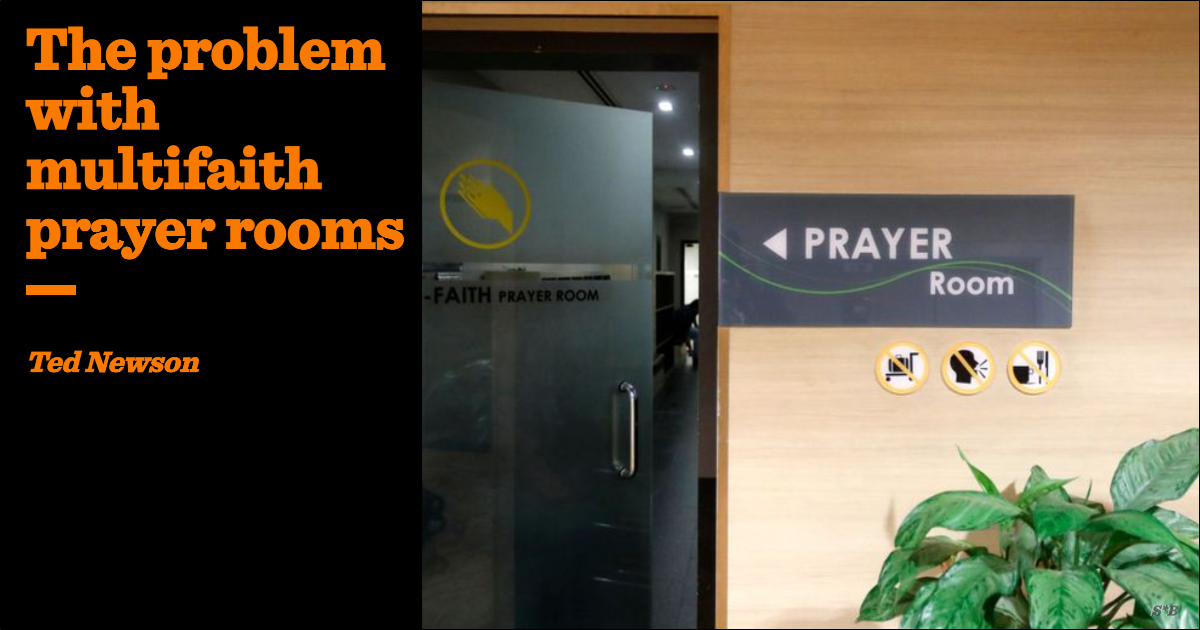
This was exactly what I set out to do when returning from a family holiday to Tanzania. During a layover in Ethiopia, I went to a multifaith prayer room to quietly reflect on my trip and pray for a safe flight. Upon entering the room, I noticed that the only people praying there were Muslims. Wanting to be respectful, I spoke to a member of staff before entering.
As I stood to pray, put my hands together, and closed my eyes, the staff member’s voice rang out, shouting at me to stop praying and leave the room. Despite being labelled a “multifaith room”, it was seemingly deemed unacceptable that I had my shoes on while praying. When I asked what I had done wrong and why I had to leave, the staff member grabbed me. As I protested, asking where the Christian space was, he angrily responded: “No Christians. Muslims only.”
I had heard stories about prayer rooms being dominated by Muslim prayer. This is to some extent understandable: prayer rules are strict, and most Muslims pray five times a day. What I didn’t expect was to face such overt religious hostility in a country that boasts over 70 million Christians. To see my freedom of religion challenged for the first time, in a nation that has been Christian since the fourth century, was deeply chilling. It is now clear that all religious people must be willing to defend full religious freedoms in prayer spaces, even if it means upsetting fundamentalist community leaders — Muslim, Christian, or otherwise.
Prayer rooms in the West were originally set up in public spaces to give religious communities a specific place to pray and worship, yet somehow many have morphed into intolerant spaces that de facto cater to only one group.
In securing the many prerequisites required for Islamic prayer, such as prayer mats, facing towards Mecca, and cleansing facilities, other religions without such conditions have been forced out. Take the new multifaith room at Manchester United’s stadium, for example. An otherwise empty room with a heater and a few windows, the space has limited provisions — the only visible religious provision comes from the club-branded Islamic prayer mats they provide to worshippers. Critics argue these are merely practical necessities, but their presence also signals who the space is truly intended for. How can a room really be multifaith when it only visibly caters to one religious group?
In Britain, many of the prayer spaces in our universities are managed by Muslim student societies. This creates an obvious conflict of interest. At Newcastle University, for instance, the Islamic Society staged protests after plans were announced to convert a prayer room into a genuinely multifaith space. While the official concern cited was capacity, it is difficult to ignore the desire among many protestors to preserve existing religious segregation and favouritism.
The fact that many multifaith spaces have gender segregated sections should signal to most observers that the primary concern is given to Muslim practices when creating prayer spaces. If prayer spaces are truly going to be for everyone, equal concern should be given to other major religions as well.
To pray is a right that all religious people should be afforded. Freedom of religion is, after all, a staple of Western democracy. As Israel and Palestine dominate conversations on Western university campuses, it is often Jewish students who suffer the consequences. While a Christian myself, it would terrify me to enter a typically Muslim-dominated space as a practising Jew, given the scale of the threats against Jewish people and protests on campus.
Multifaith rooms should be exactly that, for every faith
For Christians too, prayer rooms increasingly feel as though they exist solely for Islamic worship, with Christians treated as intruders rather than equal participants. Many religious people simply do not want to face the discomfort of their religion being so outnumbered. It is only human nature to want to go along with the crowd. If one person in a prayer room of thirty prays differently, without a mat, with shoes on, or even as a different gender, they would understandably assume that other worshippers would resent them being there.
Multifaith rooms should be exactly that, for every faith. When such rooms are designed by one religion, catered predominantly to one religion, and staffed by adherents of that religion, they make a mockery of why they exist in the first place. If all but one group can be effectively excluded, multifaith rooms might as well be abolished altogether.
In a fair world, such spaces should be staffed with well-educated but non-religious people and should have evidence of catering to all religions. At the very least, they should include individual prayer cubicles so that everyone can worship freely, without dirty looks, judgement, or in my case, outright confrontation.