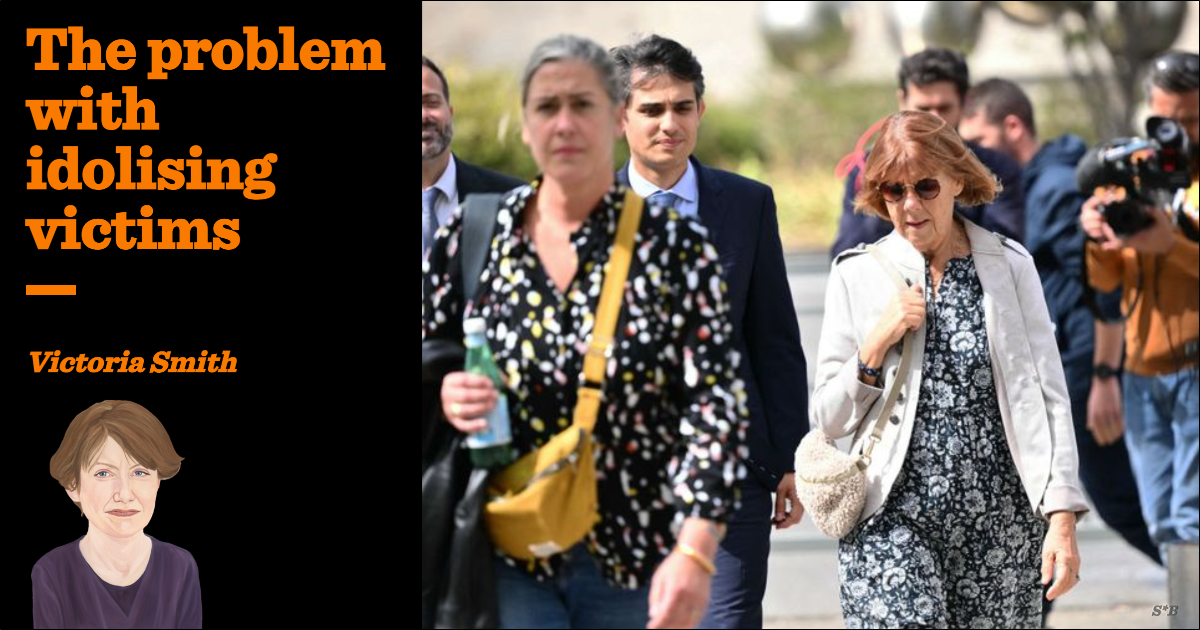

Nothing can take away from Gisèle Pelicot’s bravery. Towards the end of last year, the 72-year-old was lauded as a feminist hero, having faced down the 51 men — including her own husband, Dominique — who drugged and raped her over a number of years.
Waiving her right to anonymity, Pelicot spoke of the need to transform perceptions of sexual violence: “when you’re raped there is shame, and it’s not for us to have shame, it’s for them”. A rapist was not necessarily “someone met in a car park late at night. A rapist can also be in the family, among our friends”. The loss of trust that this brings about — surely tremendous in Pelicot’s case — is part of the lasting damage. That Pelicot remained willing to speak not just for herself, but for “all victims of rape”, was a source of inspiration for many.
This week Husamettin Dogan, one of the men convicted of raping Pelicot, will be challenging his sentence. This means Pelicot will be returning to court after, as one BBC report puts it, the “trial that made her an icon – and tore her family apart”. Icon is not too strong a word. Following the initial trial, Pelicot appeared in “person of the year” lists across the world; she received letters from world leaders; in France she was awarded the Legion of Honour. Her demand that “shame must change sides” felt — and still feels — transformative.
If there was something a little disconcerting about this — the willingness of so many to invest so much in one person, in a world where far too little is done about the broader cultural messages and social structures which continue to promote sexual violence — it has felt inappropriate to say so. If one woman can make such a difference — especially one who has suffered so much — why not allow her to do so? Pelicot’s lawyer, Antoine Camus, describes her as “a rape victim who has become a public figure despite herself”. Yet for something so personal, this can be double-edged.
The second part of the BBC headline — mentioning the family torn apart — puts the icon status in a different light. It refers to the fact that Pelicot’s daughter and one of her sons, both of whom supported her at the start of the trial, no longer speak to her. The daughter, Caroline Darian, claims that she, too, was a victim of Dominique Pelicot. Photographic evidence, showing Darian unconscious and in unfamiliar underwear, was found on Dominique’s computer under the file name “My Daughter Naked”. While Darian, like her mother, has no direct memory of abuse taking place, she believes it also happened to her. Yet in her memoir I’ll Never Call Him Dad Again, she recalls her mother insisting her father would not have been capable of doing this. In a recent interview with the Telegraph’s Celia Walden, Darian has said she will never be able to forgive her mother for her lack of support.
This is both incredibly sad and deeply uncomfortable. If part of the importance of Pelicot’s message lay in a call to acknowledge shared experience, it is hard not to feel that the rift with Darian undermines this. If we do not want Gisèle Pelicot to be someone who disbelieves her daughter, then should we disbelieve her daughter instead? Should Darian’s part of the story be quietly filed away, an unpleasant, unexpected coda that can have no real relevance? Few would want to think badly of Pelicot (or can understand the depths of her own trauma), but where does this leave Darian, who describes herself and her brother as “forgotten victims”? “My mum,” she told Walden, “was catapulted into the limelight; she became an icon. Meanwhile, there we were, back down on earth, with all these unanswered questions — and we are damaged.”
Whatever the truth here, I think this tension matters. It makes the story messier, but also more real. Darian’s claims and her feelings of betrayal do not make Pelicot’s public actions any less courageous, but they do remind us of truths that the icon narrative did not accommodate. “Shame must change sides” is a powerful statement, but it does not capture all of the reasons why shame can be misdirected. It is not just a matter of ignorant people buying into rape myths. These do play a part, but sexual abuse always occurs within very specific relational contexts, with responses shaped by shifting loyalties and beliefs about self and others. Most of us can agree, in the abstract, that shame should lie with perpetrators, but many of us behave differently when giving credence to a particular account would require a shift in our own self-perception and values.
We see this right now in the politicisation of rape in “protect girls” narratives — battles over whose experiences of trauma should be centred, whose are being “weaponised” to make certain groups look bad. Sexual violence is seen as something the “other side” — the other religion, other families, other people — commit. If it happens on your side, maybe you should stay quiet about it for fear of it being “exploited” by the “real” baddies. This is true when people cover up sexual abuse allegations within religious organisations or political movements. It’s also true when family members don’t believe accusers — including when mothers don’t believe daughters.
None of this is to take away from what Gisèle Pelicot achieved. Her courage matters, but her idolisation risks setting an impossible standard for victims, even while purporting to include them all. If her story is to have meaning and resonance, the situation of Darian — uncomfortable, unresolved — also has to be part of it. Neither woman deserved any of this. None of the shame should be theirs, but neither should have to be perfect to prove it.