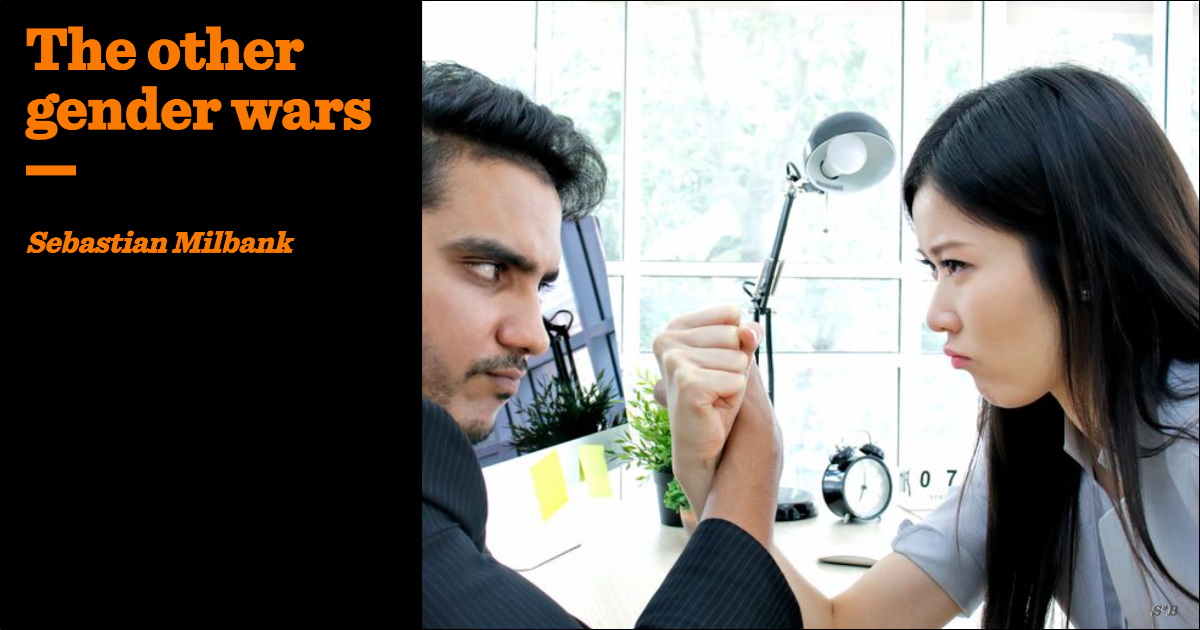
Modern politics is becoming increasingly gendered, as young men split right and young women head left. At the same time, disputes over gendered behaviour — especially in dating, workplaces and policy debates — have become fiercer. Feminist content, often polemical,and already a mainstay of social media, has been challenged by the growing heft of the “manosphere”. Long-suppressed debates about gender roles, sex differences and equalities laws have finally bubbled up in the less constrained and lower stakes environment of social media. Men and women increasingly blame one another not only for the state of modern politics, but for the grimness of the dating scene, or the problems of office culture.
Is this a taboo yet essential public debate, in which we must finally engage with uncomfortable biological realities? Or is it a toxic and unwinnable morass of mutual resentment and extreme political positions?
Which position you take probably determined how you responded to Helen Andrews’ intervention into this world. In an essay entitled “The Great Feminization”, Andrews suggests that the entry of women into the workplace was a central cause of the rise of progressive, “woke” politics, and the phenomenon of cancel culture. Many commentators praised her, whilst others accused her of misogyny. Yet most critics were surprisingly light on specifics of where her argument was wrong, rather than merely “offensive”.
There are many plausible elements to her argument (and the data she presents about psychological sex differences is fairly uncontroversial, or should be), and many of the responses seemed to confirm her thesis. Liberal critics seemed inclined to respond with emotion or ostracising mockery, rather than engaging, whether positively or negatively, with the case being made.
Yet is this tendency to deal in emotion rather than reason, offence rather than critique, purely a function of gendered psychology? Andrews may not be wrong to draw a link between women’s entry into the workforce and political change, but is it as simple as she makes out?
The issue with much modern gender discourse, whether of the left or right, is that it is largely rooted in scientific or pseudoscientific methodologies, referring to survey data, studies, experiments and biological data. Though valuable reference points, far less attention is paid to anthropology, history, or philosophy. Yet the diversity of cultures across time and space offers a vital counterpoint to the argument that gender is the sole deterministic element in institutional culture.
Andrews refers to the Larry Summers case to illustrate her point. Summers, a respected man, suggested to a conference audience that female underrepresentation in the sciences might reflect the differing tastes of women, and the clustering of ability at the extremes of the spectrum in men (more geniuses and more idiots). Despite being off the record, numerous complaints were made, mainly by women, and his remarks were leaked to the press — Summers subsequently lost his job at Harvard. Women, argued Andrews, have a zero-sum attitude to conflict, whilst men are inclined to have the idea of an honourable opposition. Likewise, men prioritise rules, women feelings and outcomes. Thus women describe emotional reactions to his words, rather than responding objectively, and throw out rules and norms in the name of avenging a perceived slight.
Yet a wider perspective might have challenged this assumption. Many male “honour” cultures lack any sense of being able to have objective debates and shake hands at the end. Instead, any challenge to a man’s authority or dignity must be vigorously avenged. Elaborate ceremonies, rituals and codes develop to avoid giving insult, or resolve such insults when given. We don’t have to look that far to see examples. 18th century nobles were quite prepared to consider themselves insulted in public and private debates, and “demand satisfaction” as a result. Likewise, try having a socratic debate in a modern gang or mafia, and you’ll find out just how inessential English fair play and honourable chapism are to male socialisation.
We can of course observe very strong gendered differences between woke culture and male honour cultures. Though both involve a certain emotional “fragility” and ostracisation mechanisms, the former is more ideological, collective and less given to straightforward codes and resolution mechanisms. Clearly wokeness is a more female mode, but crucially we can easily imagine and point to examples of feminine spaces and cultures that operate on an opposite logic. Women might act as ostracisers and ideological enforcers in a “woke” environment, but in many a male honour culture it is women who diffuse disputes, cool tempers and plead for mercy.
We live in an age of reductionism, in which we tend to assume either that biology drives culture, or that culture determines biology. The more complex reality is that culture maps onto pre-existing biology, using pre-existing tendencies to serve collective ends. Thus there is a male and female “mode” of different cultural paradigms like honour, ostracism or conflict, but there is no inherent male or female determinism by which a female-dominated institution will always pursue cancel culture, or a male one necessarily embrace fair play.
Narrowing down on cancel culture, we can see that it long pre-exists mass female participation in public life. The social dynamics at play in modern offices and universities are practically identical to the problems that have plagued revolutionary ideologies for over 200 years. Was Stalin’s Great Purge due to Soviet girl bosses? Was the French Reign of Terror an example of a “feminised” culture? In these contexts individuals were certainly cancelled for their language, ideas or simply offending others, as people informed on annoying neighbours, strict bosses or love rivals. Jacobins and Bolsheviks were singularly disinclined to treat conflict as non-existential, or shake hands after a fight, despite, and quite possibly, because of the macho nature of the movements.
Not only were these early “progressive” movements dominated by men, they were in fact frequently anti-women. In 1793, the Jacobins shut down all the revolutionary women’s clubs and associations and ordered women to return to the home, the place for which they claimed women had been fitted by nature. A frequent feature of revolutionary propaganda was that Christianity and the prominence of aristocratic women in public life had made the nation “effeminate”. Revolutionaries were returning France to a neo-Roman age of masculine heroism and political liberty, as opposed to perfumed princesses and womanish clergymen. These same ideas would persist in socialist contexts, and would see figures like former socialist Benito Mussolini develop an ultra-masculine revolutionary project of national socialism. Fascism, as well as generally limiting women to the private sphere, was also big on cancel culture and appeals to emotion.
Of course gender is important here. The Jacobins, Communists and Fascists were all essentially male revolutionary movements, despite the involvement of women. Modern “woke” progressivism, with its emphasis on the class consciousness of women, sexual minorities and non-white racial groups, is obviously a female-dominated revolutionary movement in a way that previous ones were not. Additionally, unlike revolutionary causes that sought to capture the state and market using political violence, this is a revolution in manners, social organisation and language, one which is subordinated to the managerial state and corporate power.
Women, for much of their history in British electoral politics, were a conservative force
Once we understand this, and place the “Great Awokening” in its historical context, the role of gender clicks into place. Very clearly, the mere presence of women in politics is not the cause of this movement, yet just as clearly, women, set apart and elevated as a revolutionary vanguard, are employed by progressivism as agents of change.
Women, for much of their history in British electoral politics, were a conservative force. Many of the early feminists, like Millicent Fawcett, were conservatives. Despite the attention given to the radical side of the movement, much of the mass appeal and success of the suffragist derived the kind of feminism that Fawcett embodied, as reflected in her distinctly non-emotionally coded appeal for the “principle of supporting our movement only by argument, based on common sense and experience and not by personal violence or lawbreaking of any kind”.
Indeed, without the votes of women, Britain would not have seen a Conservative government until (ironically) Margaret Thatcher, as the male-dominated labour unions defined the terms of left-wing politics throughout the post-war period.
Women are now associated with the left, precisely at the time that parties like Labour gain their support from the (female-dominated) public sector, and are leaving male industrial workers behind. This is also a context in which many women rely on the state for benefits, services and jobs, rather than male breadwinners. This reordering of gender relations, alongside the unique political and economic rights given to women, as well as the social prestige automatically accruing to women in professional fields (you’re breaking barriers!), has created a strong sense of gendered self-interest and political dignity linked to revolutionary progressive ideas. Even women who are otherwise moderate and apolitical can easily slide into politicising their dating lives, office politics and family dynamics.
The revolutionary nature of progressivism inheres not just in the fact that women are built up, but that men are torn down. This negative account of men might seem to be an inherent drawback, but it has important appeals to certain sections of men. Older, already established men can assuage their guilt and feel good without losing their own position. Other men can benefit from their minority ethnic or sexual status. The losers are generally young, straight white men, and it is this group in which the manosphere and anti-feminism is spreading like wildfire.
Andrews herself makes a strong case for removing artificial legal and managerial structures designed to artificially create gender parity, or police offence and hurt feelings. Her argument that women are allowed to complain if an office becomes a frat house but men can’t equally complain if the office has become like a Montessori kindergarten will resonate with many — I think most men, if being honest, know exactly what she’s talking about, and plenty of women feel the same way too.
Where I depart from Andrews is in her biological determinism, and what I think follows from such determinism — her implicit pessimism. This is the “longhouse” theory of female culture, in which any group of women left to their own devices will default to Mean Girls bitchiness, fake-nice corporate Karenism, and Salem witch trial-tier hysteria.
Much of what she is attacking as “feminine” flows from managerialism, and the curtailing of freedom and individuality within “professional” contexts. Areas like academia, once comprising freely associating professionals, has been reduced to a salaried “workforce”. The introduction of terms like “line managers”, derived from the factory floor, to white collar contexts, is a clear example of the managerial revolution that reduced the dignity, power and prestige of what was once middle class work. The introduction of women coincided, crucially, with the lowered prestige and power of such workers, and the neoliberal transformations of the 80s and 90s.
Women in this context became useful instruments not just for those with socially radical aims about reshaping the family or destroying social hierarchy, but just as much for managerial “radicals” who wished to reshape the workplace and impose a new kind of corporate hierarchy. This covert alliance between economic and social liberals was the key to the “girlboss” era, and it was this kind of “Hillary Clinton” elite feminism which generated massive backlash on both dissident right and left.
Interestingly, writers like Mary Harrington and Lousie Perry emerged who questioned whether this revolution was really in women’s interests. Many are unhappy at the way family formation and choices are limited by the “two-income trap”, in which lifestyles once possible on one income, now require both parents to work full time. At the same time, the miseries of hook-up culture and the commodification of sexuality are hardly traditionally feminist outcomes, yet are defended by progressives. Even on the left, many younger women, whilst complaining about misogynistic men and posting progressive memes, are falling out of love with the increasingly competitive and unrewarding modern workplace. Instead, Zoomers boast of travel plans, do odd jobs and explore alternative lifestyles.
What if modern office culture is failing men and women equally? Corporate Karen is not a member of the sisterhood, and many women complain of the lack of male mentorship in the modern office environment. Andrews has certainly diagnosed a real problem, but in focusing on women alone, and only as a problem, rather than part of the solution, she ends up with an answer too narrow for the scale of the question.
Why should men not advance in grace, and women in courage?
The modern workplace is anti-human, and the feminised policing of emotion is just the latest extension of corporate control, managerialism and exploitation. It does not follow that a feminised mode of oppression is any more on the side of women than a masculine tyranny is good for the average man. A more human workplace, liberated from managerialism, could make fuller use of feminine as well as masculine virtues and genius. Instead, at present, men and women are put in competition with one another, whether in our HRified workplaces, our consumeristic dating “market” or our divided, partisan politics. Such an environment sees men and women fall back on their worst instincts and project, in turn, the crudest sort of stereotypes onto the other sex (men are all rapists, women are all whores, etc).
What would a culture look like in which men and women strive to suppress their worst tendencies, and imitate the highest virtues of the other sex? In the middle ages, hardly the era of woke, Christine de Pizan commands women in public life to adopt “the heart of a man”, whilst Bernard of Clairvaux proposes that men in pastoral roles to have “the bosom of a mother”. Why should men not advance in grace, and women in courage? The point of culture is not to deny biology, but, working with the grain of our given nature, to transcend our passions and to strive towards a higher ideal.