
This article is taken from the February 2026 issue of The Critic. To get the full magazine why not subscribe? Get five issues for just £25.
You remember your first time. For me it was 2018, when a recent graduate learnt of my scepticism about gender self-ID and responded with what had by then become the accepted catchphrase: “Trans women are women, no debate”.
It was the first time I heard those words but certainly not the last. Both authoritarian and ridiculous, they were most closely associated with Stonewall, which a decade ago trashed its reputation and solvency by abandoning gay people and adopting gender grifting instead.
Ruth Hunt, the charity’s boss from 2014 to 2019, said there could be “no debate” about trans people’s “right to exist”. Since nobody was suggesting they be liquidated, what this really meant was that the trans lobby brooked no opposition to its outrageous demands.
Nancy Kelley, her successor, compared such opposition to antisemitism and racist speech — so “harmful or damaging” that it is limited by law. Simon Blake, who replaced her in 2024, promised “endless conversation”’ with Stonewall’s critics — but ignored them when they asked to talk.
◉ ◉ ◉
What the No Debaters meant wasn’t that there was no debate — in 2018, when I first heard the phrase, a government consultation on gender self-ID was under way. What they meant was that there shouldn’t be, and, if they could sabotage any attempt to make one happen, they jolly well would. In an inverse of philosopher David Hume’s is-ought fallacy (observations about how the world is don’t tell you how it ought to be) No Debaters seek to turn “ought” into “is”.
Their “ought” is enforced by thought-policing. “Trans women are women, no debate” is what American psychiatrist Robert Jay Lifton called a thought-terminating cliché. In his most famous book, Thought Reform and the Psychology of Totalism: A Study of “Brainwashing” in Communist China, published in 1961, he argued that these “brief, highly reductive, definitive-sounding phrases” were vital to the “language of non-thought”, shutting down free inquiry by acting as the “start and finish of any ideological analysis”.
If an embryonic heresy arises in a thought-policed mind — “gender-distressed children are too young for treatments that cause lifelong harm”, say, or “male advantage doesn’t belong in female sports” — the response “trans women are women” ensures it never reaches full consciousness. Transgressions against “preferred pronouns”, even for criminal perverts, acquired the force of taboo.
There are also literal enforcers, in the form of HR and police. Women who dare to say that the “trans woman” in their work toilets isn’t a woman can still expect disciplinary action, and I’m certainly not alone in having been recorded as having committed a crime (or that Orwellian invention, the non-crime hate incident) for stating this truth.
No Debate quite literally stopped debates. Since my first run-in with the approach, I have been asked many times to speak at an event intended to platform “both sides” on the trans issue.
Some innocent, perhaps from a student society, would get in touch. I would agree and warn them that they would struggle to find someone to take the other side. When I was proved right, rather than empty-chairing the other side, the organisers would cite the need for “balance” and cancel.
By refusing to debate, the No Debaters not only avoided having to defend their position, they deprived their opponents of the chance to put forward theirs. For those of us trying to end the era of No Debate, it was a catch-22: speak unopposed in outlets and venues already aligned with us, knowing that those on the other side would cite this as further reason to shun us and ignore what we say, or don’t speak at all.
Times are changing — the finances of Stonewall and fellow charity Mermaids are in freefall
For a decade, No Debate worked brilliantly. But times are changing. The finances of Stonewall and fellow charity Mermaids, which specialises in promoting child transition, are in freefall.
After years of refusing to speak to women’s rights campaigners, more sporting authorities are finally kicking trans-identifying men out of women’s events. The BBC, genderism’s Pravda, still calls trans-identifying men “trans women” and she/her, but its journalists have been instructed to tag on “biological male”.
Baby steps. But they mean that the debate isn’t just finally happening, it’s being conducted in language the audience can follow. No longer is the proliferation of female stranglers, rapists and paedophiles inexplicable; those little words “biological male” make all clear.
Even the bad news — the government’s refusal to reinstate single sex spaces as required by the Supreme Court; employment tribunal judges whose absurd rulings on men in women’s workplace toilets and changing rooms will require lengthy and expensive appeals to overturn — is being widely reported.
The more ordinary people know about it all, the less they like it. The biggest difficulty in galvanising public opinion in the era of No Debate was that most people were oblivious.
What will the No Debaters do next? Not astound and delight with their oratory, that’s for sure. Living in an epistemic bubble was cushy whilst it lasted. But whilst they idled, their opponents were honing their rhetoric and arguments.
As any evolutionary theorist could have told them, challenge is essential to weed out poor performers. Without it, abilities quickly degrade — especially those that are costly to maintain. The classic example is the dodo, which, lacking natural predators, regressed to docility and flightlessness. When predators arrived on Mauritius in 1598 in the form of Dutch sailors, the dodo was hunted to extinction.
◉ ◉ ◉
No Debaters weren’t just shielded from competition; they were cosseted with fees, grants and donations from virtue-signalling governments and companies. The evolutionary pressures on them worked to make them more stupid and lazy. When you’re rewarded for reaching ludicrous conclusions and promoting vicious ideologies, then logic, evidence and effort get in your way.
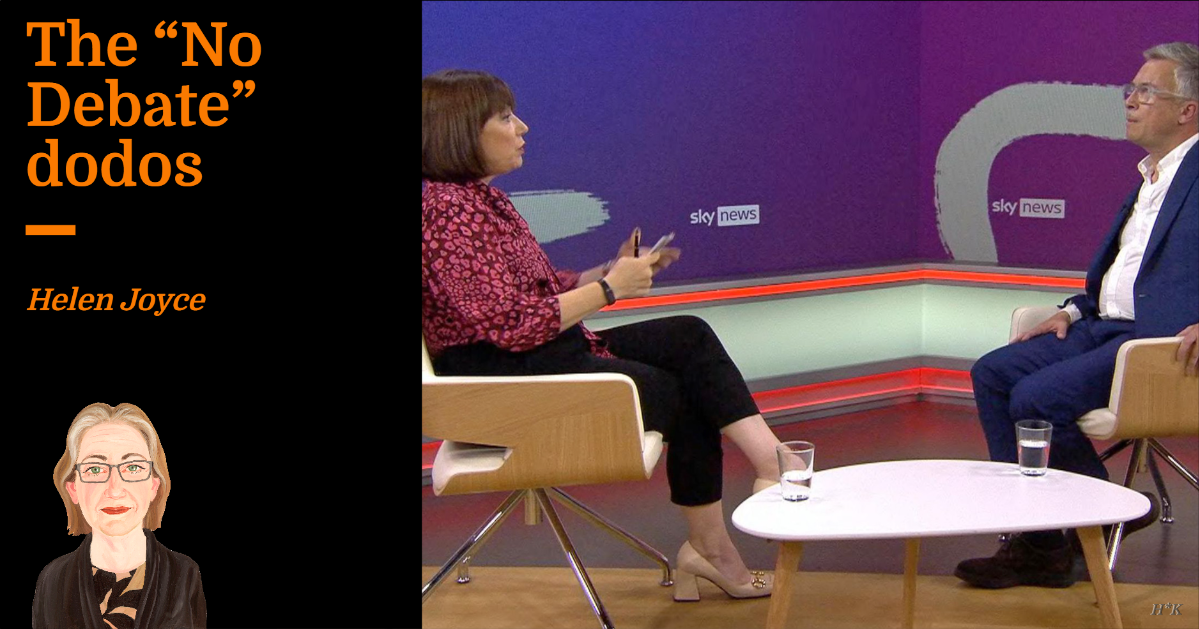
Consider Iain Anderson’s only big media interview during his short stint as CEO of Stonewall, with Beth Rigby on Sky News. She asked sensible questions; he responded with nonsense and whataboutery that presumably played well in Stonewall’s boardroom.
His staff should have helped him prepare by brainstorming hostile questions so he could hone convincing rebuttals and counter-arguments. But no one capable can last long in an organisation where saying “hang on, normies think that sounds insane” is a fast track to being fired.
Anderson could have turned down the interview — and, afterwards, surely wished he had. By the time Rigby was done with him, he looked like a hamster caught in the headlights. But No Debate is a much less appealing tactic when it means the debate happens without you, rather than not at all.
No doubt some No Debaters have noticed their skills need work. But high performance takes training and competition. Some positions are too stupid to defend convincingly against sustained opposition.
◉ ◉ ◉
That leaves fighting dirty. Expect the ad hominem attacks to get nastier and for physical ones to become more common. Bash Back, a “trans-led direct action group” formed last year, has smashed windows at a venue hosting a feminist conference; graffitied the constituency office of the health secretary, Wes Streeting, and hacked the website of the Free Speech Union.
It leaves bullshit, as philosopher Harry Frankfurt dubbed discourse that doesn’t even reach the status of being lies. Bullshitters don’t care whether what they say is true or false; they aim not to defeat their opponents’ arguments fair and square but to obfuscate and confuse.
The ideal response to bullshitters is that of Robert May, a former president of the Royal Society, when declining to debate an obscure creationist: “That would look great on your CV, not so good on mine.” But those of us who have clamoured to gain a platform can hardly try that, at least not yet. Gender bullshit made greater inroads than creationism ever did in educational and legacy media institutions; it requires debunking rather than ignoring.
Debating bullshitters isn’t a matter of changing their minds — their lack of concern with truth and falsehood means that they don’t have minds capable of change. What matters is convincing the audience — and demonstrating that you are trustworthy and the bullshitter is not.
Revealing that the gender bullshitters are speaking in bad faith will be less about correcting their nonsense and more about demonstrating that they don’t care that it is nonsense. Once that is obvious, debate becomes unnecessary.