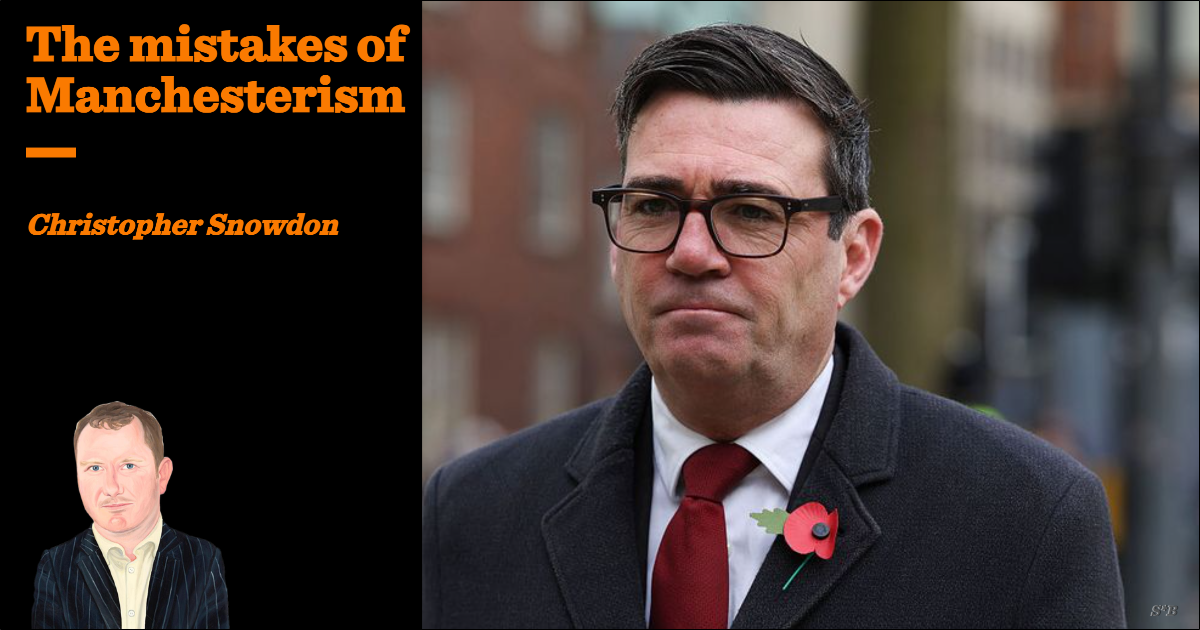

Andy Burnham has repeated his criticism that the government is “in hock to the bond markets”. The last time he did this, yields on ten year bonds spiked by five basis points. If the markets reacted more calmly yesterday it is because lenders are taking his barely concealed leadership ambitions less seriously than they did in September.
Perhaps they shouldn’t. Among the Labour faithful, Burnham inspires the same blind optimism as an unused England substitute in the last fifteen minutes of a disappointing World Cup tie. He is their Jack Grealish, their Joe Cole, the man who can single-handedly turn things around with a moment of brilliance. The difference is that Jack Grealish is good at football and popular with the public whereas Burnham’s abilities are less proven and his appeal is more select. Among Labour members, he is the second most popular politician in the land, with a net approval rating of +54. Among members who voted for Rebecca Long-Bailey in the 2020 leadership election, he is almost universally admired, with a net approval rating of +93. Admittedly, Long-Bailey lost that election and hasn’t been seen since. Admittedly, the only politician who is more popular than Burnham among Labour members is the man who lost them the 2015 election, Ed Miliband. Admittedly, Burnham isn’t an MP and finding a safe seat to parachute him into won’t be easy. But the point is that these Labour members may well decide who the next Prime Minister is and Andy Burnham has been out of the starting line up for long enough for the faithful to build him up in their imagination.
One reason for his popularity on the left is that he says things like “we find ourselves stuck in a rut and in hock to the bond markets”. On the face of it, this is a statement of the bleeding obvious. To be “in hock” is to owe money. The government owes a vast amount of money to the bond markets, and the national debt continues to grow. The OBR expects public borrowing in 2025/26 to be £138 billion (somewhat optimistically, given that we had already borrowed £132 billion by November).
But Burnham’s comment is not just an observation. It is clearly a criticism, with the obvious implication being that the government should not be borrowing money and that it should pay off the country’s £3 trillion national debt. This is a tall order indeed. Unlike the village idiots in the Green Party, Burnham does not think we should default on the debt or print £3 trillion to pay it off, so what is his plan? When I asked him for some details, the King of the North pointed me towards the text of his speech in which he espouses “Manchesterism” as the solution to Britain’s woes. In it, he boasts once again that Greater Manchester has the “fastest growing economy in the UK” and says that “Manchesterism seeks to roll back the 1980s and take more local public control over the essential drivers of the economy, such as housing, utilities, transport and education.”
In practice, this has meant introducing an “overnight visitor levy” (tourist tax), taking the buses into public ownership and building more council houses, none of which are likely to put a rocket under the economy. But he is going further. As part of what he calls “business-friendly socialism”, he has picked five parts of the region to host five “industrial clusters of growing global significance”: creative, digital and tech, life sciences, “sustainable materials” and green energy.
This is quite explicitly an industrial strategy and there is nothing new about those. Economists have long criticised industrial strategies for misallocating resources, crowding out private investment, picking losers, and forcing taxpayers to bail out industries that are only kept on life support for political reasons. It is far too early to say whether Burnham’s clusters will succeed or fail. The question is how Manchesterism is going to stop us being in hock to the bond markets.
Burnham does not give us the price tag for his industrial strategy but there is clearly a lot of money involved and most of it seems to be coming from the government. He mentions that a new liquid air energy storage plant is being built with £300 million, most of which is coming from the National Wealth Fund. A further £400 million for housing and other building projects is coming from the Greater Manchester’s Good Growth Fund, a £1 billion pot of money created from government grants, borrowing, and the Greater Manchester Pension Fund. Burnham says that this £1 billion investment fund will “unlock” £3 billion of private investment. Maybe it will, maybe it won’t, but he seems happy to be “in hock” to a lot of people in the meantime. Manchester City Council is one of the most indebted in the country. It borrowed £289 million in 2024/25 and it owes £1.6 billion to creditors.
He views a state-funded infrastructure project in the same way as some people on the right view a tax cut
Burnham’s argument seems to be that the UK is addicted to borrowing because its economy won’t grow. There is a lot of truth in that, although its addiction to spending should not be overlooked. The claim that Manchester is the fastest growing part of the UK has been contested, but Burnham should be commended for his focus on growth. The problem is that he sees market failures everywhere and, like all industrial strategists, thinks he has found tremendous business opportunities that the brightest minds in the private sector have failed to spot. And it is always borrowing today, jam tomorrow.
He views a state-funded infrastructure project in the same way as some people on the right view a tax cut, as something that will not just stimulate economic activity but pay for itself. Multiplier effects do exist and some infrastructure projects can boost growth to such an extent that they can be viewed as genuine investments; the Panama Canal, for example. Similarly, the Laffer Curve is real and there are examples of tax revenue rising as a result of tax rates falling. Just look at corporation tax in Ireland. But these examples are rarer than their advocates like to believe and, if built on rising public debt, they are seldom sustainable. A growing economy can afford lower taxes and more public works, but they should be seen as the reward for economic growth, not the catalyst for it. On both the left and right, there is a belief in a perpetual motion machine that can turn £100 billion of borrowing into £100 billion of tax revenue. This is, by and large, a delusion. Manchesterism is being built on borrowed money and when the music stops it will still be “in hock”.