The French Riviera is famed for its sunny, year–round climate, azure waters and luxury resorts – but it’ll be hit by a tsunami in the next 30 years, scientists predict.
Experts say there is a ‘100 per cent’ chance a great wave will form in the Mediterranean Sea in the next few decades.
The tsunami could hit France‘s southern coastline in as little as 10 minutes from the trigger, causing chaos for tens of thousands of people who flock there during the summer months.
While the country does have a national tsunami alert system, this only covers waves caused by distant earthquakes.
That means more local triggers, such as underwater landslides, could go undetected until it is too late, they said.
And while evacuation plans are in place, regular drills should be carried out to make sure people know how to get to safety.
‘The Nice – Côte d’Azur metropolitan area is vulnerable for a number of reasons: dense urbanisation, strong tourist appeal, and very busy beaches,’ Frédéric Leone, from the University of Montpellier Paul Valéry, wrote on The Conversation.
‘Our photo analysis and modelling work have enabled us to estimate that tens of thousands of people are present in the area to be evacuated during periods of high visitor numbers – between 10,000 and 87,000 people on the beaches, depending on the season and time of day.’
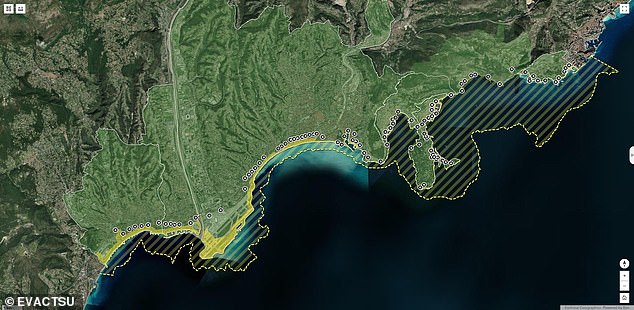
Experts say there is a ‘100 per cent’ chance of a tsunami forming in the Mediterranean Sea in the next few decades. Pictured: A map showing evacuation zones along the French Riviera
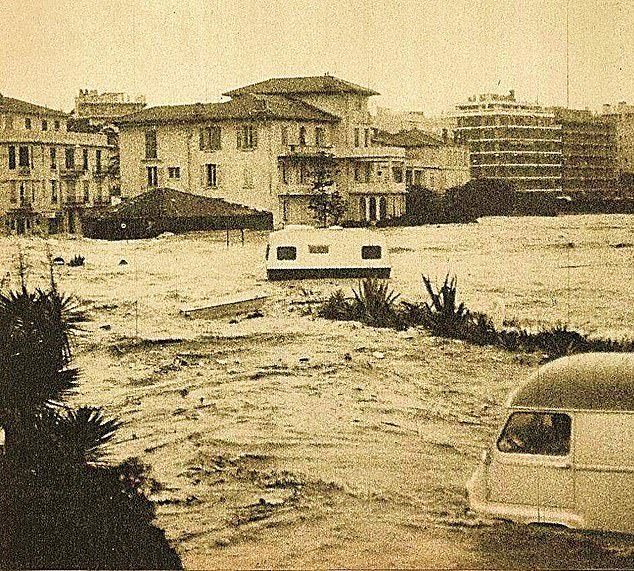
A tsunami in Nice in 1979, caused by the underwater collapse of part of a construction site, caused the deaths of eight people and significant damage
Since 1970, tsunamis have claimed more than 250,000 lives worldwide.
The natural phenomenon has long been associated with the Pacific and the Indian ocean, with risks in the Mediterranean considered marginal.
However, UNESCO have announced that statistics show there will certainly be a tsunami – measuring at least one metre (3.28ft) high – occurring in the Mediterranean Sea in the next 30 years.
France’s current alert system makes it possible to detect tsunami–generating earthquakes and transmit an alert in less than 15 minutes to authorities, who then disseminate warning messages to local people.
‘However, this global system only covers tsunamis caused by distant earthquakes and is not very effective in the case of local tsunamis or those caused by underwater landslides, where the time it takes for the tsunami to reach the coast may be less than the warning time,’ Professor Leone said.
‘This is why it is important to raise awareness among coastal populations about detecting warning signs – earthquakes and abnormal sea movements. Most often seawater retreats preceding the run–up of the tsunami, but not always.’
Along the entire French Mediterranean coastline, an evacuation zone has been set up to indicate which areas need to be abandoned in the event of an emergency.
This includes coastal areas with an altitude of less than five metres (16.4ft) that are less than 200 metres (650ft) from the sea.
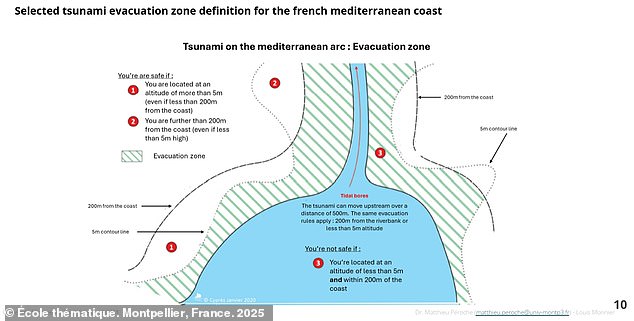
Authorities say people should be safe in the event of a tsunami if they are located at an altitude of more than five metres
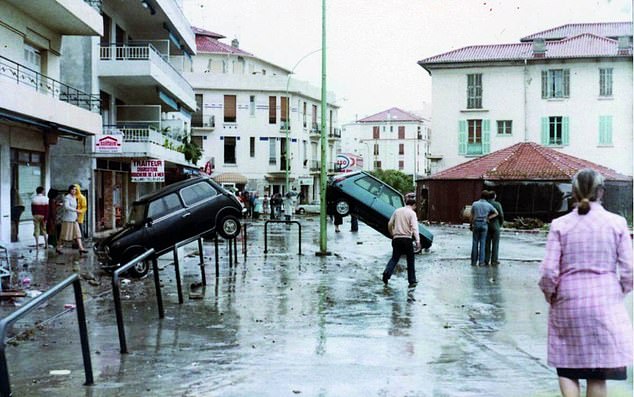
According to available data, around 20 incidences of tsunamis have been reported along the French Riviera between the 16th century and the early 2000s. Pictured: Damage in Nice following a tsunami in 1979
In Nice, nearly 100 refuge sites located out of waves’ reach have been identified by local authorities, along with evacuation routes devised using algorithms to find the fastest way to reach them.
There is also a publicly–available online platform with interactive maps which allows people to find their nearest evacuation zone.
But raising tsunami awareness should go beyond evacuation mapping, according to Professor Leone.
It should also include safety drills such as evacuation exercises, particularly in schools, and the gradual introduction of public warning signage, he said.
‘When facing a wave that can arrive in a matter of minutes, being prepared to evacuate undoubtedly makes all the difference,’ he added.
According to available data, around 20 incidences of tsunamis have been reported along the French Riviera between the 16th century and the early 2000s – with waves often exceeding two metres (6.5ft).
In 1887, an underwater earthquake in the Ligurian Sea triggered a sudden retreat of the shoreline, leaving fishing boats high and dry, before the arrival of a wave reaching nearly two metres (6.5ft).
Meanwhile a tsunami in Nice in 1979, caused by the underwater collapse of part of a construction site, caused the deaths of eight people and significant damage in Antibes, Cannes and Nice.
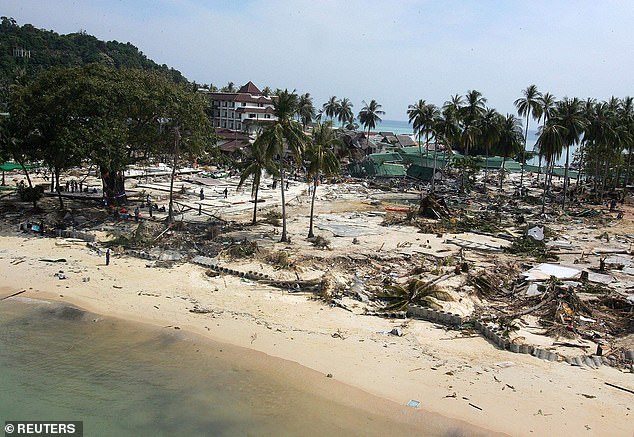
Since 1970, tsunamis have claimed more than 250,000 lives worldwide, notably the Boxing Day tsunami in 2004. Pictured: An aerial view of Thailand’s Phi Phi island after the devastation
‘These events are a reminder of how we are completely taken by surprise, and how such short spaces of time show the limits of traditional warning systems,’ Professor Leone said.
‘Coastal communities’ ability to evacuate quickly becomes crucial.’
Some of the most common tsunami warning signs include strong or long–lasting ground shaking, a loud ocean roar and a sudden rise or fall in water levels along the coast.
Experts recommend getting to higher ground immediately. If there is no hill nearby, then they suggest getting to the highest floor of a sturdy building.
WHAT CAUSES TSUNAMIS?
A tsunami, sometimes called a tidal wave or a seismic sea wave, is a series of giant waves that are created by a disturbance in the ocean.
The disturbance could be a landslide, a volcanic eruption, an earthquake or a meteorite; the culprit is most often an earthquake.
If the landslide or earthquake triggering the tsunami occurs nearby the shore, inhabitants could see its effects almost immediately.
The first wave of the tsunami can arrive within minutes, before a government or other institution has time to issue a warning.
Areas that are closer to sea level have a higher risk of being affected by the waves.
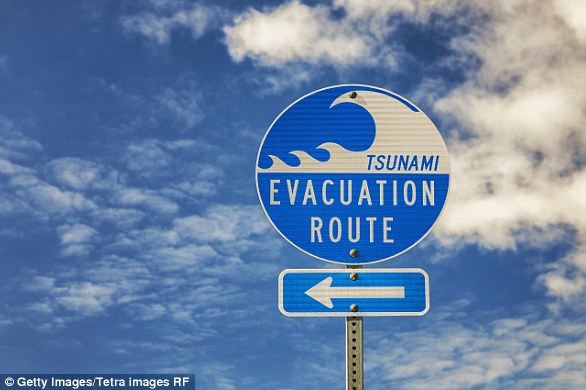
Researchers have found that a layer of the remains of microscopic organisms at the bottom of the ocean can cause tsunamis (file photo)
Those less than 25 feet from sea level are the most dangerous.
The cause of death most frequently associated with tsunamis is drowning. Additional hazards include drinking water contamination, fires and flooding.
Initial tsunami warnings are usually based on seismic information only.
Inhabitants of coastal areas that might be exposed to a tsunami are encouraged to follow evacuation routes in the event that they receive a tsunami warning.
They should seek higher ground or move inland immediately to get away from the ocean.