This article is taken from the March 2026 issue of The Critic. To get the full magazine why not subscribe? Get five issues for just £25.
Judicial retirements, like buses, come in groups of three or more. Passed over for the lady chief justiceship, Dame Victoria Sharp has announced her retirement from the presidency of the King’s Bench Division, whilst Sir Geoffrey Vos will give up the mastership of the rolls.
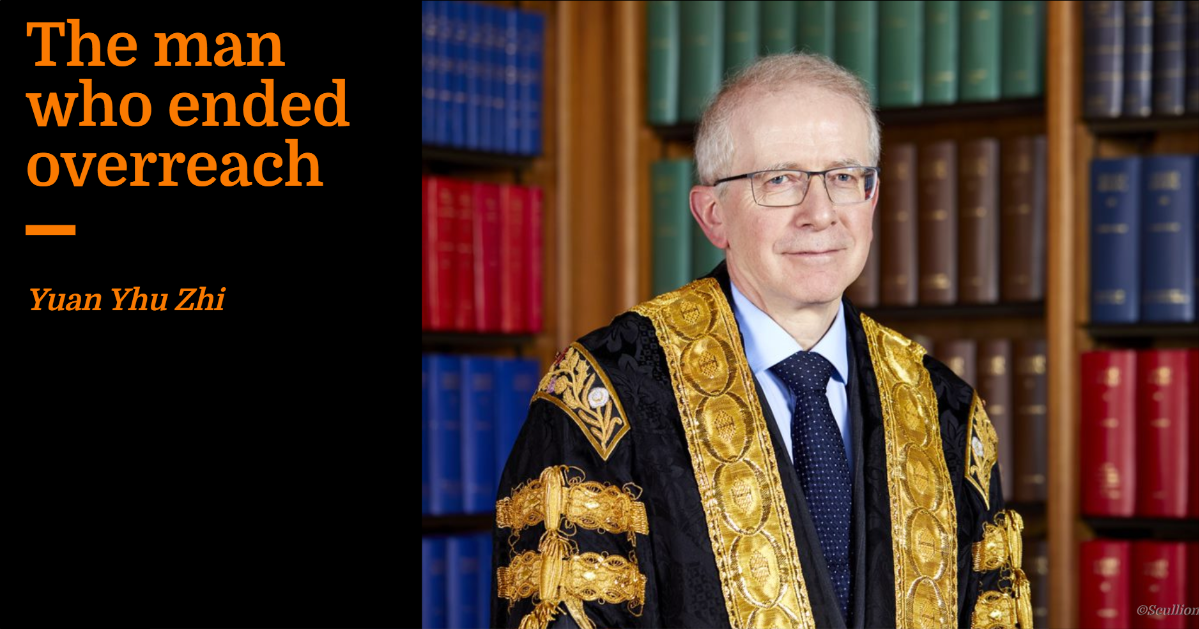
But it is Lord Reed of Allermuir’s retirement as president of the Supreme Court of the United Kingdom that will signal the end of a small epoch.
The son of a civil servant, Robert John Reed’s CV was conventionally distinguished: dux at George Watson’s College, a First at the University of Edinburgh, and a DPhil at Balliol College, Oxford, with a thesis on “Legal Control of Government Assistance to Industry”.
Reed hesitated as to his future career after Oxford, but Alan Rodger, who had followed the same path to England, albeit from Glasgow instead of Edinburgh, snatched him for Scotland and took him on as his pupil.
Admitted to the Scottish Bar in 1983, Reed did the usual diet of cases but had a propensity for public law and commercial law. He even ventured to the insalubrious Strasbourg (where he later sat) and The Hague. He was appointed a Queen’s Counsel in 1995.
After two years in the Crown Office, Reed was tapped on the shoulder in 1998 and became Lord Reed at the young age of 41, modestly noting that his appointment “raised some eyebrows”. In fact, he was the youngest senator of the College of Justice since 1811; when David Boyle, Spencer Perceval’s solicitor-general for Scotland, was appointed at the positively cherubic age of 38.
Known for his good writing, Reed was promoted to the Inner House and sworn of the Privy Council in 2008. He sat in the Supreme Court during Lord Rodger of Earlsferry’s illness and replaced him in 2012.
In 2020, Reed became president of the Supreme Court, the post whose predecessor post was first held by his almost-namesake Lord Reid, with whom he will be confused by law students as long as there are law school assignments.
The average man on the number 88 to Clapham would not recognise him
Less exuberant than his predecessor Baroness Hale of Richmond (which must be part of the reason he got the nod), Reed nonetheless gave regular interviews, but the average man on the number 88 to Clapham would not have recognised him. His ties do not rival those of Lord Sumption, and he does not wear brooches.
A small-c conservative in his judicial approach, Reed has been credited by academics with pushing back against the judge-driven expansion of the law of unjust enrichment; but it is really in public law that he made his mark — or some would say, his lack thereof.
Reed was involved in both Miller cases during Brexit; in Miller I he dissented from the majority’s opinion that legislation was needed in order to trigger Article 50. In Miller II he wrote the court’s decision with Hale (who remarked that it is easy to spot who wrote what).
As president, Lord Reed was not exactly shy to find against the government in public law litigation. In R (UNISON) v Lord Chancellor he found that the Lord Chancellor’s tribunal fees for employment tribunals were high enough to be a denial of the rule of law; whilst in R (AAA) v Home Secretary he found the Rwanda policy to be illegal.
But in R (Elan-Cane) v Home Secretary, Reed pushed back against the gold-plating of Strasbourg decisions. In R (Begum) v Home Secretary (what a popular minister), Reed deferred to the decision to ban Shamima Begum from coming back to the UK after her jaunt with ISIS. To those public law academics who had been used to the expansionist approach of the Hale years, when no theory of judicial power was too wild to entertain, the Reed years were ghastly.
In the words of the late Conor Gearty, Reed’s court (a detestable development in recent years has been the naming of eras of the Supreme Court after the president) is “backward-looking … [i]t has reverted to an approach rooted in legal formalism, extremely narrow reading of the rule of law, whilst displaying an old-school lack of interest in the lived experiences of those whose plights have brought them to the judges’ attention”. One of the many charges Professor Gearty levied against Lord Reed was that Miss Begum would find his judgment very hard to follow.
I suspect Gearty’s verdict will remain in the books: law professors love to write about individual judges who disrupt the law. They are more interesting than the incrementalists who merely trim at the edges.
But for those of us who value the stability of the law and the primacy of democratic institutions over legal philosopher kings, Lord Reed will endure as the man who (gently) ended a long era of judicial overreach and exuberance. Happy retirement, my lord.