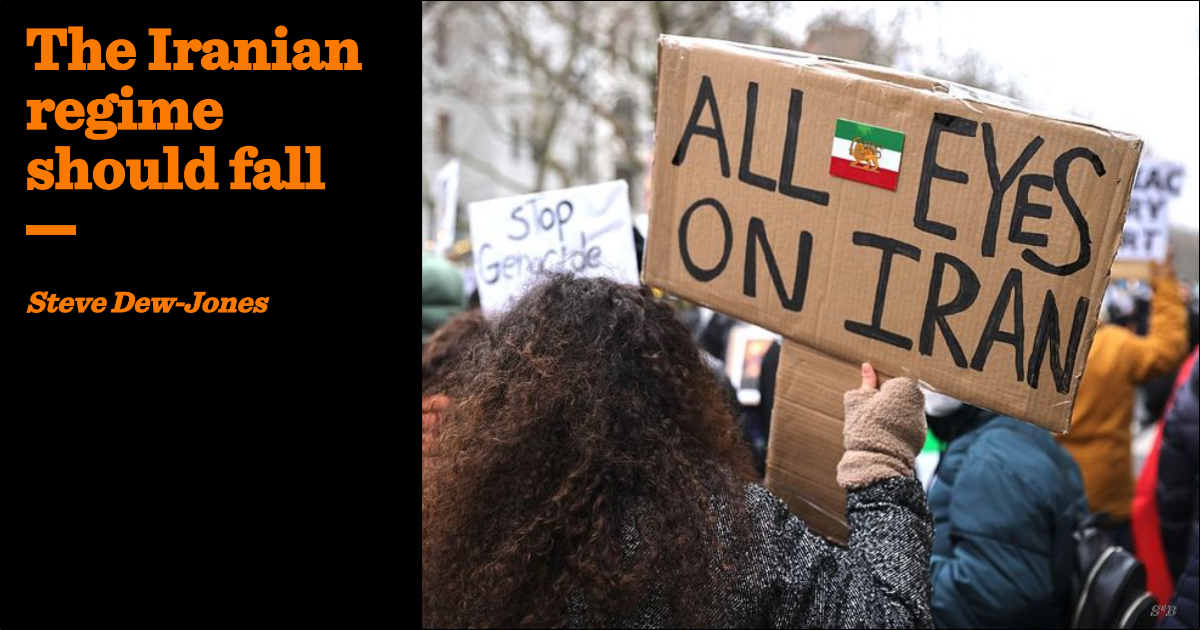
When the Iranian protesters took to the streets on 28 December, the US President had a simple message for their leaders: if they started killing people, there would be consequences.
The true scale of the killings that have taken place since may not be known for some time, but credible reports suggest a death toll already in the tens of thousands.
It should therefore have come as no surprise when the United States ordered an armada to travel to the region. According to reports, an aircraft carrier and several missile-guided destroyers are now within striking distance. The only question is precisely what Donald Trump plans to do with them. Did the American president mean what he said when he promised consequences should the Islamic Republic murder its citizens again? And if he did, what exactly would that look like?
Away from Washington, the collective response of the non-American West to the worst massacre of Iranians in modern times has been limited to a few more sanctions; the long-overdue designation by the EU (but still not the UK) of the Islamic Revolutionary Guards Corps (IRGC) as a terrorist entity; and the convening of a special session at the UN on the “deteriorating human rights situation” in Iran.
All of which is to say that there has been a fair bit of talk, but not a lot of concrete action of the sort that may have been anticipated by Iranians when they took to the streets in the wake of promises by America that they would not be left alone.
And yet, alone they most surely have been ever since the Internet was cut off on 8 January and the killings began. Indeed, the closest anyone has come to action is Donald Trump and his armada. The United States was conspicuous by its absence at the UN special session last week, in line with Trump’s general approach to the UN, but there were no shortage of references – tacit or otherwise — to the United States and its perceived intentions, with calls for “restraint” and “de-escalation”.
The UN Human Rights Commissioner, Volker Turk, championed “dialogue” as the only way forward — a message echoed by many a member state. Others focused on justice and accountability, including by renewing and strengthening the mandate of the UN Fact-Finding Mission set up in the wake of the last mass killing of Iranian protesters (2022). But while such a step will certainly aid the pursuit of future accountability, it will be futile if the regime stays in place. It is for freedom now — today — that Iranians have shed their blood.
Some commentators have called for a stronger response, such as targeted military strikes on IRGC command structures. Among them is Labour MP David Taylor, who wrote: “The only thing that will stop the regime from killing its own citizens is targeted military action to degrade its repressive capacity.”
While some might flinch at the prospect of involvement in, or support for, military action, it should be noted that the UN permits such intervention in the event a state is “either unwilling or unable to fulfil its responsibility to protect [its citizens], or is itself the actual perpetrator of crimes or atrocities”. This comes from the 2005 agreement on the “Responsibility to Protect”, which includes potential use of force as a last resort.
The question of whether we have reached “last resort” territory may be up for debate, but it is clear that the Islamic Republic is transgressing against its citizens more than it is protecting them. As such, the responsibility of protection falls upon other states. The only question is what form such protection should take.
Will we once again continue to attempt to “dialogue” our way forwards, in the vague hope that truth, justice and accountability will follow in due course? Will we increase the pressure on the regime in other ways — through further sanctions, for example — and cross our fingers in the hope that the system will collapse in on itself before too long? Or, if we decide that the regime must be removed, will we increase this pressure with direct intervention?
A direct response need not involve an all-out invasion. For example, Robert Satloff of the Washington Institute has made the case for “shutting down the communication system employed by the regime”, undermining its national crackdown. A kinetic attack, if it is necessary, could involve targeted yet sustained attacks on IRGC barracks and facilities — weakening its effectiveness in projecting power externally and internally.
Some have said they fear another Iraq, Libya or Afghanistan should we intervene militarily, while others have asked: can we really be sure that what will replace the Islamic Republic will be better? The fear is understandable. That said, it is worth observing that Iranians are far less religiously divided than Iraq, with the vast majority of Shia origin, leaving less space for sectarian conflict. Iranians have also become more secular, with a 2020 study by the Netherlands-based Gamaan Institute finding that most Iranians do not believe that religion should determine the policies of the state.
Alas, the trouble is that the Iranian people do not currently have the power to control their future
Some member states at the UN last week were at pains to argue that the Iranian people should be the ones to decide their future, not us, and I couldn’t agree more. In fact, that is precisely what they were attempting to do when they took to the streets — yet again — on 28 December, in protests that may have been sparked by economic concerns but soon led to an uprising on a scale not seen in half a century and calls for the death of the dictator and his regime.
Alas, the trouble is that the Iranian people do not currently have the power to control their future. As a result, many of them are asking us to help change the balance of power.
The question is: how will we respond?