Older people will start to see increases in their state pension from Monday 6 April, in the first full week of the new tax year onwards.
The annual rise will not kick in all at once for everyone, because the state pension is paid four weeks in arrears and people receive it on different days of the week.
The headline state pension rates will be hiked by 4.8 per cent under the ‘triple lock’.
This is the popular government guarantee, which means the state pension is increased every year by whichever is the highest of inflation , average earnings growth or 2.5 per cent.
This year earnings growth won out in the crunch month of last year that determined the annual increase. See our guide to the triple lock for full details of how it works.
Pensioners should bear in mind though that not all elements of the state pension are increased according to the triple lock.
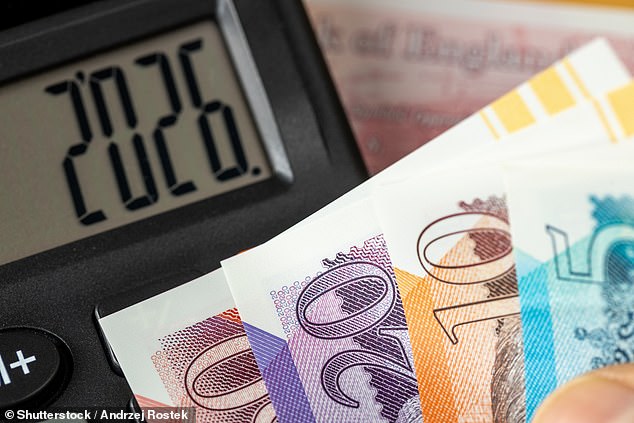
State pension rise: Payments are made four weeks in arrears and people receive them on different days of the week
Various key parts of it, which may or may not come into play depending on your age, marital status, National Insurance record and whether you deferred your state pension, will be increased in line with CPI inflation instead.
This was 3.8 per cent in the relevant month that decided annual rises last year.
Meanwhile, the state pension age is going to start to rise from 66 to 67 from April, which will affect all new pensioners.
The change will be phased in, so there will be periods when the state pension age is 66 years and between one and 11 months.
A month will be added on to the state pension age every two months from April 2026 onwards until 2028 when everyone will reach pension age at 67.
So, for those who now qualify how much will you receive and when will you get it? We explain the different elements so you can work out what you will be due from 6 April onwards.
If you are already drawing a state pension you will know which weekday it arrives, but if you are not yet doing so you can look up your National Insurance number and check the table above.
To find out your state pension rise, check the two headline rates for pre and post-April 2016 listed here first, then look at which other elements might affect you.
New state pension: The full flat rate for people who reached state pension age from April 2016 onwards is going to rise 4.8 per cent from £230.25 to £241.40 a week.
That is a £575 annual rise to £12,548.
To get this amount, as well as being the required age of 66 – or slightly older if your 66th birthday is pending – you must have made National Insurance contributions during your working life, or have bought voluntary NI top-ups , or received credits from the government for years spent caring or other reasons.
Until April 2016, workers needed to have 30 years of qualifying National Insurance contributions to get the full basic state pension, but everyone retiring since then typically needs 35 years of contributions to get the new flat rate state pension.
However, even if you paid in full for a whole 35 years or more, if you contracted out of paying additional state pension entitlements – S2P and Serps – for some years on top of that it might still reduce what you get.
You need a minimum of 10 qualifying years to receive any state pension.
Basic rate state pension: The amount for people who reached state pension age from April 2016 will rise 4.8 per cent from £176.45 to £184.90 a week.
Many people on the basic rate also get hefty top-ups, called additional state pension, S2P or Serps – but only if those were earned earlier in life by paying extra salary-related National Insurance contributions.
Additional, Serps or State Second Pension: This element of the state pension will rise according to inflation at 3.8 per cent from April.
Protected Payment: If you reached state pension age after April 2016, but had already built up enough additional state pension, S2P or Serps to qualify for more than the headline flat rate earlier in your working life, you will receive the difference between the two on top.
This ‘protected’ portion of your state pension, over and above the flat rate, will increase by 3.8 per cent.
Deferred new state pension: Many people put off their start date in exchange for higher payments later in retirement – read our guide to whether deferring your state pension might be worth it.
The extra sum you get for having deferred will rise by 3.8 per cent.
Inherited old state pension: Some widowed spouses and civil partners can inherit state pension.
It depends on when the surviving partner reaches or has passed state pension age and their spouse’s date of birth and National Insurance record. Read our guide to inheriting state pension.
If you have inherited a portion of a spouse or civil partner’s state pension since April 2016, this will increase by 3.8 per cent.
But if you inherited their basic state pension dating from before 2016, it will go up by 4.8 per cent.
Married women’s rate: Spouses, usually women, who retired on small state pensions before April 2016 get an uplift to 60 per cent of their partner’s basic state pension payments once they reach retirement age too.
This is known as the ‘category B’ state pension, and it will rise 4.8 per cent from £105.70 to £110.75 in April.
Over-80s state pension: People who are 80 or over and resident in the UK get a ‘category D’ state pension. This will rise 4.8 per cent to £110.77 in April.
If you are already on more than that, it isn’t paid extra on top. The over-80s additional payment is frozen again at 25p.
Graduated Retirement Benefit: This was the forerunner to Additional, Serps or State Second Pension, and it ran from 1961 to 1975. If your state pension includes any GRB, this part of your payment will rise by 3.8 per cent.
Christmas bonus: Frozen again at £10.
The Government has full details of state pension increases for 2026-27 here.
SIPPS: INVEST TO BUILD YOUR PENSION
AJ Bell
AJ Bell
0.25% account fee. Full range of investments

Hargreaves Lansdown
Hargreaves Lansdown
Free fund dealing, 40% off account fees

Interactive Investor
Interactive Investor
From £5.99 per month, £100 of free trades

InvestEngine
InvestEngine
Fee-free ETF investing, £100 welcome bonus

Prosper
Prosper
No account fee and 30 ETF fees refunded
Affiliate links: If you take out a product This is Money may earn a commission. These deals are chosen by our editorial team, as we think they are worth highlighting. This does not affect our editorial independence.