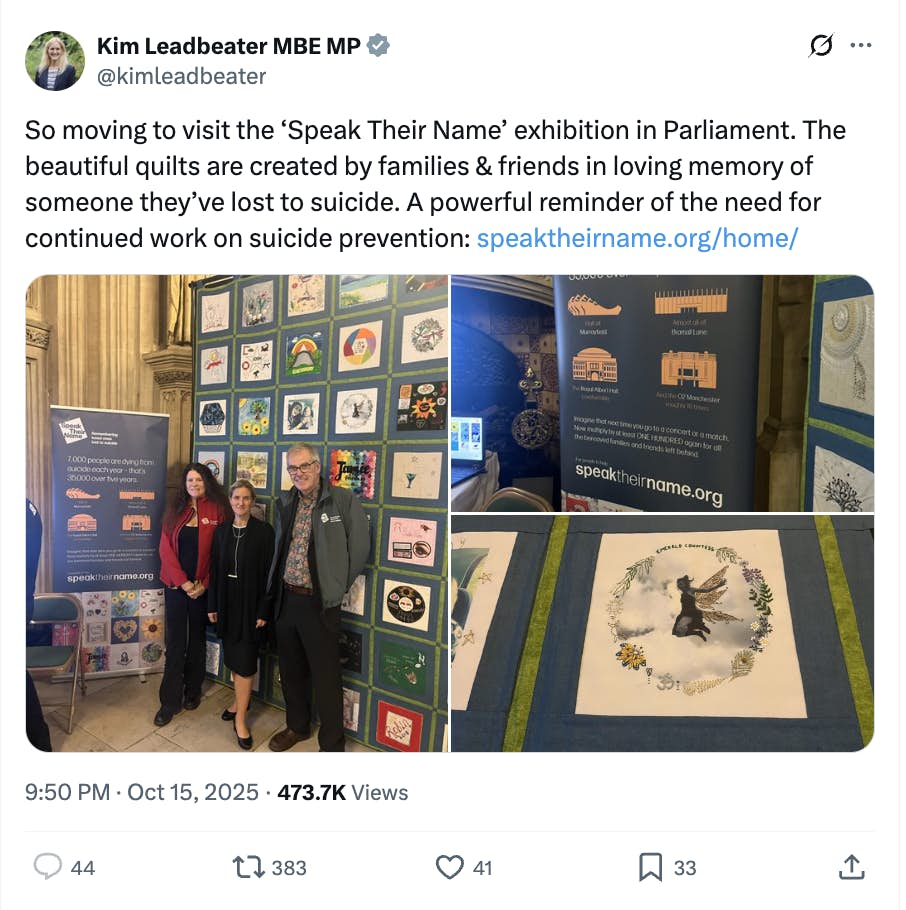
Kim Leadbeater, Member of Parliament for Spen Valley, shared on X yesterday that she visited the “Speak Their Name” exhibition in Parliament. The exhibition, which Leadbeater described as “[s]o moving”, consists of quilts made by loved ones in memory of individuals who have lost their lives as a result of suicide. The charity responsible for the exhibition, Speak Their Name, states that their “purpose is to help people in the UK who are bereaved by suicide.”
Leadbeater highlighted that this important exhibition exists as a “powerful reminder of the need for continued work on suicide prevention.” The issue, however, is that Kim Leadbeater is a staunch supporter of the principle of assisted suicide and introduced the Terminally Ill Adults (End of Life) Bill into the House of Commons as a Private Member’s Bill at the end of last year.
This Bill, which last month concluded its Second Reading in the House of Lords, would seek to legalise assisted suicide in England and Wales for those with a prognosis of six months or less. 67 per cent of Peers who spoke during the Bill’s Second Reading did so in opposition to the Bill, and so the proposed legislation will undergo additional scrutiny through a dedicated select committee, delaying the formal Committee Stage until this has been completed.
The Government’s lead advisor on suicide has highlighted how legalising it undermines suicide prevention as a whole
Kim Leadbeater appears to believe that both that suicide prevention is a good and worthy cause and also that suicide should be actively facilitated and thereby encouraged by the state for those who are believed to be nearing the end of their lives. It is morally nonsensical to advocate for greater support for suicide prevention while simultaneously spearheading the campaign to legislate for suicide to be provided by the National Health Service on behalf of the state.
In the unfortunate instances when someone feels as if their only remaining option is to end their own life, there is no distinction in the definition of suicide that such an act only constitutes suicide if it is done outside the remit of legislation. Suicide is the intentional ending of one’s own life; whether the state condones this or not is irrelevant.
Many people were quick to point out Kim Leadbeater’s cognitive dissonance on this issue. Dan Hitchens, senior editor of First Things, points out that “banning assisted suicide is a form of suicide prevention”, based on research from the US that suggests there is a causal relationship between legalising assisted suicide and an increase in non-assisted suicide. Others, such as Conservative MP Neil O’Brien and GB News presenter Patrick Christys also drew attention to her double standard.
The Government’s lead advisor on suicide prevention, Professor Sir Louis Appleby, has highlighted how legalising assisted suicide undermines suicide prevention as a whole, as the main goal of the Government’s mental health services is to prevent people from taking their own lives. Such services simply cannot be squared with a Government whose laws simultaneously encourage the provision of suicide to others.
In Oregon, where assisted suicide is already legal, Professor Mark Komrad, an American psychiatrist on the clinical and teaching staff of the Johns Hopkins Hospital in Baltimore, said the legalisation of assisted suicide removed the societal taboo on suicide, subsequently increasing suicide rates.
“There’s a great worry that by creating these two different tiers of suicide”, he said, “we are removing the taboo from suicide. That became increasingly clear [in Oregon]”.
There, in the most recent year for which data is available, 42 per cent of all people who ended their lives by assisted suicide cited feeling like a burden as one of their end-of-life concerns. In Canada, this is 45 per cent, and 59 per cent in Washington State. Is this really something we want to encourage in the United Kingdom?
Suicide prevention is an important issue, and one which the Government and the NHS rightly dedicate a great deal of time and resources towards. For the Member of Parliament who has spearheaded the campaign to undermine these efforts by introducing assisted suicide in England and Wales to promote the good work of a suicide prevention charity, is nothing short of hypocrisy. If she truly cared about suicide prevention, she would withdraw her dangerous assisted suicide Bill at once.