The stench of chemicals was overpowering. When 20 armed police officers burst into a flat linked to a Colombian drugs gang, the place was strewn with buckets, bottles and canisters of substances emitting a noxious odour.
‘Officers were shouting that there was a stink of chemicals in there that could be dangerous,’ says Detective Constable Matt Cooper, who was in charge of the operation. ‘At the time, we didn’t know why, but we soon found out.’
It didn’t take long for Cooper and City of London police forensic scientists to discover that they had found Britain’s first Breaking Bad-style laboratory designed to extract cocaine that had been chemically incorporated into a cosmetic product.
In this case it was blocks of orange and eucalyptus-scented wax hair-remover – into which cocaine had been dissolved for smuggling.
The one-bed rental apartment on a tree-lined street in Vauxhall, south London, was packed with dangerous chemicals that could have poisoned the occupants of the other seven flats in the building – or caused it to burst into flames.
Detectives found hydrochloric acid, ethyl acetate, methyl ethyl ketone, calcium chloride, citric acid and other chemicals alongside a large can of petrol – all potentially lethal ingredients that were used to extract cocaine from the wax.
‘This was a respectable street lined with £1million houses and nobody would have had any idea that behind those closed doors was a drugs laboratory – it was incredibly dangerous,’ says Cooper.
Yesterday, the four kingpins of the gang were jailed for a total of 43 years at Inner London Crown Court after pleading guilty to importing and producing cocaine, and conspiring to supplying it.
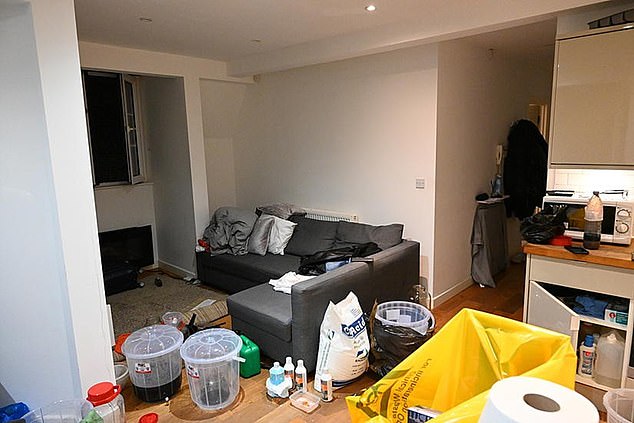
The Vauxhall flat police raided where the drug gang had been operating
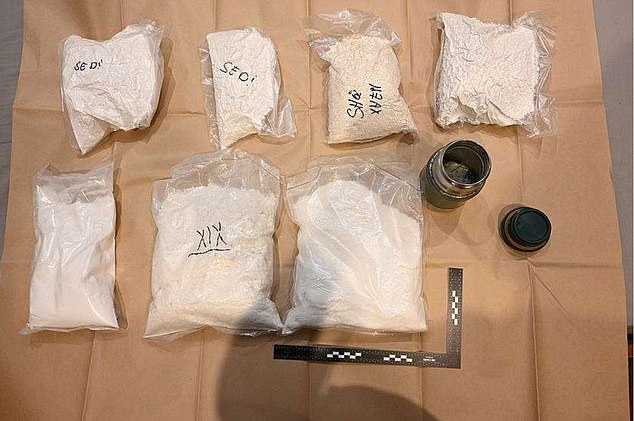
By the time they finished searching the lab in October 2024, City police’s Serious Organised Crime Team had recovered 8lbs (3.51kg) of cocaine with a street value of more than £211,000
Humberto Caicedo Ramirez, 53, from Vauxhall, south London, was sentenced to 13 years and six months in prison. Carlos Barbosa Arias, 61, from Colombia, received eight years. Sebastian Camacho Lopez, 31, also from Vauxhall, was sentenced to six years and seven months in prison.
Jonny Delgado, 49, from Enfield, north London, was also convicted of conspiracy to supply cocaine and the supply of ‘adulterants’ used to bulk out the drugs before being sold on the streets and jailed for 16 years.
By the time they finished searching the lab in October 2024, City police’s Serious Organised Crime Team had recovered 8lbs (3.51kg) of cocaine with a street value of more than £211,000.
They had first been alerted to possible drug activity as part of wider intelligence provided by UK Border Force, but had no idea anything so audacious or dangerous was taking place. The force only raided the flat, on the grounds of public safety, after gang members were seen taking in petrol canisters and other chemical containers.
‘The leaders of the gang, Ramirez and Delgado, were brothers – Delgado changed his name when he arrived in the UK – and in their community they were called “El Flacos”, meaning the skinny ones,’ says Detective Sergeant Dominic Shaw, who has served 15 years in City of London police.
The brothers were known to the law, having been convicted of cocaine offences before. ‘They were each imprisoned for eight years in 2012 after being caught with just over 4lbs (2kg) of cocaine,’ says Shaw. ‘Coincidentally, they were released from prison on the same day, October 13, 2015, Ramirez from HM Prison Ford, and Delgado from HM Prison Wormwood Scrubs.’
The men, it seemed, got straight back to work. By the time they were arrested again, they had a network supplying three standards of cocaine across south London. According to Cooper, they had tailored their business to cater for all income groups.
‘They had a product they described as “normal” at 45 per cent purity, which they sold at £40 a gram, another called “VIP” at 45 per cent, sold at £60 per gram, and “VVIP” at 65 per cent purity for £70 a gram,’ he says. Lab tests established that there was, indeed, more cocaine in the more expensive products.
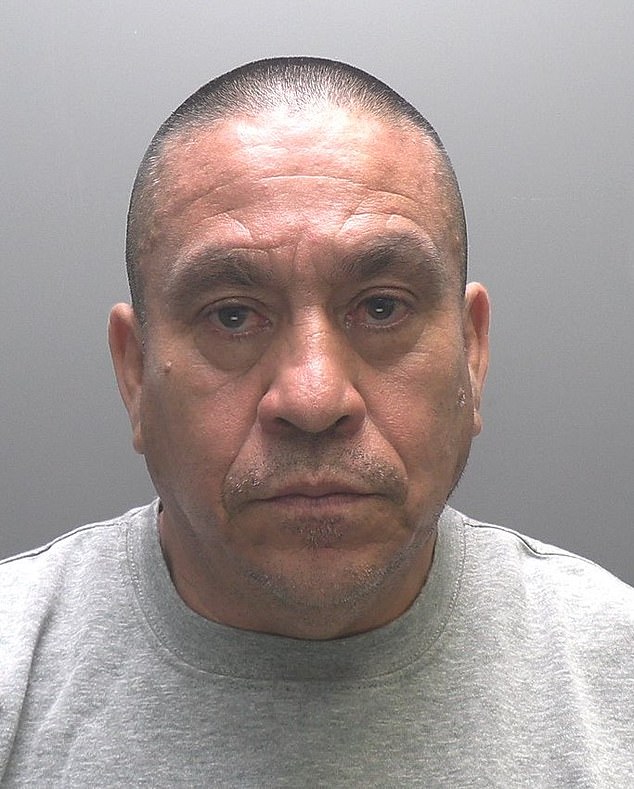
Mugshot of 61-year-old Carlos Barboas, one of the cooks in the drug operation, was sentenced to eight years in prison

Sebastian Camacho Lopez, 31, also from Vauxhall, was sentenced to six years and seven months in prison
Two additional gang members, Arjan Metliaj, 38, of Swanley, Kent, and Alina Telecan, 32, of no fixed address, were thought to focus on bulking, packaging and selling the cocaine.
They had been sentenced at an earlier hearing after pleading guilty. Metliaj was jailed for four years and eight months for possession with intent to supply. Telecan was sentenced to two years and four months.
Detectives don’t know how much of the business was built on the new extraction-from-cosmetics model, or from old-style importation of powdered cocaine, but there is evidence that the Vauxhall operation could have been a trial run.
The size of the consignment thought to have been shipped from Colombia was relatively small – just 120 bars weighing 14lbs (6.8kg) – and, tellingly, the man who acted as the ‘cook’, Arias, had only just arrived from South America.
‘We know he has qualifications in Colombia to deal with chemicals within cosmetics,’ says Cooper. ‘And he had flown in from Colombia less than 24 hours earlier. I believe this could have been the first shipment of its kind, and with a successful yield it could have led to more. We certainly believe that we interrupted a potentially bigger operation.’
What isn’t up for speculation is that the lab was incredibly dangerous.
When officers forced entry, Ramirez and Arias were in the flat. Neither Ramirez in the kitchen, nor Arias in the bathroom, offered any resistance – in fact, Arias was already on the floor with his hands behind his head.
‘They were in a state of undress,’ says Cooper. ‘It wasn’t clear whether that was from the heat or because they were extracting cocaine and it was messy. There was a lot of black liquid in there thought to contain activated charcoal as a filtering system. It did remind me a little of the TV programme Breaking Bad.’
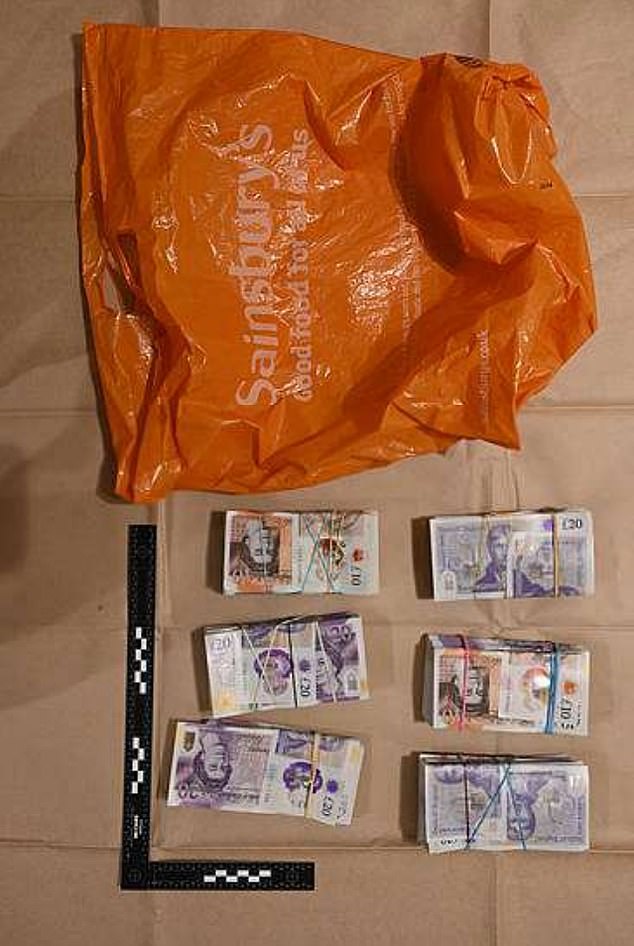
Police image shows wads of cash that were found in during the raid on the flat
I asked Dr Peter Mansi, former London Fire Brigade Borough Commander for the City, and partner at Fire Investigations UK, to analyse the risk from the chemicals found by the Serious Organised Crime Team – his conclusions were terrifying.
Not only was not having proper laboratory-standard ventilation and storage equipment dangerous, but the chemicals themselves represented a ticking time bomb.
He reported that the ethyl acetate could have caught fire easily – from static electricity or a boiler pilot light – at temperatures as low as -4C. It is heavier than air and so can seep under doors and into drains.
The methyl ethyl ketone, meanwhile, is highly flammable, even at -9C and can irritate eyes and lungs, and cause headaches and confusion.
Isopropanol is also highly flammable and in close proximity to petrol, fires can easily start and spread faster. The hydrochloric acid, citric acid and boric acid also cause damage to the body.
‘When these chemicals are kept or used in an uncontrolled environment, the real danger is not just each substance on its own, it is how they can mix with each other and make everything much more volatile,’ says Dr Mansi. ‘Some of the fumes produced are heavy and can sink to the floor or collect in low areas, so a fire can start in a location totally different from where the liquid was sitting and vaporising from.
‘Breathing in a mixture of these vapours can be much more dangerous than breathing in just one, as they can combine to make people lose consciousness, become confused, impairing their judgement, or seriously damage lungs and nervous systems.
‘If involved in a fire, even if the fire originally had nothing to do with the substances, like a kitchen or appliance fire, any of their containers can rupture from increased heat, igniting the substances within the containers and adding to the fuel load that is already burning.’
While the Daily Mail does not want to give away the process for extracting the drug from the wax, in broad terms, the chemicals found in the Vauxhall flat perform the following functions.
Solvents such as petrol are used to first dissolve the wax into a sludge, followed by more substances dissolving the remaining wax and scents, leaving a wet residue of cocaine behind.
Hydrochloric and citric acids, and isopropanol play different roles in turning the oily residue into crystalline powder. Calcium chloride is a drying agent, used to ensure the final cocaine powder is perfectly dry. And boric acid is not used in the process but more likely forms an agent to bulk out the final product.
Although it is the first time this extraction process has been discovered in Britain, there have been other cases worldwide where drugs have been incorporated into wax, soap or even moulded into household products.
In 2024, two women were arrested at Hong Kong International airport after trying to smuggle cocaine in bars of soap.
In 2015, a 91-year-old Australian man arriving in Sydney from India tried to smuggle 10lbs (4.5kg) of cocaine in 27 soap bars. And in 2017, the US Drug Enforcement Administration intercepted a consignment of 1,300lbs (589kg) of wax candles laced with $1million (£750,000) of methamphetamine.
It is thought smugglers are increasingly incorporating drugs into perfumed cosmetics because the cosmetics’ scents interfere with customs dogs’ abilities to sniff out drugs.
A significant and worrying development is the arrival of what is known as the ‘chemical incorporation’ or ‘secondary extraction’ method into the UK.
‘What police appear to have uncovered is not a traditional cocaine “factory”, but something more modern and arguably more dangerous – a chemical recovery lab hidden inside a one-bed rented flat,’ says Tony D’Agostino, a drugs expert who writes about trends in narcotics
‘This is known in Europe as a “secondary extraction” site where cocaine is chemically stripped out of everyday materials used to disguise it during transport.’
In this case, bars of scented wax. It is not a new phenomenon internationally – the European Union Drugs Agency (EUDA) and Europol have reported for several years that organised crime groups are increasingly importing cocaine chemically bonded or embedded in materials such as plastics, charcoal and consumer goods, then recovering it in laboratories in countries including the Netherlands and Spain.
‘What is unusual is the domestic setting. In a confined property, solvent vapours can build up quickly. The real concern is not just the drug trade, but the public safety risk created when industrial-scale chemistry is brought into residential buildings.’
When I broke details of the new drug lab threat to the National Residential Landlords Association (NRLA), it was greeted with consternation. Landlords have already faced growing problems from criminal tenants setting up cannabis farms in rental properties. Such enterprises can result in walls and floors being ripped out, structural damage and wiring being left in a dangerous condition. The added risks of fire and explosion serve only to crank levels of concern to new heights.
‘We’ve had cases where neighbours have told landlords that their tenants were sleeping in tents in the back garden because every inch of their property was being used for growing cannabis plants, so we’re used to criminal activity,’ says Chris Norris, chief policy officer at the NRLA.
‘But the use of a property as a drugs lab sounds absolutely horrific. For the other people living in that building, the consequences of something going wrong could be catastrophic.’
Shaw advises anyone who experiences strange or noxious odours coming from a rental flat to call 999 and ask for the fire brigade. London Fire Brigade have responded to 1,504 incidents involving hazardous chemicals last year alone.
Meanwhile, police and firefighters nationwide are hoping the Vauxhall discovery does not herald a new – and terrifying – front in the war on drugs.
- To get a free exclusive article with new revelations about Britain’s youngest female murderer, sign up to our newsletter HERE and receive it right away
- What kind of cases do you want to read more about? Let us know at: crimedesk@dailymail.co.uk