And the Word was made flesh, and dwelt among us, (and we beheld his glory, the glory as of the only begotten of the Father,) full of grace and truth.
In a vast array of languages and settings, the words of Saint John’s Gospel echo out across Christmas celebrations, the world over. When Saint Augustine contemplated these words before his North African congregation, as they celebrated the Lord’s Nativity in the early 5th century, he exclaimed:
“Truth, holding the world in place, has sprung from the earth so that He might be carried in the hands of a woman. Truth, incorruptibly nourishing the happiness of the angels, has sprung from the earth in order to be fed by human milk. Truth, whom the heavens cannot contain, has sprung from the earth so that He might be placed in a manger”.
The long Christian tradition of Christmas carols flows from such exclamations and wonder. Standing before the Manger, hearing Saint John’s great proclamation ring out, what else is to be done but sing the praises of the Word made flesh. In the words of the carol, “O come, let us adore Him, Christ, the Lord.”
It is why the angelic host sang praises on the first Christmas; why shepherds hastened to the Manger; why Magi knelt before the Christ Child, held by His Mother; why, across the centuries, the praises of Christians have rung out on the feast of the Lord’s Nativity. Before the Word made flesh, born of the Blessed Virgin, lying in the Manger, all else must give way: there can only be praise and adoration. “O come, let us adore Him, Christ, the Lord.”
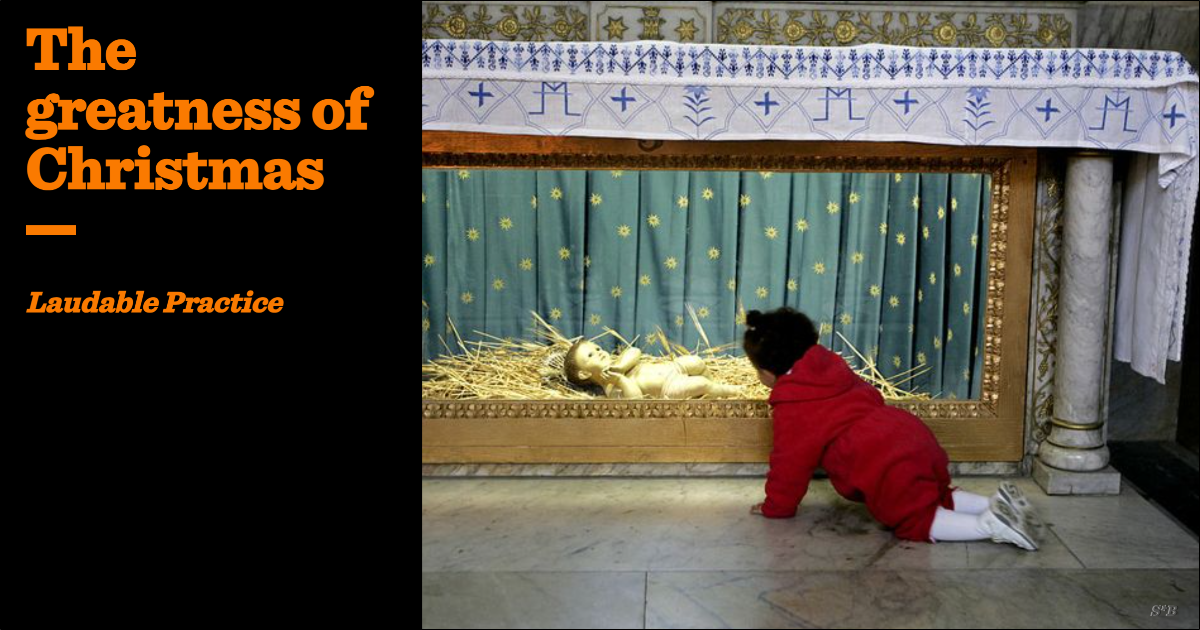
This praise and adoration is also heard in the words of the Nicene Creed, the common confession of Christians. To recite it at Christmas, having heard Saint John’s proclamation, beholding the Nativity scene, is itself an act of praise and adoration: “Who for us men and for our salvation came down from heaven, And was incarnate by the Holy Ghost of the Virgin Mary, And was made man”.
In his first Christmas address in 2022, The King spoke of visiting the traditional site marking the Lord’s Nativity:
Some years ago, I was able to fulfil a life-long wish to visit Bethlehem and the Church of the Nativity. There, I went down into the Chapel of the Manger and stood in silent reverence by the Silver Star that is inlaid on the floor and marks the place of our Lord Jesus Christ’s birth. It meant more to me than I can possibly express to stand on that spot where, as the Bible tells us, ‘The light that has come into the world’ was born.
“It meant more to me than I can possibly express”: such wonder and reverence, joy and adoration is to be our response to the glorious truth of Christmas.
This is why attempts to use Christmas, the celebration of the birth of Our Lord, to further earthly, political agendas are a profound failure to recognise the grace and truth of that which we celebrate. No, the nativity of Our Lord Jesus Christ does not further the cause of Western civilisation. No, it does not make the case for restricting immigration. No, it does not serve the interests of those of us who are cultural conservatives. The Nativity of Our Lord is infinitely greater than all such issues and causes. Standing before the Nativity scene, hearing Saint John’s Christmas Gospel, such matters cannot be on our minds or in our hearts. This day, this season, is for wonder and reverence, joy and adoration before the Word made flesh, for us and for our salvation.
Likewise, those bishops and clergy who, with tiresome predictability, use Christmas sermons to invoke the Incarnation in support of whatever fashionable agenda they support — uncontrolled immigration, further increases in the welfare budget, Net Zero — are attempting to reduce the wondrous truth of Christmas to a mere partisan talking point. Christmas, however, is always infinitely greater than the concerns of progressive clerics.
This is the season of wonder and reverence, joy and adoration before the Manger
Debates about the complexities of immigration policy are for another day. Cultural conservatives and fashionable progressives alike are to set aside their partisan agendas on this day. And, yes, even the cause — and the sins — of Western civilisation can wait. Today we behold the Word made flesh. This is the season of wonder and reverence, joy and adoration before the Manger — the season in which we are to be changed, knowing that whatever our partisan agenda and concerns, they are always, throughout the year and for all of our earthly lives, of immeasurably less significance than the One in the Manger. “O come, let us adore Him, Christ, the Lord.”
C.S. Lewis described the Incarnation as “the Grand Miracle”: “The central miracle asserted by Christians is the Incarnation. They say that God became Man”. This Grand Miracle is why Christmas is celebrated. It is why the Nativity scenes are set up; why the carols are sung; why Midnight Mass is celebrated; why, in those many places across the globe where Christians face terror and persecution, churches are full on this day. May we, moved in heart and soul this Christmastide, rejoice in the Grand Miracle of the Incarnation, knowing that here, in the Christ Child, is our true centre, our everlasting hope, the Light eternal for all of our life.
Yea, Lord, we greet Thee, born this happy morning,
Jesu, to Thee be glory giv’n,
Word of the Father, now in flesh appearing.
O come, let us adore Him, Christ, the Lord.