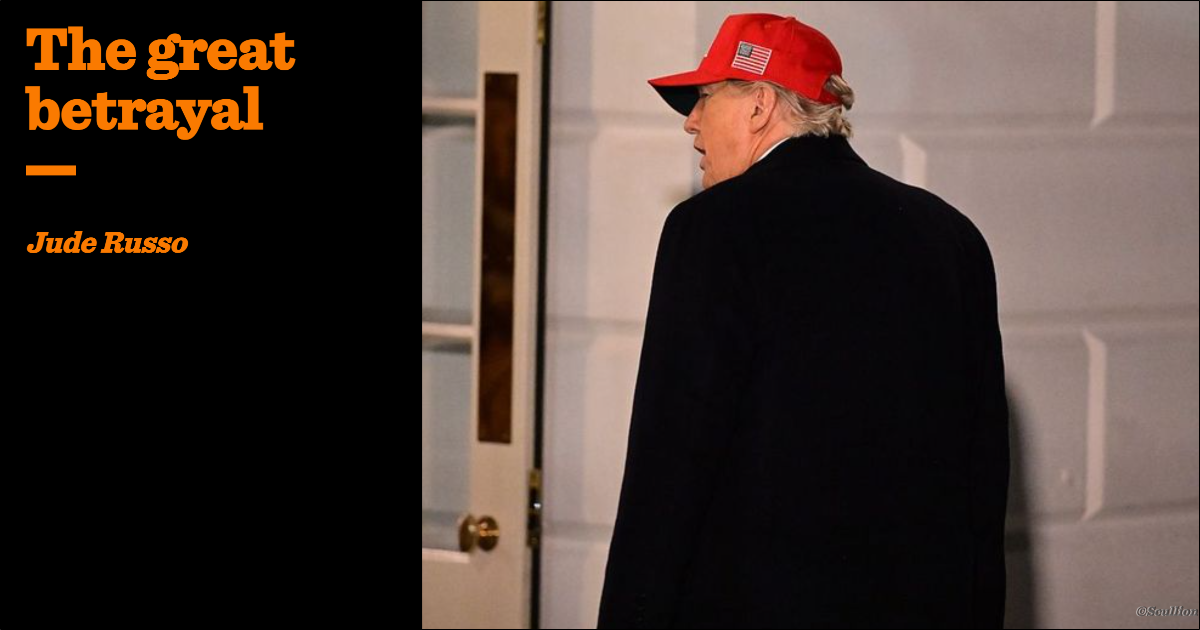
MAGA will always be Trump’s, but how much is an ever-shrinking coalition actually worth?
After President Donald Trump’s resounding victory in the 2024 presidential election, my own magazine featured a very sharp piece from Ryan Girdusky titled “A Governing Majority, If You Can Keep It.” The Iran War has made the protasis of that conditional look very shaky indeed.
There is a long-running left-wing critique of the “Make America Great” movement, often articulated in hysterical terms, that posits that MAGA is fundamentally a cult of personality around Trump’s singular figure. The counterargument has always been that MAGA, like all political movements, is in fact a coalition. There are people who just love Trump, sure, but there are those who have supported the president for a wide variety of policy-based reasons. They like his positions on trade, on immigration, on foreign wars — positions that had largely been drummed out of elite politics but still had a reservoir of support among many Americans and that, for all his inarticulate bombast, Trump had consistently expressed since the 1980s. Plenty of diehard Trump voters didn’t care for the man, but politics is the art of the possible, and you go with the option that advances your interests, largely irrespective of taste or style.
This is not solely an internal MAGA phenomenon. Trump’s ability to pierce through the hostility of his many detractors to convince a wide variety of voters that he’s worth a shot made him an electoral force to be reckoned with, rather than just another spoiler candidate. Trump won the popular vote in 2024 on the backs of Americans who, many for the first time, thought he was a better bet than the other guy (or gal, after the June ouster of President Joe Biden from the top of the Democratic ticket for Vice President Kamala Harris).
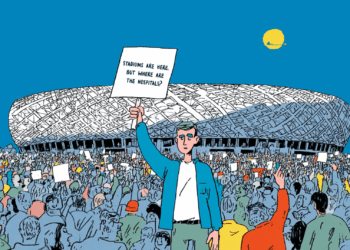
Well, a year and a half can change things. The coalition is collapsing inward. Even before the war began, Trump had already largely lost the nontraditional Republican voters who brought him back to Washington; his overall approval rating was hovering in the mid-30s, which is not remarkably bad for his own polling history, but does bear comment following a popular-vote win. (And those crossover voters are not rallying around the flag for the Iran adventure; the polling on the war is abysmal.) Now the war threatens the support of the conservatives who backed Trump because they believed he would reorient America away from adventurism abroad and focus on solving domestic ills; it also threatens those who supported him for purely economic reasons. Growth and employment numbers were already faltering in the final quarter of 2025. If the war roils energy markets for an extended period of time — not an unlikely scenario, even if the Strait of Hormuz is opened by dint of American arms — suffice it to say that bad things will happen.
If MAGA’s definition contracts … it becomes difficult to say that it isn’t a cult of personality
o some degree, talking about a “schism in MAGA” is an exercise in no-true-Scotsmandom. As Trump has reminded the public repeatedly, he is the ultimate arbiter of what MAGA is and is not. Fine. But if MAGA’s definition contracts so that it no longer includes Steve Bannon, Matt Walsh, and Rep. Warren Davidson, it becomes difficult to say that it isn’t a cult of personality. It also becomes difficult to say that it is anything like a durable political coalition — something that can actually win elections. People forget that about a quarter of the country thought George W. Bush was just dandy when he left office; it turns out that this core of support doesn’t actually get candidates over the finish line. That’s bad news for J.D. Vance, whose political future relies on keeping together the band in which he has invested so much political capital. Even if this war goes well (by whatever measure the administration ultimately decides on), the noninterventionist Right that feels betrayed is liable to hold it against him. “Judas Vance” is a very catchy nickname.
Vance in fact has a lot of problems brewing. If the war goes south, Trump will have recapitulated the post-Bush political dynamic that he himself exploded: He has saddled the Republicans with a broadly unpopular war that they can’t quite repudiate. It will be uniquely impossible for the man’s vice president to distance himself from this war of choice, especially after the New York Times reported that he has said that if the U.S. must attack Iran, it should “go big” rather than engaging in the limited strike options the president was said to prefer at the time. (Vague leaks from his office about how he expressed “reservations” regarding the operation, even if true, are painfully obvious, and smell of a man trying to buy life insurance after getting a leukemia diagnosis. They are also unlikely to provide sturdy political shelter in the storm that would follow a real war disaster.) Simultaneously, he will face challenges from a reinvigorated hawkish faction within the party that has always doubted his commitment to the cult of Mars and will accuse him of having been a speed bump on the way to the sublime crescendo of American violence. It is an unenviable position.
The best-case scenario politically (and also probably militarily) is a quick conclusion to the war — not a very original thought, perhaps, but nonetheless true. The likeliest version of this is Trump declaring victory, cutting bait, and leaving. Some amount of damage is done, economic, diplomatic, and political, but it will give markets and the coalition the opportunity to heal; the political outcome could look more like last year’s Twelve-Day War or January’s caper in Venezuela, which both gave noninterventionists the heebie-jeebies but were ultimately forgiven. How probable such a conclusion is I leave to the war journalists. The worst-case scenarios are not difficult to imagine and can be left as an exercise to the reader.
After the 2024 election, I wrote in these pages, “The annals of Trump’s first term suggest that the incoming administration will show an ample talent for damaging itself; further, the conventional wisdom holds that the economy is due for a correction sometime in the next four years. I do not think it is too soon to say that, come 2028, the de-Harrised Democrats will be in the catbird seat.” I would like to claim credit for my farsighted analysis, but must admit that I did not see a regional war in the Persian Gulf as a likely consummation of the prediction. The curse of the prophet is that sometimes visions pan out in surprising ways.