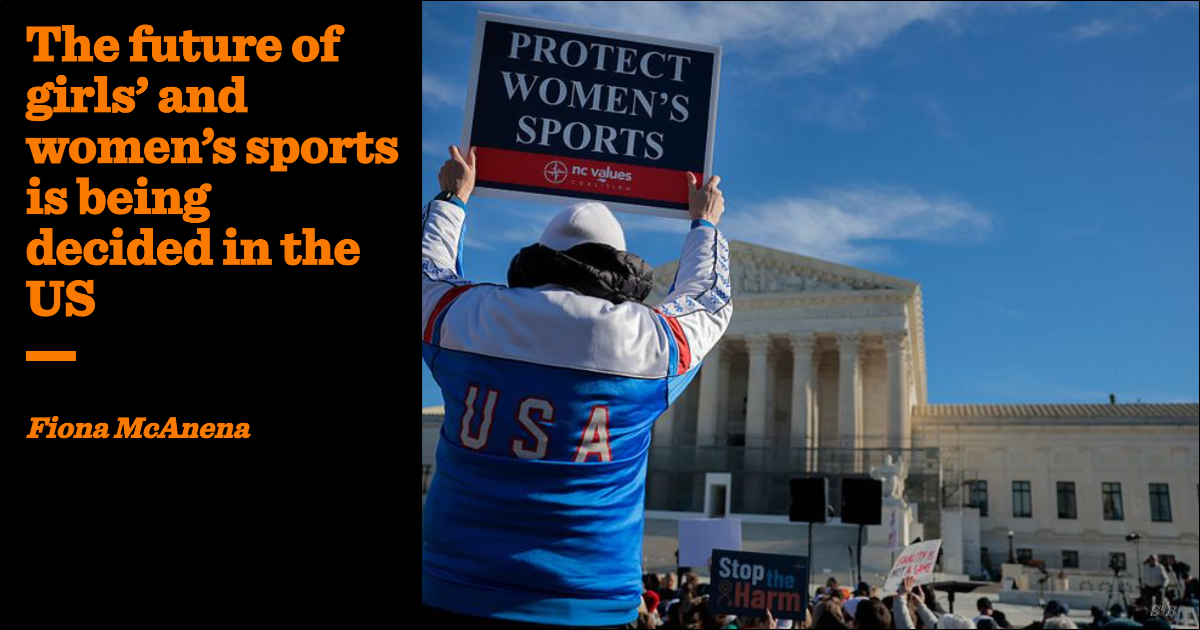
This week, the United States Supreme Court heard two cases that ask it to adjudicate on what “sex” means in American sex-discrimination law. Two states, Idaho and West Virginia, are defending state laws that restrict female athletics to those born female.
These cases are, in effect, an American version of the For Women Scotland case, which established that in UK equality law, sex has its normal biological meaning. The USA has no single law like Britain’s Equality Act. But it does have “Title IX”, which is part of its 1972 Education Amendments. This prohibits discrimination based on sex in education programmes and activities that receive federal financial assistance. It covers admissions, athletics, employment and student conduct, and has been influential in moving towards equal provision of facilities, funding and scholarships for girls and boys in high school and college.
Title IX states:
No person in the United States shall, on the basis of sex, be excluded from participation in, be denied the benefits of, or be subjected to discrimination under any education program or activity receiving Federal financial assistance.
The legal issue for the Supreme Court is what “on the basis of sex” means. If it means biology, as in the UK, then admitting trans-identifying boys or men to programmes or scholarships for women or girls violates Title IX since it in effect subjects women and girls to discrimination by destroying the female category and causing them to lose out on medals, scholarships and team places to boys. If it ignores biology so that a boy can count as a “transgender girl”, then schools and colleges can treat those boys as female without facing a discrimination challenge under Title IX.
Battles between state and federal law
Over the past few years, many American states have passed laws prohibiting school and college sport from allowing trans-identifying boys or men into female categories. Other states have insisted that these “transgender girls” are girls. The divide is predictably partisan: Republican state legislatures have protected the female category; most Democrat-led states have not, and in a few cases a Democrat governor has blocked state legislation that seeks to do so.
There have been legal challenges in both directions. Female students have brought cases against states such as Connecticut that allowed boys to claim high-school girls’ state championships; and against sports bodies, such as the National Collegiate Athletics Association (NCAA), which allowed Lia (William) Thomas, a young man who started to identify as a woman while at university, to swim in women’s national competitions. The Connecticut case is currently at the Court of Appeal, the final stage before the Supreme Court. A challenge in Minnesota, where a trans-identifying boy was part of a girls’ high-school team that won a state softball championship, has also reached appeal level.
In the other direction, trans-identifying students and the American Civil Liberties Union (ACLU) have challenged state laws that protect the female category and do not grant them access to the sports matching their claimed identity. It is two of these cases that have now reached the Supreme Court.
The cases in the Supreme Court this week
In The Governor of Idaho et al v Lindsay Hecox et al and West Virginia et al v BPJ, Idaho and West Virginia are defending state laws that restrict female athletics to those born female. The two cases were heard together because they are on the same point of law. Idaho was the first state to take action explicitly to protect female sport, with its Fairness in Women’s Sport law, passed in March 2020. Hecox won an injunction against that law, the state appealed, and now the case has reached the highest level, the Supreme Court.
West Virginia followed Idaho with its own law a year later. That was challenged by BPJ, a trans-identifying young man whose puberty was blocked and who wanted to compete in girls’ high-school sport. Although the case was brought by the trans-identifying boy, the evidence now includes accusations that he sexually harassed girls in his high school, including in the girls’ locker room.
Both trans claimants have been assisted by the ACLU, which claims that these laws violate the equal-protection clause of the American Constitution. The ACLU argues that transgender people must be treated as the sex in which they identify, and the state laws need to be struck down.
British academics and campaign groups contributed to the court in the form of “amicus briefs”, expert input on relevant topics. These considered sex screening, sex differences in sport, how legal protection on the basis of sex works in the UK and why it matters, and why male and female function as “natural” categories.
What’s at stake?
There are now 27 American states with laws protecting sport for women and girls similar to those in Idaho and West Virginia. If these two cases are lost, then no state will be permitted to pass such a law. All would have to adopt policies like those of California and Connecticut, which actively support “transgender girls” — trans-identifying boys — in female sport.
If, conversely, Idaho and West Virginia win, laws keeping everyone male out of women’s sport will be permitted but not obligatory. California and other states that mandate “trans inclusion” would not be forced to stop doing so.
The job of ensuring that all states must protect the female category on the basis of sex falls to the cases being brought against states such as Connecticut — always assuming that those cases reach the Supreme Court and win.
These legal battles are not just about sport. A declaration that sex in Title IX means biology would clarify the meaning of sex-discrimination protections across all federally funded education programmes. And like the For Women Scotland judgment in the UK Supreme Court, it would provide a strong indication that sex can only mean sex, anywhere it appears in American law.
Signs that US media coverage is shifting towards reality
For years, media coverage in both the UK and US has centred the demands of “transgender girls”, which is to say boys, with little or no regard for the impact on others. The BBC’s coverage of the Supreme Court hearing failed to mention that the two trans-identifying athletes are male, as are all “transgender women”.
But the Washington Post, a liberal paper that has long been sympathetic to “trans girls”, said in an editorial published the day before the hearing that neither science nor the American public is on the trans athletes’ side. It said:
The Supreme Court has the chance this week to save women’s sports, allowing states to restore a level playing field for girls by excluding biological men and thereby correcting one of the worst excesses of America’s cultural revolution.
Such a strong and unequivocal statement from a traditionally Democrat-leaning journal is a long-overdue recognition that on this issue, popular opinion is not with the trans-affirming Democrats.
Which way will it go?
The conservative majority in the US Supreme Court suggests it is likely that reality will prevail. In a sign that the trans claimants think this too, Hecox asked the court not to hear the Idaho case, on the basis that he is no longer participating in college sports in Idaho. The state governor requested that it be heard nonetheless, since he wants to establish that the Fairness in Women’s Sport statute is lawful. One liberal judge made Hecox’s point in court, saying that the case should be thrown out as “moot”, but the hearing went ahead.
In court, counsel for the states pointed out that no one was questioning the need for sex categories in sport. Instead, the trans-identifying athletes argued that they should be an exception to the general exclusion of males from women’s categories and suggested that they were not the same as “cisgender boys” because they had taken medical steps to mitigate their advantage.
This led to detailed legal arguments about when a law may be deemed unconstitutional. In American law, if it works generally but discriminates against some individuals, this may be defensible. But if those individuals are part of a recognised category that has suffered discrimination in the past, such as those who share a race or religion, then the law must be justifiable under a process called “strict scrutiny” to ensure no repeat of past mistakes. Laws that discriminate on the basis of sex must also be justifiable, but face a lower bar called “intermediate scrutiny”.
Counsel for the trans lobby did not argue that transgender identity should count as one of these special categories requiring strict scrutiny, as some had expected. Winning on that would have made transgender identity officially a protected class. But that was unlikely in a court where six of the nine justices are Republican appointees. In any case, the states pointed out that the laws being challenged are about women and girls, and do not mention transgenderism.
Judgment will be handed down in the coming months, with no further indication of likely timing.