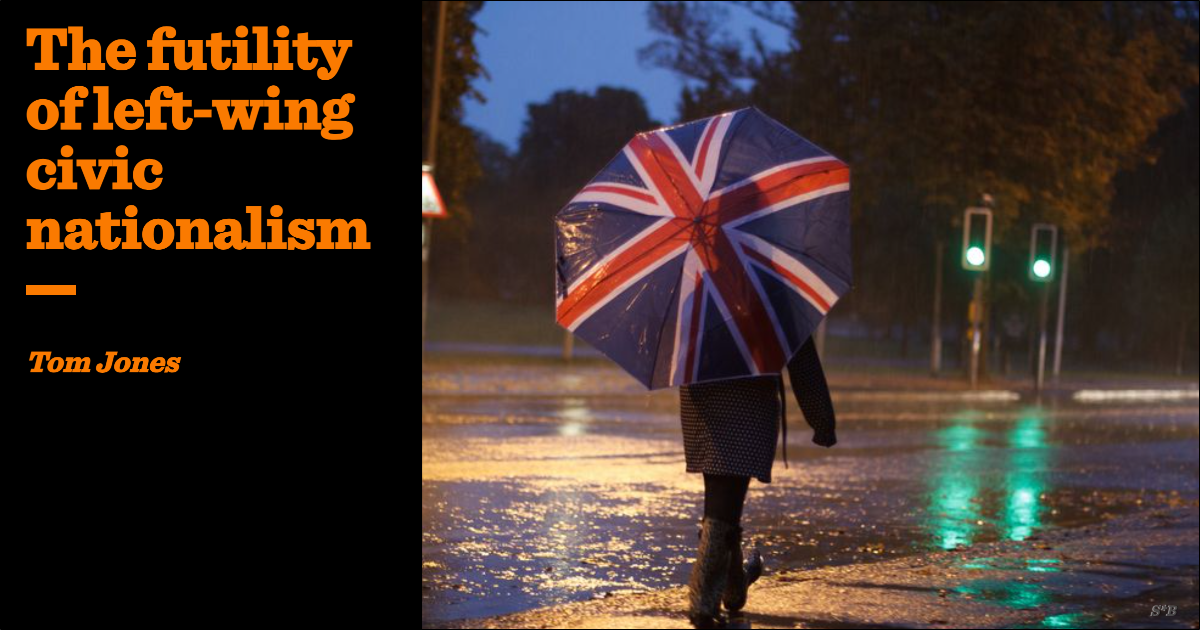
Earlier this year, I wrote in these most august pages about Mike Tapp and the ever-expanding list of always capitalised British Values. One of the acts that wasn’t included in the list, however, was waving the British flag.
Although it hasn’t been included on the list of British Values Mike Tapp MP has thus far identified, over the summer the question of whether flying, raising or waving the British flag was a demonstration of simple patriotism or open racism has divided Britain. The left has been firmly set on condemnation, but given how comfortable Tapp himself is in using the Union flag, should it be?
In fact, Tapp has already provided a handy guide for how Labour have approached the problems it faces when its political opponents use symbols of national identity as a means to assert themselves against it. In an article for Labour List in 2023, Tapp wrote that Labour needed to “embrace the symbols of Britain” — including the flag. Labour’s mission, he wrote then, was to “reclaim them and restore their true meaning as unifying symbols that represent the diversity, inclusivity, and shared values of our nation.” Recently Luke Charters, Labour MP for York Outer, took to Twitter to declare that St George is “an emblem of internationalism”, and that “English identity belongs to all of us”.
As a political trick, this is pretty neat; claim that the symbols are being used by political extremists who do not represent the majority of people or reflect the values the symbols convey. This allows you to insist that extremists have hijacked the symbols, stripped them of their true meaning, then claim it is this extremist use to which Labour objects — but only because they remove the symbols from the values of ordinary people, rather than for a general unease with the assertion of English nationality.
Yet without moving into unreadable semiotic notioning, it is clear that Labour do still have a problem with symbols of identity. That is because their use of national symbols are made conditional on their being “retaken” from people using them incorrectly. “Incorrect” here, as both Tapp and Charters outline, is to make distinct the notion of an identity that is not diverse, international, or that belongs to all of us, but which is specifically English.
Their attempts to commandeer symbols for this purpose are fatally flawed, for the simple inclusion of the word “inclusivity”. That is because identities are by their nature non-universal. In order to exist, they must be exclusionary; in order to define an “us”, there must be a “non-us”. As Michael Bernhard and Daniel O’Neill note, inclusion and exclusion is inseparable from identity, because collective identities are sustained only by drawing lines of belonging and non-belonging.
That is not to say this “other” must be our enemy, a group to which we are hostile, but simply that there are people who cannot assume our identity. If English identity belongs to everyone and not specifically to the English, then it is not English identity. In fact — as Claudia Zilla argues — it would not be an identity at all, because to erase exclusion is to erase identity.
Whilst a few remaining Blue Labour types (who should be commended for their efforts) recognise grasp that national symbols cannot be endlessly redefined as “inclusive” without losing their substance, the majority of the left’s coalition will deny any element or signifier of identity as soon as it becomes exclusionary on any level. As I have written previously, this is because the fundamental assertions of modern progressivism are premised on a flawed understanding of humanity.
Liberal progressivism depends on the idea of the blank slate. The universal sameness of the human, in this model, means that individuals and groups are interchangeable across time, space, and function. But the often brutal asymmetries of groups and individuals in the real world challenge the fundamental assumption. In order to counteract this unwelcome intrusion of reality, modern progressivism has developed a levelling impulse, which works towards a system of relentless horizontalism that flattens difference.
The flattening impulse has extended to culture, helping to foster the ideology of multiculturalism — which held, as its central contention, that there could be no overarching culture which holds sway in Britain. Instead, there would be a multiplicity of cultures, all of equal value. Like all flawed projects, the seeds of its own demise were sown within it — the unwillingness to integrate incomers into a central culture allowed for the existence of parallel societies, whilst devaluing the host culture to the point that people who have no memory of pre-multicultural Britain deride the idea it has any culture at all. The idea of Britain as a “community of communities” has led directly to the flag not belonging to every community in this country.
That the Union flag can now be spoken of in the same breath as the Nazi symbol should shame those who hollowed out our national identity
Fears around the assertions of national identity seem to take no note, ironically, of cultural context. We are — or were, when we knew what we were — a people possessing a unique individualism. This means the conditions to foster nationalism are notably less propitious than elsewhere; hence, as John Gray writes, “Of all European countries, mainland Britain has been among the least afflicted by Völkisch nationalism.”
But even so, the rising heat of 2025 has seen the national flag treated as a symbol as divisive as the stone Swastika that stood atop Speer’s monumental Zeppelinfeld grandstand in Nuremberg.
That the Union flag can now be spoken of in the same breath as the Nazi symbol should shame those who hollowed out our national identity, but I doubt it will. We are a community of communities now — a people inclusive, and divided.