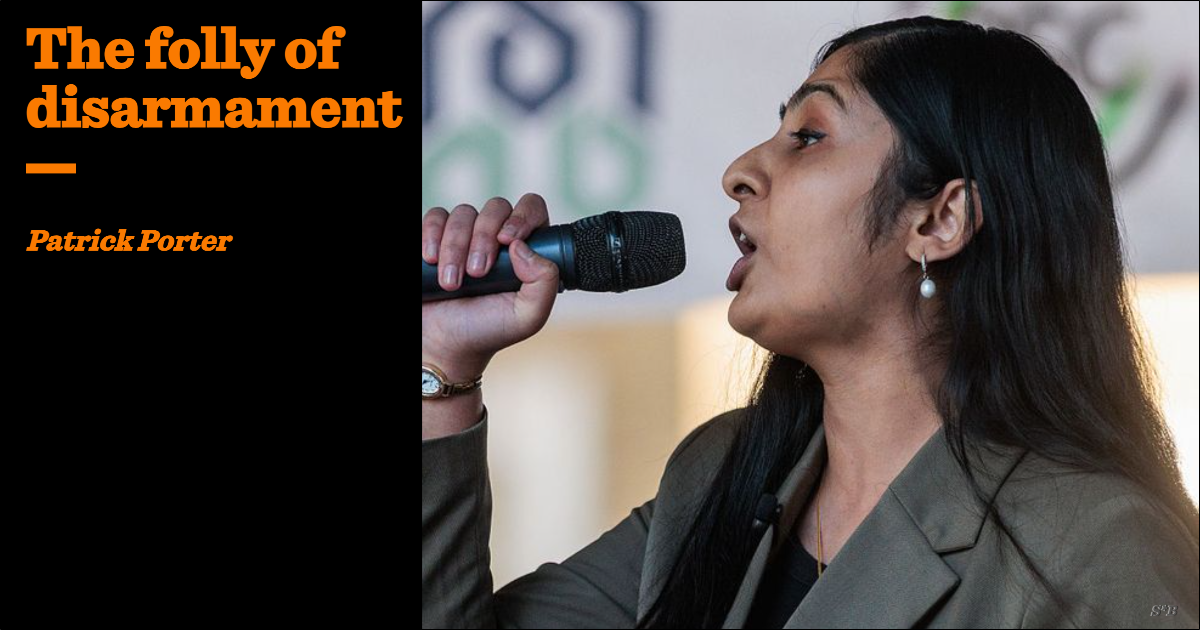
This past week, the radical parliamentarian Zarah Sultana offered her thoughts on foreign and defence policy in various forums. NATO, we heard, is nothing but an “imperialist war machine”, and Britain should withdraw. As well as spreading carnage abroad, British instruments of death rob from the working-class and the poor. “Arms dealers profit while our NHS collapses, public services crumble and millions of children grow up in poverty.”
Sultana opposes not only the Atlantic West’s main alliance, but its whole defence-industrial base. Western weapons are wrong both because they serve imperial purposes and because they are intrinsically wasteful, consuming scarce resources better spent on nobler causes, like fighting poverty. True to the rhythm and gravitas of TikTok agitprop, she declared “Wages, not weapons. Welfare, not warfare.”
On a fair reading, Sultana’s remarks were shallow, distinguishing her from those parts of the British Left that have a proud tradition of serious thought about defence and the cause of working class emancipation, from George Orwell to Aneurin Bevan to Michael Foot. Unwittingly, though, Sultana put her finger on a deeper predicament that principled anti-imperialists have historically grappled with.
The notion that Britain is prioritising Warfare over Welfare is absurd. Today, health and welfare combined take up approximately 40 per cent of the UK’s annual budget, while Defence must make do with 4-5 per cent. Disability benefits alone exceed the defence budget. Ask our stretched and under-equipped pilots, sailors, submariners or tank crews whether it feels like a military spending bonanza. Even if Sultana is right, that the NHS and poverty reduction should be even more of a consuming priority, that doesn’t logically dictate radical disarmament. Deterring aggressors, who also have their own war machines, from attacking us or allies might prevent major war and/or the expansion of a very imperial Russia in Europe. Major wars also tend to drive up poverty and damage services.
As with defunding the police, if the West disarms, it’s not that nothing bad happens as a consequence, while good resources flow to the needy. Something else bad happens. And I say this, for what it’s worth, as a critic of the Iraq war, the later rounds of NATO enlargement, the Libya intervention, and of Ukraine war “maximalists” who are dismissive of nuclear escalation risks.
British or Western disarmament would likely enable a larger process of unchecked imperial expansion, followed by war, but worse, because states would have to scramble against the clock to arm themselves. Were NATO Europe to run the experiment and defund defence, a plausible scenario would be a rearmed and mobilised Russia seizing parts of the continent. But it is hard to weigh up such scenarios if you live in a rhetorical world of absolutes.
The actual world is more tragic. Similar disarmament arguments were made in interwar Britain. Virtuous souls among the peace movement argued that British rearmament was wrong because it was the fruit of a poisoned tree, poisoned by its imperial, capitalist and anti-worker character, and that arms were wasteful in a time of mass unemployment. And besides, Hitler’s Germany had legitimate grievances. Britain with its racial empire had disqualified itself anyway from opposing expansionism. Then, as now, a certain kind of moralist assumed arms are only for the pure, only for inoffensive states, and refused to follow their thoughts beyond that point.
The disarmament voices lost that argument. Looking back, should we regret this? By arming itself against their advice, Britain could ride out the opening rounds and stay on the board, preventing Nazi Germany being able to concentrate its fire on any one front, preventing the Axis from ruling the Mediterranean uncontested, and building a base for a counteroffensive later. When Hitler did attack Stalin, British communists rallied around the cause, not because they loved “king and country”, but because aligning with the British empire was the only plausible platform, given the U.S. still had not entered the war. Their anti-imperialism ran up against the cause of anti-fascism.
Were they wrong? What would have been worse, the increased wealth of arms manufacturers or a fascist-run Eurasia? Is it your view that between the British empire and the new Nazi order, there was little to choose? If you are from harder quarters of the Left, would it have been better if, after June 1941 and the launch of Operation Barbarossa, Britain had no arms or equipment to donate to the Soviet Union, and no way to protect ships to supply them via the Arctic convoys? That is where absolute disarmament visions lead. And it is what purist arguments sound like when they are played back.
Sultana takes flight into glib relativisms
Those who dismiss their own nation’s military power sooner or later will relearn its value. Sultana recently called for Britain to send naval escorts to protect a Gaza-bound flotilla. Well, that would have meant deploying crewed ships with weapons on them under a White Ensign. Such things only exist because states decide to have them well in advance. They are capital intensive commitments. And they take long lead times. If Sultana and her faction had their way decades ago, there would not be a fleet to call upon in the first place. But this is the same politician who appeared at the World Transformed festival “to chat shit and build socialism.” As with socialism, so with defence. Building things is harder than chatting.
Asked about Ukraine, Sultana takes flight into glib relativisms. Putin she describes as a “gangster”, but then again, based on cherrypicked Russian and Ukrainian speakers, Zelensky is “no friend of the working class”, and enabling Ukraine to keep fighting its war of national defence only benefits “arms manufacturers.” Ukraine presumably is only deserving of military assistance — from someone, not us — if Kyiv nationalises corner shops or abolishes landlords. Tough luck for Ukraine’s working class, that. As for arms manufacturers, they indeed are benefiting. But it might also benefit Ukrainians who don’t want to be devoured by Russia’s imperial war machine. Again, the fixation with purity.
No pacifist, Sultana has said in the past that she supports the right of struggling peoples to defend themselves against aggressors, even if she now works hard to exempt a large, obvious recent case (the Ukraine-Russia war) from this category. Back in February 2022, Sultana condemned Russia’s “brutal invasion” of Ukraine. Without defending her position in detail, she now argues for cutting off the supply of arms and materiel to those doing the resisting, and “ending the war.” In other words, she supports anti-imperial self-defence but also opposes the flow of arms to the defenders. She likes apples but hates the orchard.
Sultana assumes that withholding support from Ukraine — while Russia remains armed and in the field — would somehow end the war. And she is right. Wars typically end when one side is made to surrender. Whether what follows will be a decent peace is another question. In this case, it would likely not be the tolerable conflict termination scenario Sultana so blithely assumes. Something else would probably happen, worse than war. A paralysed, isolated Ukraine would be on the receiving end of unchecked conquest, by an invader that has invested heavily in blood and treasure to dominate its neighbour, and which commits atrocities and declares Ukraine to be its historic property. Hence the willingness of millions of Ukrainians to fight on. Taxed with the outcome of a brutal aftermath, it would no doubt be time to change the subject to Gaza.
If Sultana is right, that the UK is so thoroughly rotten in its statecraft and history that it must cease arms transfers and disarm, why does this only apply to the West? Why is it only Western armament and power projection that is worth worrying about? Taken logically, this is also presumably a message for Tehran, Islamabad, Pyongyang, Moscow and Beijing. In those cases, arms also come at the expense of other things. The money invested in them could be more productively allocated to shelter, infrastructure, social care or the health service. And in some of those cases at least — Russia, China, Iran — intensive rearmament and violent imperialism (and resistance to it) is not unknown. Kurds, Tibetans or Ukrainians could attest. But about this problem, she says little.
It gets darker still. Sultana claims to support the right of victimised peoples to arm themselves against oppressors, seemingly with Palestinians particularly in mind. Granted, it is unclear what form of resistance she would be sympathetic to. But where does she suppose Palestinian armed groups get their small arms, mortars and rockets, along with training and technical support? Their main patron and armourer, in fact, is Iran, an expansionist and ruthless force in its region on any reasonable measure, sponsoring death squads and militias from Lebanon to Syria to Iraq and coercing and subverting neighbours. Applied consistently, the Palestinians that Sultana speaks up for would also be disarmed.
Sultana is not alone in this foreign policy purism. And neither is it just a problem for parts of the Left. It also has Rightist equivalents. Simon Jenkins, for instance, in 2010 advocated cutting Britain’s defence force in its entirety, given how historically safe it was. After all, good times for security, like the weather, will surely never turn bad. In January 2018, he claimed it was absurd to fear that the “Russians are coming” less than two months before the Salisbury chemical weapons attack.
To oppose, in absolute terms, wasteful weapons of empire only in the West’s case is to treat our world, a tragic one of trade-offs, compromises and lesser evils, as a large morality play, with a fixed cast of goodies and baddies, oppressor versus oppressed. Sooner or later, that world view will collide with reality. And if, as a principled anti-imperialist, you believe that peoples have the right to defend themselves against imperialist predators, those people will require access to arms. And those devices will have to come from somewhere. In the modern world those arms must include mass produced instruments from an industrial base, needed to create lethal firearms and munitions. Ukraine would not be able to survive without a constant large-scale supply of artillery shells. Most states capable of selling or donating such weapons in the first place will also be ruthless powers with bloody hands at home and/or abroad. It will be, as ever, a matter of picking one’s poison. There’s no sloganising our way out of it.