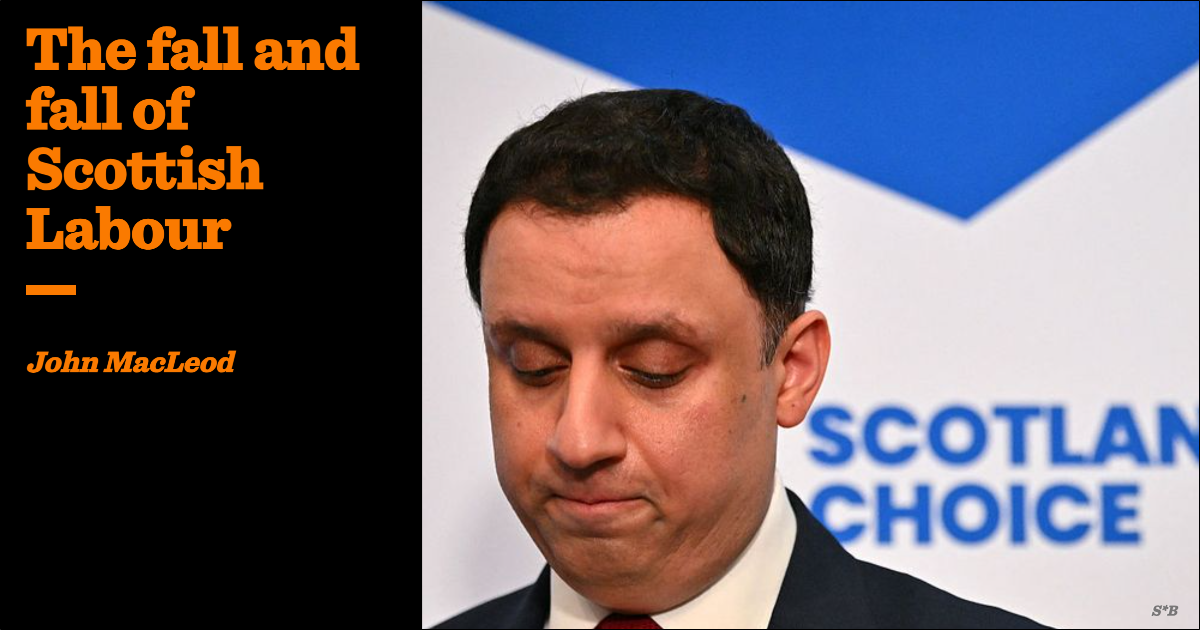
Anas Sarwar, of cherubic features and the general air of resignation that has marked every Scottish Labour leader for as long as anyone can remember — he is the tenth since 1999 — does not appear to be a devotee of chess.
He has never taken a penalty, undergone special-forces training, binge-watched Game of Thrones, enjoyed The West Wing or even chillaxed before The Traitors.
Otherwise, Anas Sarwar would know that in serious professional politics no weapon is as important as surprise.
If you plot to repudiate the Supreme Dalek, it is probably not the best idea to have your people trail the cunning plan across the media that morning and, besides, call De Bossman before lunch to tell him personally that you will be demanding his head on a charger around the hour for afternoon tea.
It was no surprise, last Monday afternoon, that Sarwar had scarcely begun to address his Glasgow press-conference when, on orchestrated cue and with the general atmosphere of a Communist show-trial, every Cabinet minister you had ever heard of hit their socials in vocal support of the beleaguered Prime Minister.
It was dreadfully Stepford Wives, and almost embarrassing… but if you come at the King, as they say, you had better not miss.
For all his woes, Sir Keir Starmer is still Prime Minister. The three likeliest usurpers — Rayner, Streeting, Miliband — all have unfortunate embarrassments at this time; nor would any of them wish to seize the throne before Labour’s likely slaughter in May’s devolved and local elections.
Almost as important as surprise, in politics, is timing. Anas Sarwar, assuming he does not retire in a day or two with a dagger for dutiful seppuku, now leads Scottish Labour into a Holyrood election, scant weeks away, under a Westminster leader he has just told the world is unfit to be Prime Minister.
Of course, Starmer is still PM. Douglas Alexander, Secretary of State for Scotland and professional creepie-crawly, has naturally come out for Sir Keir; it is unlikely the Prime Minister will hit Scotland for a reconciling hug and some chilled Irn Bru — and, every day he clings to his post, Sarwar will be beset with the same impossible questions.
As if things had not already been bad enough. Labour has been in historic decline in Scotland for years. At every Scottish Parliament election — including the first, in 1999 — it has shed constituency-seats even as the Nationalists have gained them.
In 2011, Alex Salmond even snatched an overall majority — in a Holyrood electoral order supposedly engineered to make that impossible. In the 2015 Westminster election — and again, four years later — Scottish Labour secured just one MP.
Its infamous hegemony in Scottish local government has long gone — thanks to then-First Minister Jack McConnell, back in 2003, granting the Liberal Democrats their demanded Danegeld for renewed Edinburgh coalition, proportional representation in our council elections.
By the Irish system — the single transferable vote in multi-member constituencies — maximally incomprehensible to the general public. (In 1992 one Teachta Dála, the late Ben Briscoe, survived a Dublin South-Central count that lasted ten days. Describing it afterwards as “the agony and the ex-TD.”)
Scottish Labour’s resurgency at the last Westminster election (albeit on barely 35 per cent of the Scottish vote and on a poor turnout) has, increasingly, the air of the drowning man rising one last time.
Even before Anas Sarwar’s Toy Town coup d’état bid on Monday, Scottish Labour’s upcoming date with the electorate — Thursday 7th May — already had the air of an extinction-event.
Stuck in third-party territory — the high teens — it is trailing Reform in the opinion-polls. The latest, last week, even shows the Faragists just five per cent behind the SNP in the regional-list vote, and (at nineteen per cent) just in the zone where they could pick up one or two actual constituencies, especially given Scotland’s diverting 3-way marginals.
It is extraordinary — almost a mark of judgement on the land — that, after nineteen years in office, a Scottish National Party with a quietly appalling record in government is coasting back to office against a hopelessly divided opposition.
But it has broadly corralled all supporters of independence; voters for the Union are scattered hither and yon and commanded by political pygmies.
That is not, of course, a uniquely Scottish problem: you look at the preening Lilliputians for Starmer’s crown and recall wistfully the titans — Tony Benn, James Callaghan, Anthony Crosland, Michael Foot, Denis Healey, Roy Jenkins — who fought to succeed Harold Wilson half a century ago.
Callaghan, who won, had been in Parliament since 1945, had enjoyed junior ministries under Clement Attlee and is still the only politician to have held all four great offices of state. Thinkers all — orators, war-veterans, men of letters happy to sit down with the likes of Sir Robin Day for a live, long-form television interview.
A Rayner or a Streeting would not last five minutes. Day would have casually downed Anas Sarwar like a salty snack.
From the 1922 general election, Labour broadly dominated Scotland’s politics and, though it never won an absolute majority of the Scottish vote — it came closest in the 1966 election, with 49.9% of the poll — three Scottish-born MPs have been Labour Prime Ministers.
Historically, this was a political movement that embodied very Scottish values
Indeed, the last Labour government was dominated by a tranche of very able Scottish MPs from the party’s notable Caledonian intake at the 1987 general election: the likes of John Reid, Brian Wilson and Adam Ingram. (There was also George Galloway; but every Eden has its serpent.)
Historically, this was a political movement that embodied very Scottish values. Hard work. Public service. Concern for the small man, the poor, the unfortunate, the sick and the old.
It is widely forgotten, too, that till the triangulated, “Third Way” horrors of the Blair era that it was a party of profound social conservatism.
William Ross, who twice served under Harold Wilson as Secretary of State for Scotland, was an elder of the Kirk. Many Scottish Labour MPs were compassionate Roman Catholics: David Marshall, a Glasgow MP from 1979 to 2008, never held office, but in an unobtrusive career held out against abortion, fought against solvent abuse, rebelled in 1998 against cuts in incapacity benefits, opposed the 2003 invasion of Iraq and, the following year, liberalisation of our gambling laws.
Rather sweetly, he even campaigned for Celtic football-legend Jock Stein to be granted a posthumous knighthood.
The heavily Presbyterian, most agrarian constituency of the Western Isles has returned three Labour MPs — the first, Malcolm K MacMillan, serving from 1935 to 1970 — and the inability to grasp that much of the Scottish Labour vote was one that upheld family, church-going, and general decency was a big reason for the SNP’s protracted political exile after 1979.
The Blair years, the drift away from the politics of social conscience and the constant placation of such kitchen-supper obsessions as ceaseless demands from the LGBT lobby then wrought slow but corrosive harm.
One issue that did enormous damage to the new, devolved Scotland — momentarily jeopardising the new Parliament in Edinburgh itself — was the repeal of Section 28/Clause 2A legislation in 2000.
It was an indefensible measure from Thatcher’s third term, enacted to capitalise on the obsessions of “Loony Left” Labour councils by prohibiting the promotion of homosexuality “as a pretended family lifestyle” under local authorities.
Schools purged their libraries; teachers, overnight, became too frightened to counsel gay children. Its abolition was a sensible, overdue measure that could readily have been left to Westminster — or undone, very quietly and with minimal publicity, under some broader Criminal Justice Bill.
Instead, Wendy Alexander — the tiny elder sister of Douglas, of vast intellect and minimal acquaintance with common sense and, from 1999, a Scottish Executive Minister for this-that-and-the-other — harrumphed her plans for the repeal of Clause 2A at a packed public LGBT conference and plunged Scotland into uproar.
Newspapers on all sides came out against the reform; a Christian businessman with vast bus interests funded an alarming poster campaign and even a sort of referendum. Catholic backbenchers hit the roof, there were general headlines of the they-will-sodomise-your-sons variety and Tony Blair himself hit Scotland in a bid to calm everyone down.
Clause 2A was duly repealed by the Scottish Parliament, 99 votes to seventeen, but it was the ugliest episode in Scotland’s public life I can recall in four decades of journalism and, startled and sobered, it would be 2003 before the law was struck down by Westminster MPs.
Scottish Labour never quite recovered from it. It had already lost a Highland seat to the Nationalists in the first Scottish Parliament poll. It shed several more in 2003. It was defeated in 2007, reduced to beaten dockets in 2011 and finally plucked, gutted and stuffed in 2015.
We touched on David Marshall. In 2008 the veteran MP for Glasgow East rather hurriedly stood down, in circumstances that brutally exposed the rotten-burgh reality of Scottish Labour politics.
Marshall had been returned at the 2005 general election with 60.7 per cent of the vote — a little short of the giddying heights of 1987; his majority had been 18,981 — and, incredibly, did not even have an office in the constituency.
It is no longer identified as a working-class party
Nationalists seethed all over Glasgow East in the ensuing by-election, the Labour campaign disintegrated — there was no local organisation to speak of; MPs and even ministers were reduced to taxiing voters to the polls come the day, and the SNP triumphed in a dreadful blow to Gordon Brown’s clout.
Scottish Labour has no longer any credibility for quiet Scottish Christians. It is no longer identified as a working-class party. Though it has declined to give out the numbers for some years, its membership is now thought south of 10,000. It is a political movement, these days, for be-lanyarded public-sector women, some students, not very successful graduates and (if strained of late by Gaza) most of Scotland’s small Muslim population.
It says everything about what Labour now is, for most ordinary Scots, that her own trade union, the Royal College of Nursing, refused to support or succour Sandie Peggie, the Fife nurse forced to share a changing-room with a biologically male doctor. In a particular humiliation, she had to strip off in front of them.
Nor even Unison would help: our biggest trade-union’s newly elected leader, Andrea Egan, told reporters she would not be “comfortable” representing Peggie, who nevertheless pulled out a tight win at her employment tribunal — and has appealed against wider aspects of the judgement, as well as launching legal action against the RCN.
With few activists and not much money in this increasingly insane context, Scottish Labour seems to be largely waging its Holyrood campaign by social media and this final, desperate Anas Sarwar bid to disown the total bin-fire down in Whitehall.
At the last Scottish Parliament election, Scottish Labour only returned two constituency MSPs — in their worst electoral performance since 1910.
One suspects Jackie Baillie and Daniel Johnson are, as of now, quietly polishing their résumés.