A new exhibition of the work of Joseph Wright of Derby has much to tell us about science and the soul
The National Gallery’s new Joseph Wright of Derby exhibition brings together his two masterpieces, A Philosopher giving that Lecture on the Orrery in which a Lamp is put in the Place of the Sun (1765) and An Experiment on a Bird in the Air Pump (1768), allowing the public to see them side by side for the first time in 35 years. The exhibition shows how Wright, referred to as the first artist of the Industrial Revolution, captures the Enlightenment’s faith in scientific experimentation, while also locating the material objects of our reasoned discovery and our industrious endeavours to conquer the natural world, within our finite, emotional and ever mysterious human world. Wright has much to say to modern audiences living through the new information revolution, which poses similar questions about our place in the universe.
Wright was born into a respectable family of lawyers in Irongate, Derby in 1734. Deciding to become a painter, as a seventeen-year old Wright made his way to London. For two years he studied under portrait painter Thomas Hudson. In 1753 he returned to Derby. After a period in Liverpool, in 1773 he set off for Italy, the artistic centre of the universe. In 1777 he returned, via a short stint painting portraits in Bath, to settle in Derby for the rest of his life.
Over the years he became increasingly asthmatic and suffered from lethargy and depression that alternated with his creative spells. For these complaints, he was treated by his friend and physician Erasmus Darwin, who was also a poet, inventor and, decades before his grandson Charles, a theorist of evolution. As Wright’s disposition moved from light to dark, so did his compositions.
“Wright of Derby: From the Shadows” — a collaboration with Derby Museums — is the first major exhibition dedicated to Wright’s “candlelight” paintings. These display his use of tenebrism, with which he is associated. Tenebrism is a term derived from the Italian “tenebroso” which means darkened and obscuring and is an extreme form of chiaroscuro (another Italian term which literally means “light-dark”). It is used to describe a type of realistic painting in which significant details, such as faces and hands, are painted and illuminated by highlights which are contrasted with a predominantly dark setting creating a dramatic effect.
The late paintings of Caravaggio are most commonly provided as examples of this style (Wright has been referred to as Britain’s Caravaggio). However, instead of the biblical and mythical scenes that inspired Caravaggio’s paintings, often commissioned to hang in religious buildings as powerful illuminations of counter-reformation Catholic power, Wright painted the priests of the new religions — science and industry.
There is debate about the exact beginning of the Industrial Revolution, but by most historians’ accounts its birthplace was the British Midlands and by the 1760s when Wright was at the peak of his creativity, the complex web of activities involving global trade, property law, scientific discovery, military conquest and artistic creativity that intertwined to result in the social, legal and economic change we call the Industrial Revolution had begun, and were starting to impact most aspects of British life.
Wright would have seen the construction of innumerable factories and mills, and miles of canals across the Midlands and North West of England. He would have heard the thump of iron being forged and the thunder of steam engines waking sleepers as they roared down newly laid tracks. He would have read of the discovery of new gases that could emerge from the solidity of new minerals, and new medicines to cure old diseases and new ills from the colonies washed up on our shores by the tides of trade.
Yet many of those driving these changes were not aristocrats, scholars or statesmen, but provincial manufacturers, professional men and gifted amateurs. These architects of the revolution would spend their spare time in clubs discussing the latest evolutions in commerce, science, the arts and everything else under the increasingly smog obscured sun. In Wright’s time science and art were not separated: you could be an inventor and designer, an experimenter and a poet, and an entrepreneur all at once.
There were clubs for politicians, scientists, poets, for singing, drinking, and even for farting. One such gathering of like-minded men was the Lunar Society of Birmingham. It may be significant that in the background of five of the ten paintings on display in this exhibition a silvery moon is visible, especially as only two of these paintings are actually set outside. Some commentators have suggested that Wright’s representation of moonlight in his candlelights and “night pieces” was in part due to the club’s name, which came from its tradition of holding meetings on the Monday closest to the full moon, so its members had light to travel home by.
The Lunar Men were a small informal bunch, with no official membership. Wright himself was never a direct participant in the group, but his physician Erasmus Darwin was a key member. Others included the ambitious manufacturer Matthew Boulton; James Watt, of steam-engine fame; the potter Josiah Wedgwood; and chemist Joseph Priestley, discoverer of oxygen and liberal political theorist.
They would drink, laugh and argue into the night. But according to Jenny Uglow in her excellent The Lunar Men: The Friends who Made the Future, “…the Lunar men are different — together they nudge their whole society and culture over the threshold of the modern, tilting it irrevocably away from old patterns of life towards the world we know today.” Uglow sees, “The alluring sociability of this culture” in Wright’s paintings, noting that even though he was never a formal member, due to his interest in light, the details of apparatus, the technicalities (and market realities) of his art, and the long tradition of natural philosophy, “he was certainly a Lunar man.”
These interests are clear to see in That Lecture on the Orrery. The painting shows the orrery’s central orb replaced with a lamp to simulate an eclipse. The scene is domestic, but suggests that natural philosophy — the study of the material world — is open to all sexes and all ages. The lamp is itself eclipsed by a young observer in the foreground but illuminates the scene. At the centre, a red-gowned, white-haired, natural philosopher presides over the demonstration. He presides over the experiment from an elevated position seemingly orchestrating this celestial spectacle. An assistant makes notes as two young boys look on with wonder, two other older observers look on, one studies the orrery the other looks to the philosopher. Several identities have been proposed for the philosopher delivering the lecture, including Sir Isaac Newton and an unidentified member of the Lunar Society.
The effect of the experiment was designed to be experienced in a darkened room, heightening the drama. Wright uses the effects of the experiment to heighten the drama of his art. The lamp allows the lecturer to explain an eclipse: a sudden darkness that was once so terrifying but science could now explain. The painting captures the hopeful view the Lunar men had of their world; its progress defined by the reason of solid geometry — orderly, harmonious, serene. Priestley, the most optimistic of them and supporter of the American and French Revolutions (a revolution that saw churches turned into Temples of Reason where the Cult of Reason, a new state atheist belief system created to replace Christianity, could be practiced), believed a proper understanding of the natural world would promote human progress and eventually bring about peace for all in a coming Christian millennium.
In the accompanying exhibition catalogue, Research Fellow, Jon King, claims that despite the painting’s engagement with scientific instruments, Wright’s interest was as much in the visual culture of optical entertainment, its theatricality, clever trickery and its potential to transform knowledge into spectacle. This interest is obvious in Wright’s other great painting hanging nearby.
An Experiment on a Bird depicts another scientific experiment. A single candle, hidden behind a glass vessel, casts shadows across the painting. At its centre is the natural philosopher, but here he appears more like a conjurer with his arms widely spread as if presenting a trick to an audience. Again, there is white hair and red robes, but his robes look more like a dressing gown or smoking jacket than official or scholarly. A white cockatoo flutters in panic as the air is sucked out of the glass it is trapped in creating a deadly vacuum. One girl clings to another in distress, looking away. Should we look away or look on like the young boy in the painting who watches with fascination, absorbed in the mechanics of the experiment ignoring the life and death struggle of the bird? The philosopher has the power to save the bird by releasing the air back into the glass, but the bird’s fate is uncertain.
Wright shows us that science is not a morally neutral search for truth, which sweeps aside superstition and ignorance as it progresses from the darkness of chaos and ignorance to the light of reason, order and harmony. It inspires wonder but also apprehension. Science is often seen as the search for certainty but more often than not its discoveries seem to defy reason and turn our world upside down. Each new discovery leads to more questions. Its roots are in dark arts such as alchemy, and in Wright’s paintings the scientist and magician are sometimes hard to tell apart. The power that science gives us can be used for destruction and creation, and will not provide us with the moral guidance to know which we are heading toward.
Wright’s paintings explore the moral and ethical implications of looking, their offer of warmth in the darkness inviting us in. Wright was influenced by the magic lanterns of his youth and children are key observers in his paintings, their reactions vary from wonder to horror. Their innocence is a reminder to us of how we once saw the world. There were those, such as William Blake who were quick to see the dark side of the Industrial Revolution’s progress and lament the loss of an imagined rural innocence as enclosures emptied villages, factories became Blake’s “dark satanic mills” that oppressed and dehumanised their workers, Quaker anti-slavery campaigners sold guns to Africa and the French Revolution ended in the Terror and the guillotine.
There are other reasons Wright might have included a discrete, silent moon in so many of his paintings. Most straightforwardly as a source of light. But it is also a source of light that plays a trick on us: the moon appears to shine but does not create its own light merely reflecting the sun’s. However, the contrast of the silvery moonlight and the warm, often fiery, glow of manmade light in Wright’s paintings could be more than just an aesthetic choice or a fondness for illusions and trickery. The contrast also shows us that despite our endeavours, cruel or kind, destructive of nature or creative in material or emotional terms, it makes no difference to the orbits of the celestial bodies represented on the orrery, or symbolised by the sailing moon, glimpsed through the window, passively watching on as we come and go, despite our most grandiose illusions, on a cosmically insignificant timeline.
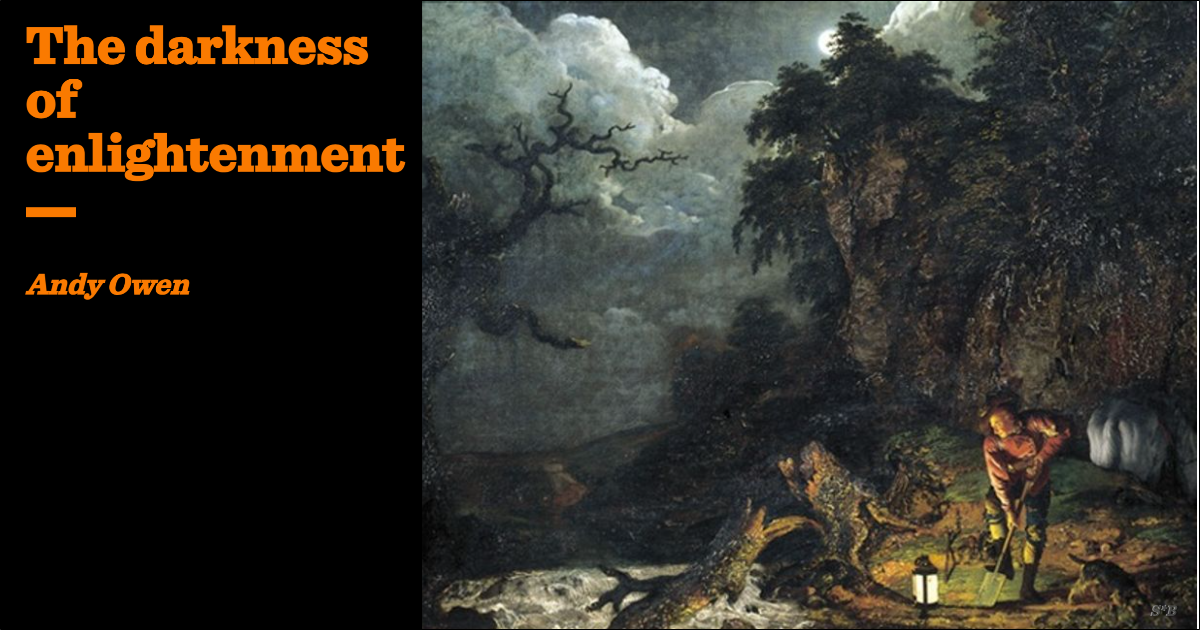
Wright’s paintings captured the manual labour and the scientific innovation of the industrial revolution yet also contained memento mori. Displayed here is A Philosopher by Lamplight, in which an old philosopher in a lamp lit cave is observed by two travellers, playing with a skeleton, almost disinterestedly lifting a long bone as its skull lolls backwards with un-staring eyes. Also displayed is Earthstopper on the Banks of the Derwent, which shows a man digging by lamplight at nighttime beside the River Derwent in Derbyshire, blocking foxholes so that a subsequent foxhunt could kill the fox without the animal having the opportunity to hide underground.
This small but superb exhibition shows how Wright’s work located our material discoveries and conquests in our emotional human world
One of England’s most famous poems, Thomas Gray’s Elegy written in a Country Churchyard, had recently been published in 1751 and was part of a gothic genre called the “Graveyard Poets.” The poem tells us that “The paths of glory lead but to the grave” and laments the unfulfilled potential of England’s poor who could include a “mute inglorious Milton” beneath the poet’s feet. The eerie, mysterious, numinous quality of A Philosopher by Lamplight and Earthstopper, as well as his paintings of blacksmiths and iron forgers set in the ruins of a church or abbey, echo the poetic sentiment of these poets.
This small but superb exhibition shows how Wright’s work located our material discoveries and conquests in our emotional human world. He can provide a timely warning to today’s scientists to avoid cosmic hubris and remember, as they try to create new intelligences before we really understand our own, that scientific progress is no guarantee of moral and ethical progress. As we emerge out of darkness, we should fan the flames of our curiosity, humbly situate our discoveries in the widest understanding of what it means to be human and enjoy the spectacle of our brief time in the light, whilst remembering it is to the darkness we all must return.