With its exposed brick Georgian facade, traditional bar and fireplace, and a beer garden nestling at the foot of the Chilterns, it looks at first glance like any pleasant but unremarkable old country inn.
But The Plough at Cadsden in Southern Buckinghamshire has not one but two unusual claims-to-fame.
The first is that it is the local boozer for Britain’s Prime Ministers.
This is courtesy of the fact that the first property you encounter if you walk out of The Plough and up the famous Ridgeway path from that beer garden is Chequers, the historic country house set aside for use by the incumbent PM.
And it was indirectly because of this that The Plough achieved its second claim-to-fame: because, extraordinarily, this inconspicuous Buckinghamshire boozer is closely linked to the murky post-Communist regime in Beijing.
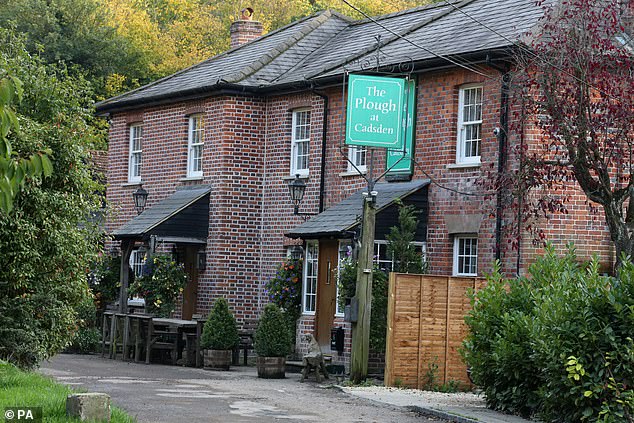
The Plough at Cadsden in Southern Buckinghamshire has not one but two unusual claims-to-fame: it is the local boozer for Britain’s Prime Ministers, and it has a mysterious Chinese owner
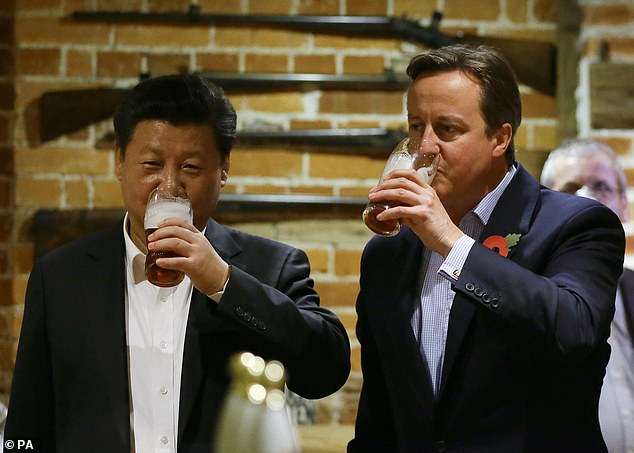
he strange episode of The Plough and the Chinese began to unfold ten years ago this month. On 23 October 2015, then PM David Cameron popped down to his local with a VIP guest – China’s President Xi Jingpin
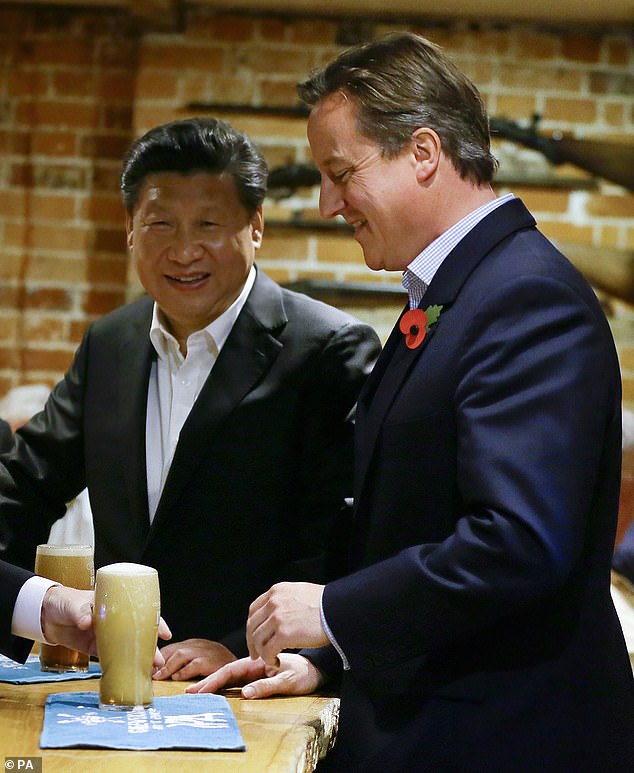
It seems that this slightly lively pint didn’t put off Cameron’s visiting guest – or his fellow Chinese investors. The photo opportunity in the pub was the cue for a prominent Chinese businessman known to have connections to Beijing to suddenly become interested in The Plough
The story of how that came to happen and what it has meant is rather a curious one to which a lot of speculation – and even a James Bond-style conspiracy theory – have become attached. The strange episode of The Plough and the Chinese began to unfold ten years ago this month.
On 23 October 2015, then PM David Cameron popped down to his local with a VIP guest.
He then announced this visit on social media: ‘I dropped into The Plough at Cadsden for a pint of IPA and some fish and chips with China’s President Xi,’ he wrote. And he accompanied this news with a picture of himself with Xi, each clutching a pint inside The Plough’s main bar.
Apparently the visit was to appease Xi’s fascination with a national dish – the Sunday Times had reported earlier that week: ‘The Chinese are desperate to order fish and chips. They’ve asked about it repeatedly.’
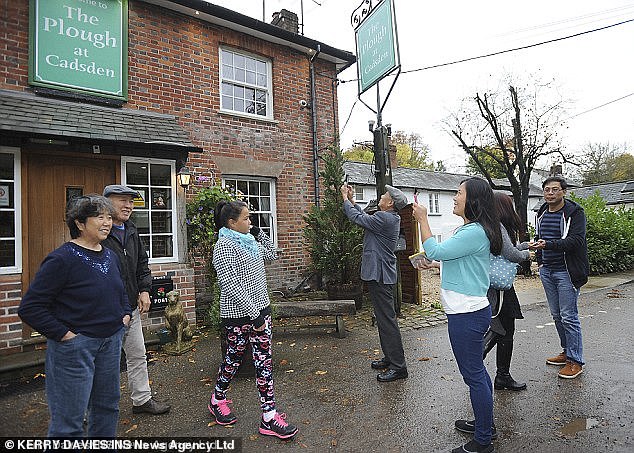
Writer John Sturgis visits the Chinese-owned Plough, near Chequers, where he encountered a large selection of traditional pub crisps … and an interesting conspiracy theory
The photo opportunity in the pub was the cue for a prominent Chinese businessman known to have connections to Beijing to suddenly become interested in The Plough.
Peter Zhang was well known in The City because of his status as agent for CRG3, a state-controlled Chinese company with huge resources. It was this connection which had persuaded well-regarded City figure Sir Richard Heygate to team up with Zhang as a consultant on investment deals with his new company SinoFortune Group.
And soon Zhang – often accompanied by Sir Richard – was everywhere, announcing Sinofortune’s grand plans for billions of pounds of investment across the UK.
The most unlikely – and least valuable by some distance – of these schemes was the takeover of The Plough.
The pub’s owners were made an offer they couldn’t refuse. So generous was the offer – rumoured to be north of £2m – that they decided to retire immediately and threw a party to celebrate the fact that they could now do this in style.
And more celebration would follow: new landlord Zhang invited financial journalists to the pub to mark his takeover. He served them those now famous fish and chips, this time accompanied by Chinese dumplings, while explaining his bonkers-sounding plan: he wanted to open 100 replicas of The Plough across China within three years.
Zhang was later quoted in the state-run China Daily newspaper explaining further: ‘We are so excited about this new adventure…The English pub concept is growing very fast in China and it’s the best way culturally to link people from different countries and build friendships.’
This sort of grandiose scheme was typical of Zhang’s plans at the time.
There was also to be a £100m theme park in Kent, £250m to build holiday resorts in Cornwall, the Lake District, London and Scotland, a £2bn investment in two biomass power plants in Stoke and Huddersfield, a £10bn deal for infrastructure in Scotland, even suggestions of a takeover of Liverpool Football Club.
If all this sounds a touch hubristic, it was. What actually happened was – nothing.
All of these deals fell through. Those public figures who had talked them up – Nicola Sturgeon, for example – were left with egg fried rice on their faces.
Sir Richard would later conclude that Zhang had not had access to the resources he had initially claimed. It was ‘all b******s’, he conceded. The company’s website shut down and Zhang went to ground. There has been no reported sighting in some years.
The only deal that did go through was the purchase of this solitary pub south of Aylesbury, just off the A413.
So what happened next?
The Plough just went on much the same. A hundred replica branches were not rolled out across Asia. None were.
And the only visible consequence of its China connection was that The Plough became a new staging post on tours of olde England for thousands of Chinese tourists.
The Plough remains Asian-owned to this day even if it’s not clear who exactly is in charge. According to Companies House, its current owner is one Xinyu Tang, a mysterious Chinese national. There are a number of Xinyu Tangs on LinkedIn but none describing themselves as a publican or landlady. She is rumoured to be or to have been Zhang’s girlfriend. Though who really knows? Certainly not the staff at The Plough.
Chinese tourists often visit the Plough for a pint of IPA and some fish and chips
They seem as much in the dark as anyone.
I visited the pub this month and found it visibly unchanged from the day it found global fame ten years ago.
At the height of his big-talking Zhang had even described The Plough as ‘the best known pub in Britain’ – which sounds particularly far-fetched during my visit when it’s barely half full on a pleasant Sunday lunchtime.
The same hunting guns that Cameron and Xi posed in front of are still mounted on an exposed brick wall. Punters can recreate the image featuring themselves, as a framed copy hangs just along the wall for visual reference.
But aside from this small print of Cameron and Xi – who, a decade on, remains the most powerful man in China and hence one of the most powerful in the world – there is no other visible suggestion of any connection with the Chinese.
The cask ales on tap come from nearby Marlow rather than Shanghai. The snacks are Scampi Fries and salt and vinegar crisps rather than rice crackers. They still serve those fish and chips (£20.95 accompanied by peas and tartare sauce) now minus the accompaniment of dumplings or anything else Cantonese or Szechuan.
The pub’s history had already been rich before the Chinese ever heard of it.
It was, for example, the site of the 1643 wake for John Hampden, one of the Parliamentarians who provoked the English Civil War, after he was killed in one of its early battles.
But it’s the cold war that The Plough evokes these days – at least according to what is undoubtedly the best story about The Plough of them all.
For this story I will quote (anonymously, as requested – for his own safety), the local drinker who told it to me.
‘The Plough is a spying base from which the Chinese secret service monitors the British Prime Minister,’ he told me. ‘If you think about it, it’s obvious. There’s 40,000 pubs in Britain and they buy a single one and it just happens to be the one a stone’s throw from the Prime Minister’s home where he entertains other heads of state?
‘Anyone who can’t see why that might be the case is incredibly naive.’
The spectre of widespread Chinese espionage activity in the UK was raised just this week when the trial of two Britons said to be working for Beijing collapsed for technical reasons.
The pair had been accused of ‘gathering and providing information prejudicial to the safety and interests of the [British] state’.
So it would appear that our security services believe such espionage by the Chinese does go on.
But if The Plough really is serving pints of Stella to local walkers above some Bond villain-style secret warren of tunnels teeming with Chinese secret agents wielding listening devices, then it’s fair to say that their efforts to disguise this fact have been very successful indeed.
And staff at The Plough seem blissfully unaware.
‘The owners never come here and we have almost no communication with them,’ one told me, speaking on condition of anonymity. ‘In fact the place could do with a bit of upkeep but they’re just not interested. We’re not even quite sure who they are.’
Despite this wider failure to become a global brand, I’m told The Plough remains very much a destination for Chinese tourists.
‘We used to get loads of Chinese visitors here in the first two or three years after the President Xi visit – they’d come in coaches on their way back from visiting Bicester Shopping Village,’ another bar worker told me. ‘There’s less mania about it these days but we still get Chinese visitors several times a month turning up, often in minibuses.’
The Plough has been described as our only Chinese pub. This is based on the assumption that you don’t count the 2,700-odd Greene King pubs around Britain whose ultimate owner since a £2.7 billion takeover in 2109 is Hong Kong billionaire Li Ka-shing of CK Asset Holdings – but as they are still run by an established UK management firm, I don’t. The Plough is in a class of its own.
On the day I visited, there was a single drinker of Chinese heritage in the beer garden. However she hadn’t come from China but from the nearest town, Wendover, just three miles away. Nor had she ever heard about the famous Cameron-Xi drink at the Plough. She had just popped in after working up a thirst walking on the Chilterns, she told me. As, to be fair, had I.
Because ultimately The Plough remains a good place to wet your whistle after a walk, even if its workings are mysterious.