With Trump carving out a new sphere of influence over Latin America following his raid on Caracas, the question for us in Britain is this; where does a world order based around spheres of influence leave smaller middle powers such as us, still struggling to re-establish ourselves as an independent nation-state after decades as a member-state of the European Union?
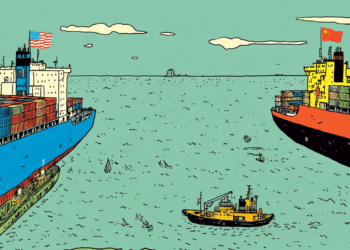
British prime minister Sir Keir Starmer has studiously avoided criticising Trump’s actions, while opposition leader Nigel Farage has supported Trump, seeing it as a warning to Moscow and Beijing, rather than as a back-handed endorsement of their own gangsterism. After all, in kidnapping Venezuelan president Nicolas Maduro, Trump has not only provided retroactive legitimation for Russian efforts to annex eastern Ukraine, but has also made it easier for Beijing to reclaim Taiwan by force.
The Chinese Communist Party will now be more confident that Trump’s actions in the Caribbean have soaked up global shock and outrage, especially among the broad range of non-aligned middle powers in the Global South that make-up China’s diplomatic constituency abroad. Trump’s actions will make it easier for Beijing to cast any grab for Taiwan as a defensive strategy in reaction to the US, rather than as regional destabilisation. So where does all this leave Britain, remote as we are from Ukraine, Taiwan and Venezuela?
Both Starmer’s and Farage’s responses to Trump’s new gunboat diplomacy avoid the harder question, which is not what to do about Venezuela, but rather how to articulate a geopolitical strategy that asserts Britain’s national interests abroad. In a world divided between Trump, Putin and Xi Jinping, does Britain need to carve out its own (inevitably more modest) sphere of influence, perhaps staking claims to the oil of the North Sea and South Atlantic?
At one level of course, assertions to a British sphere of influence would be akin to high-level performance art, similar to urgings that Britain urgently prepare to fight a war with Russia. Such demands are hallucinatory, made by people that know full well that the British state has neither the capacity nor the authority to put its legions of roadmen in uniform, that the army is shrivelled to historic lows, and that its procurement policies are snarled up in grisly levels of bureaucratic incompetence. Small wonder that the British army is, like Putin, seeking to recruit more foreigners than citizens. More to the point, how can Britain claim influence anywhere in the world when it cannot even police its own borders?
The hard-headed response to this farrago is not to seek to play in the same grim league as Trump or Putin, but instead to transform Britain. Here, the realist response would not be to stake out imaginary spheres of influence on the oceans, but rather to foster internal national renewal — not through military adventurism or special forces raids to kidnap tinpot Third World dictators, but by strengthening the British nation. This would obviously involve expanding state capacity by tearing away the red tape that prevents us from being self-sufficient in energy as well as nationalising key utilities and industries. More importantly, it would also mean strengthening the authority of the British state, thereby enhancing the popular legitimacy that it could draw on to defend our national interests.
This is the lesson about the national interest that Trump has evidently forgotten. In tangling himself up in regime change in Latin America, Trump is forgetting that his voters — especially veterans and their families — originally put him in the White House because they were hostile to the forever wars and nation-building experiments of Trump’s globalist predecessors. The lesson of Trump’s electoral success is that the national interest is less about imposing one’s will on other nations so much as effectively expressing the will and interests of one’s own citizens — in this case, the people of the heartland whose work and patriotism were the basis of America’s greatness, and who had been abandoned in America’s bid for global supremacy.
Granted all this, if Britain were in a stronger position internationally, and enjoyed the greater national strength and political confidence that would come from the British state enjoying more popular legitimacy, it is still not clear that it would be in Britain’s national interest to carve out its own sphere of influence. Spheres of influence are, after all, themselves expressions of weakness. Russia invaded Ukraine and annexed its eastern oblasts because it was not strong or rich enough to sway Ukraine through diplomatic or political means, and because Ukraine’s youth looked westwards rather than eastwards for their future. Similarly, Trump is re-establishing a regional sphere of influence in Latin America because the US is no longer strong enough to maintain its global hegemony. China is perhaps in a stronger position, having laid the infrastructure of global influence by building up its industrial might and exporting goods that people want to buy, rather than by using military force to compensate for political weakness.
Obviously, there is no industrial policy no matter how ingenious or cunningly devised, that would allow Britain to become the workshop of the world once again. Nor is there any procurement policy that would make Britain a military superpower. So what would a geopolitical strategy of national renewal look like? More than spheres of influence; as an independent middle power, Britain needs strong new friends and allies abroad. At the moment, these are in short supply. Trump’s raid on Venezuela and continual threats to Danish sovereignty over Greenland make clear that Trump is no champion of national independence, and that membership of NATO is redundant. In so doing, Trump has at least exposed that membership of international organisations cannot substitute for political self-reliance and having the capacity to defend one’s own national independence. Here, Britain does have one geopolitical advantage that even the superpowers lack – that is that its voters made a precocious early break from globalism when we voted to restore national sovereignty via Brexit back in 2016. This gives us a solid democratic – and therefore legitimate – basis on which to craft a new geopolitics.
Trump has at least exposed that membership of international organisations cannot substitute for political self-reliance and having the capacity to defend one’s own national independence
Brexit Britain is thus in a prime position to build up new international leagues of independent middle powers acting on their national interests. Some of this effort is already underway, such as with Britain’s negotiations in the Comprehensive and Progressive Agreement for Trans-Pacific Partnership (CPTPP), that includes resource-rich potential trading partners and growing, dynamic economies such as Australia, Canada, Malaysia and Vietnam,. But a geopolitics crafted around national independence requires sovereign states as partners – and our closest and natural allies, by dint of geography, history and peer-level size in economic and political terms, are the middle powers of the Western Atlantic – namely, the Netherlands, Norway, France, Germany, Spain and our closest neighbour, Ireland. These are states that Britain could never suborn into a sphere of influence.
At the same time however, most of them are member-states rather than nation-states. They are locked up in a crumbling, economically stagnant confederation, hoping that membership of the EU can compensate for their internal weaknesses and fantasising that the more they sacrifice their independent national interests, the more they can collectively compete on a global level with Moscow and Beijing. If we are to secure Britain in her region alongside powers such as Germany and France, more than a sphere of influence we need reliable allies – allies that are free from outside interference from Brussels and that can be relied on to follow their national interests as independent states. This means in short, that Britain’s national interest is to break up the EU into independent nation-states.
For centuries, British foreign policy hinged around ensuring that no single power dominated the continent – whether from Paris, Berlin or Moscow. Britain even yoked itself to the US in the process of seeking to preserve a European society of independent states. The one exception to that pattern has been Britain’s willingness to tolerate Brussels as an imperial transnational capital. As Trump pulls back American hegemony to the Western hemisphere, Britain has even less need to tolerate a continental trading bloc that is not only hostile to Britain but also undermines Britain’s traditional allies, sapping their popular sovereignty and gouging out their national interests. Britain’s national interest lies in making alliances with national sovereigntists across the continent, and encouraging them to bring the EU to an end. This is the way to make true allies of potentially powerful independent states that are also our immediate neighbours, thereby helping to ensuring our security. Instead of fantasy spheres of influence, Britain needs a foreign policy of Brexit-maxxing.