The late Gore Vidal once recounted how Norman Podhoretz, the neoconservative intellectual and longtime editor of Commentary, was flummoxed by Vidal’s persistent interest in the American Civil War, which to Podhoretz was “as remote and as irrelevant as the War of the Roses.”
Vidal, who chronicled American history through his series of bestselling novels, was struck by this distant and alien sentiment, since “the Civil War was—and is—to the United States what the Trojan War was to the Greeks, the great single tragic event that continues to give resonance to our Republic.”
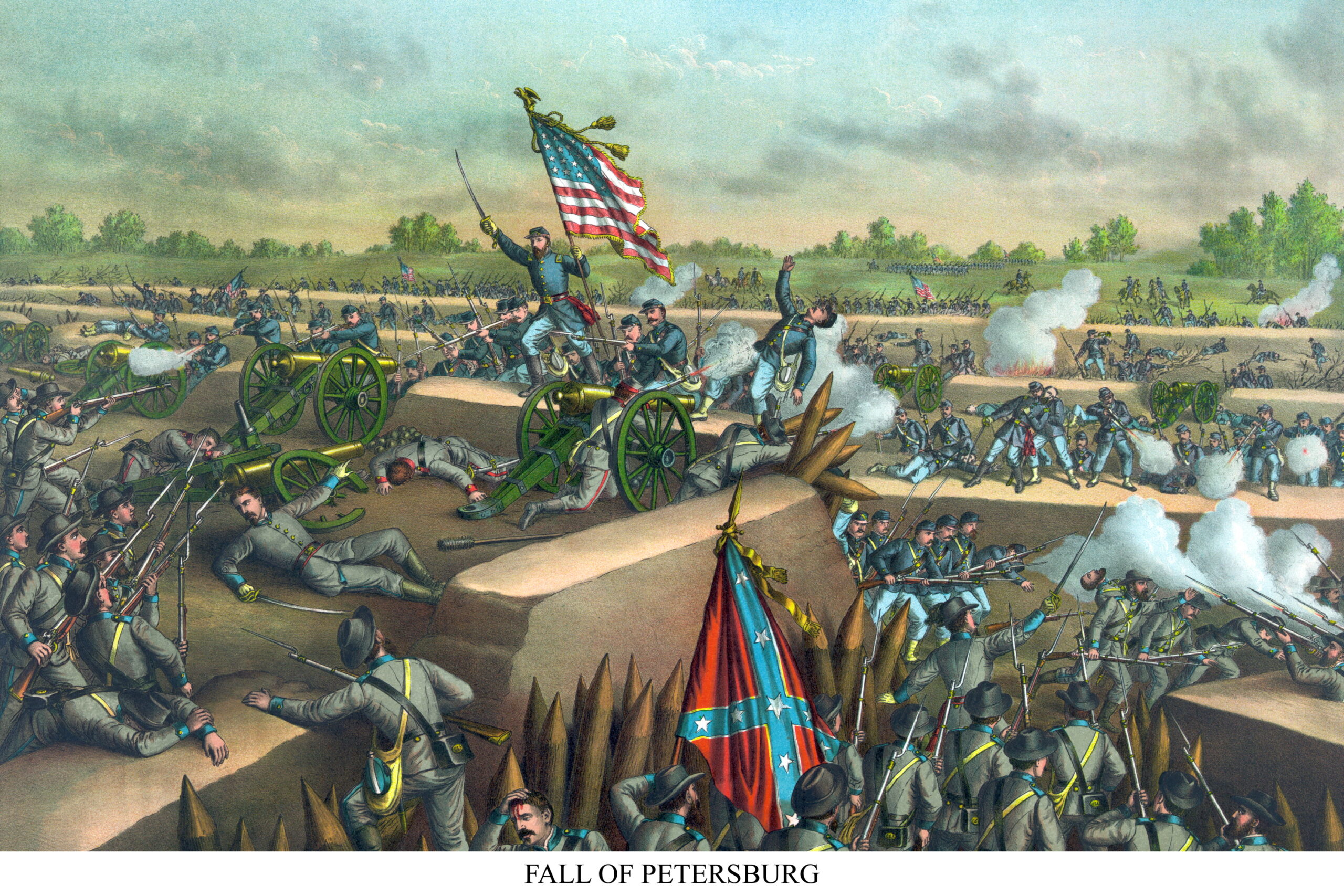
Though it’s little talked about, the Siege of Petersburg represents the last chapter of the war in the east, lasting 292 days—a fifth of the Civil War’s whole duration.
The seventh largest city in the Confederacy and the second largest in Virginia, Petersburg was a major transportation hub in addition to possessing several iron foundries and tobacco depots. General Robert E. Lee and his Army of Northern Virginia hunkered down to protect their supply routes and the Confederate capital of Richmond, holding off encroachments from Union Generals Ulysses S. Grant and George Meade and their Army of the Potomac.
This was not a campaign of glorious bayonet charges; there was no Gettysburg moment. Soldiers were “living like a rat underground” for nine months, explained a local guide, dying in ever-tightening trenches amid continuous offensives which foreshadowed the combat of the First World War. In the local Blandford Cemetery—the second largest in Virginia, after Arlington—30,000 Confederates are buried, but only a little over 10 percent are identified.
This was a fitting spot to host an October conference headlined, “1865: A Year of Reckoning,” the 29th annual symposium held by Pamplin Historical Park, site of the National Museum of the Civil War Soldier and the “breakthrough” battlefield that ended the Petersburg siege on April 2, 1865.
The first symposium began modestly enough in a hotel with a dozen Civil War aficionados. (One couple in attendance had been to all 29). But these days it is a disciplined, three-day event that attracts a sustainable crowd of over fifty registrants, with a predictable census: overwhelmingly elderly, mostly male (75 percent), and exclusively white.
“Always nice to see some guys who aren’t on Social Security,” a park guide said to me and a friend, both young millennials.
This year’s topic focused on the end of the war: the concluding military campaigns, the terms of Confederate surrender, the intentions of the Lincoln administration (cut short by his assassination), and how the American people faced the future in 1865. Professor Brooks D. Simpson of Arizona State University lamented that his students are always interested in how wars start, but that “we don’t study how wars end.”
President Abraham Lincoln personally visited the battlements at Petersburg and witnessed the guns firing. With the apparent end of the war at the forefront of his mind, Lincoln composed what Harold Holzer, Director of the Roosevelt House Public Policy Institute at Hunter College in New York, referred to as “the greatest inaugural address in presidential history.”
A speech of less than 10 minutes, the shortest since George Washington’s second inaugural and until Franklin Roosevelt’s fourth, Lincoln’s second inaugural laid the basis for what he hoped would be a sectional and racial reconciliation: “With malice toward none, with charity for all, with firmness in the right as God gives us to see the right, let us strive on to finish the work we are in to bind up the nation’s wounds….”
Lincoln was “a sucker for sentiment,” chimes Holzer, who supposes “maybe we could try for that [forgiveness] again” to heal current national divides.
When his position in Petersburg finally became untenable, Lee withdrew with 50,000 men composed of dismounted cavalry, old draftees, militia, and local call-ups, “not the army he started with” in 1862. Although denying any consideration of surrender for another week, after his route of escape was cut off and his expected resupply of food confiscated, Lee stopped his army’s march at Appomattox Court House to surrender his sword on April 9.
“Let them up easy,” had been Lincoln’s instruction for Generals Ulysses S. Grant and William T. Sherman, both of whom understood the instruction and agreed with the magnanimity.
Grant paroled Lee’s men, and sent 25,000 portions of captured rations to the former Confederates before letting them go home. Sherman’s terms to General Joseph E. Johnston on April 17 were just as generous, and as explained by Craig Symonds, formerly of the U.S. Naval Academy, the two generals even tried and failed to craft a broader peace agreement. Although there would be Confederate armies in the field until late June, the war was effectively over.
When one of Lee’s lieutenants suggested dispersing the army into the mountains to continue the fighting as guerillas, Lee declined. “General, you and I as Christian men have no right to consider only how this would affect us. We must consider its effect on the country as a whole.”
That sentiment for peaceful coexistence and an end to the bloodshed was shared by the legendary Confederate General Nathan Bedford Forrest, who despite expectations surrendered his 8,000 cavalrymen. Forrest instructed his men:
Civil war, such as you have just passed through, naturally engenders feelings of animosity, hatred, and revenge. It is our duty to divest ourselves of all such feelings; and as far as it is in our power to do so, to cultivate friendly feelings towards those with whom we have so long contended, and heretofore so widely, but honestly, differed.
As I chronicled previously in The American Conservative, post-2020 cultural arsonists have torn down and destroyed statues of both Lee and Forrest, among other Confederate veterans. Professor Brian Steel Wills of Kennesaw State University said the act of taking down these statues gave “success to the wrong kind of message and the wrong kind of people.”
Subscribe Today
Get daily emails in your inbox
Whether attendees traveled to Petersburg from the north or south, and whether their ancestors wore the blue or the gray, there was a distinct sense of kinship among these people who remember better than anyone how bitter political divides can lead to bloody and unpredictable results. “Wars promise more than they deliver. And they deliver more than most would care to promise,” explained George Rable, professor emeritus at the University of Alabama.
Carlton Lowry, a retired carpenter and member of the Sons of Confederate Veterans, has volunteered at Pamplin Park for 14 years. “My advice to people when they come and ask me certain questions about history is to take the time to read the journals from these soldiers that actually fought in this conflict and the history that people wrote about back then and apply it to yourself,” he told TAC.
“There are plenty of people here who have mentioned that if you place yourself in their time, you’ll understand more why what was happening did happen. I feel strongly that we’re getting ready to repeat another civil war because too many people are ignoring what happened in the last one,” Lowry surmised.