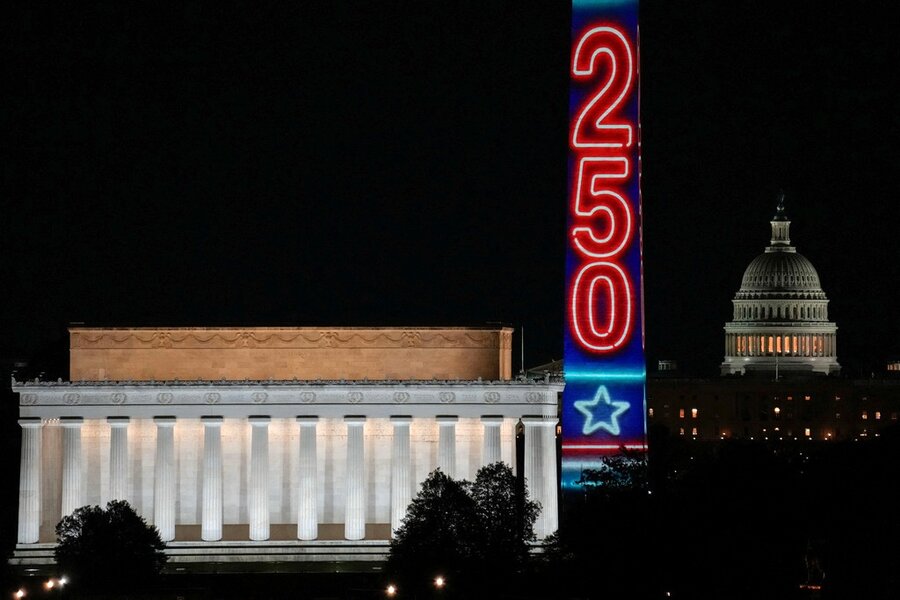
Amid a fraught political environment, Americans are preparing to mark the 250th anniversary of the United States this year. It’s a timely opportunity for both honest self-reflection and potential unity – around a remarkable story of national achievement and a recognition of all that still needs doing to fully realize the country’s founding ideals.
Two-thirds of Americans, the Pew Research Center reported this week, believe it is extremely or very important to publicly discuss historical strengths and successes – as well as flaws and failures.
Yet, the nation still disagrees on how to tell its history. The Trump administration has issued directives to parks and museums to remove signage that it views as not in “alignment with shared national values.” Last week, the city of Philadelphia filed a lawsuit against the Interior Department for removing exhibits referencing slavery at the site of a residence once occupied by George Washington. The City Council deemed this “an effort to whitewash American history.” The exhibits were controversial in 2010 when they opened during the Obama administration.
At the same time, according to a report by the center-left Progressive Policy Institute, recent historical scholarship has tended to present “a one-sided and unrelentingly negative portrait” of the U.S., examining its “moral failings but nothing about its virtues.” Studying nearly 100 articles published in American Quarterly, a journal of the American Studies Association, the report found that 80% were critical of the U.S., 20% were neutral – and not one was positive.
Ideally, the researchers said, scholars should “seek to capture the whole of America: the challenges alongside the heroism; the slavery and segregation, but also freedoms and values that gave rise to the civil rights movement; … economic inequality with an understanding of how the country came to have the world’s most vibrant economy.”
Their observation echoes counsel that President Barack Obama offered in 2015 during a speech honoring civil rights marchers in Selma, Alabama.
“To deny … hard-won progress – our progress,” Mr. Obama said, “would be to rob us of our own agency … to do what we can to make America better.”
Attaining a candid and balanced reckoning with history is a worthy endeavor, one that might help bridge political divides and offer guideposts for the next 250 years. The process would call for a willingness to consider varied perspectives, especially from those whose stories and contributions have previously been ignored. But it would also need to avoid what one historian has described as “reading the present into the past” – judging (and condemning) history and historical figures by present-day norms and standards.
Ultimately, coalescing around a shared history is about a civic purpose that goes beyond academic debate or disciplines. As late sociologist James Loewen observed: “We aren’t just learning about the past to satisfy our curiosity – we are learning about the past to do our jobs as Americans.”