The discourse on the health benefits of art is back. Unable to sustain the narratives of economic or political prowess of culture, which just about carried arts institutions in the past decades, leaders are once again speaking of “creative health”. A series of think pieces in the industry magazine Arts Professional, for example, recently suggested that tripartite collaborations between cultural producers, the NHS, and universities would overcome the all-too-obvious limitations of programmes with names like Dance to Health. It is almost as if some parts of the establishment thought it were 1997 again, the year François Matarasso published his infamous whitepaper Use or Ornament, which paved the way for the social instrumentalisation of all creativity.
Whether they are genuinely well-meaning or merely opportunistic, as Ella Nixon pointed out in this magazine, these narratives collapse under the weight of the expectation put on them. Recently, demands have intensified among the increasingly alarmist accounts of the nation’s declining “mental health”.
The question of an artefact’s relationship with its maker’s mind may only be addressed aesthetically
Few initiatives, however, attempt to answer a fundamental question which, by necessity, precedes the therapeutic: how does art reflect how we feel? This phrasing is so deceptively simple that the only way to avoid the pitfalls of instrumentalisation is to insist that the question of an artefact’s relationship with its maker’s mind may only be addressed aesthetically. In other words, it must be the work of art itself that is the answer.
The Weight of Being, an exhibition of over a hundred works loosely linked to mental health struggle, sticks more closely than many such projects to what is discernible directly from the artefact. This show, staged at the opulent neo-Tudor Two Temple Place on London’s Victoria Embankment, is quaintly unassuming in its selection principle, and not only by contrast with the setting. The exhibition foregrounds painting, for example, and includes multiple works of a single, relatively unknown artist.
The recognition that the inherited English “stiff upper lip” attitude to emotion has become inadequate in postmodernity is at the core of curator Angela Thomas’s project. The Weight of Being subtly reflects the evolution of mental health as a paradigm — without, alas, making overtly psychological claims.
A dozen or so canvases by the painter John Wilson McCracken, loaned from the collection of a Northern English borough council, scaffold the show. McCracken studied at the Slade in the 1950s and was diagnosed with schizophrenia shortly after graduating. With the support of his family, he retreated to Hartlepool, where he became active in the local art scene. His life was cut short by illness in 1982.
Until recently, McCracken was remembered primarily as the animator of artistic exchanges between the institutions of the North East and the Soho art scene with which he kept close correspondence. He takes the credit, for example, for arranging an exhibition of works by Lucien Freud travelling to Hartlepool, and the town purchasing a work from it.
Yet even without this biography, McCracken’s work attests to the psychological turmoil of twentieth-century Britain. It also points to this turmoil’s aesthetic reproduction. McCracken’s canvases variously adopt the hallmarks of Freud, Francis Bacon, and Paula Rego, with whom McCracken rubbed shoulders in London. The younger artist was discernibly inspired by his peers’ depictions of anguish, yet he applied their techniques to subjects who could not benefit from wider artistic attention.
For example, his 1974 Figure in Interior, a ghostly rendering of a body trapped by the apparatus of an institution — the school classroom, hospital waiting room, and prison canteen being interchangeable in his hand — is unmistakably informed by Bacon’s celebrated studies in despair. It shares with it aspects of composition and brushwork, and even a certain studied indecision. Yet it is the unfamiliarity of McCracken’s images that offers a profound insight into the condition of both its maker and sitter. It is, in other words, the painter’s status as a minor artist that allows for his internal state to become apparent, because it is layered between other, easily digestible aesthetic influences.
Does it not, therefore, fall to art — in its aesthetic, rather than instrumental sense — to solve it?
This is not a minor point, nor does it disparage McCracken’s work. However, the institutions responsible for the staging of The Weight of Being undeniably have a stake in reproducing ideas of illness in order to make illness itself manageable. What if, as social constructionists maintain, our understanding of mental illness is profoundly memetic? Might art not, to extend Nixon’s critique, be as responsible for making the problem visible as it is for spreading it? Does it not, therefore, fall to art — in its aesthetic, rather than instrumental sense — to solve it? Could Bacon’s portraits of his lover George Dyer, for example, reveal more of the man than the art criticism they fuelled?
McCracken’s work punctuating The Weight of Being highlights the profound difficulty of translating between the mind, the artefact, and language. A handful of works in the exhibition are banal evidence of it. A 2019 series of metal protest placards made by Mark Titchner with the users of HNS mental health services associated with the Bethlem Gallery and Museum of the Mind (which contributed its collection to the exhibition), for example, outright shuns aesthetics.
Titchner’s crowd-sourced slogans include “Is your life governed by your own principles?” and “Where are the resources and support for those who need them?” This series, as well as Narbi Price’s 2025 Untitled Bench Painting, which projects the Palestinian flag onto street furniture, recklessly mixes health and activism. They confuse material demands — critiques of the unequally distributed access to artistic experiences, for example — for a politics of eliminating human anxiety.
Thomas’s exhibition, however, is remarkably even-handed in its social history. Next to Jenna Greenwood’s somewhat predictable feminist banners and Trackie McLeod’s narcissistic queer complaints, The Weight of Being considers the effects of events such as the 1980s miners’ strike (in Robert Olley’s depiction of the battle of Orgreave after Guernica), the desolation of the 2008 economic crash (Nathan Eastwood’s Job Centre scene), and even Brexit (Mark Pinder’s photograph of an EDL protest) without losing focus on how the artefacts illuminate them.
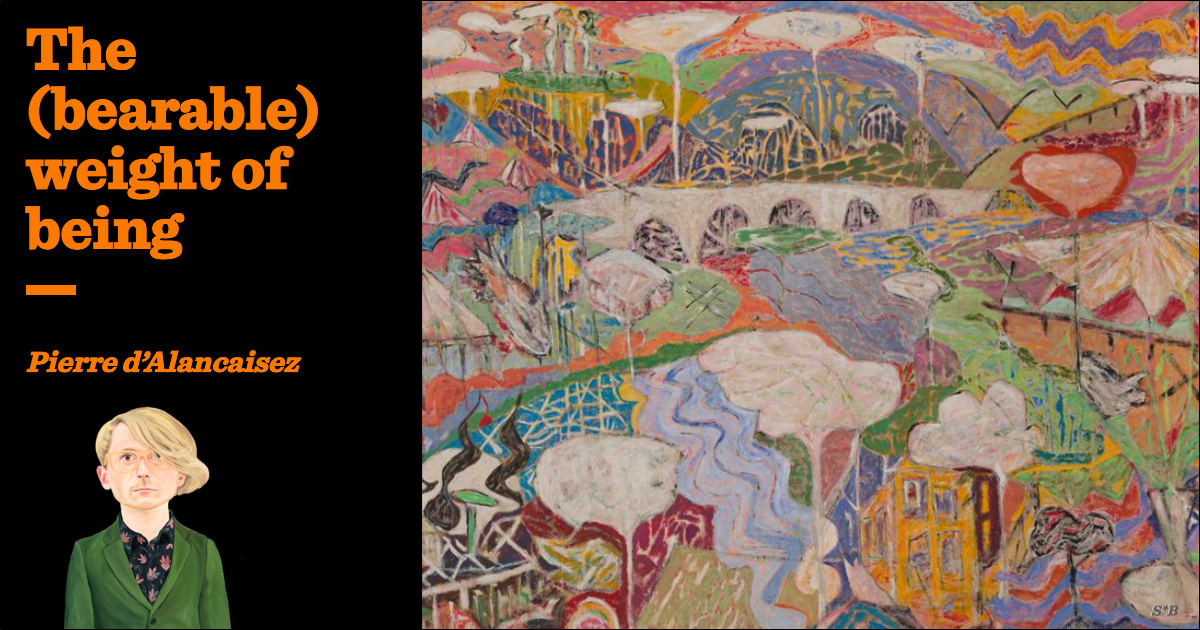
The exhibition’s revelation, then, is that there is an art history to the mind becoming political. Elaine Shelmit’s 1979 video performance Doppelgänger suggests that other ends for the public understanding of the mind were possible. The piece, in which the artist applies makeup in front of a mirror while two narratives of schizophrenia confuse the image, is explicitly psychoanalytic, offering no cure. Gordon Dalton’s 2019 acrylic landscape Life is hard, that’s why no-one survives, likewise implies that to look for a single exit is an idle fancy. This pastel-coloured canvas’s extraordinarily rich collection of natural and human motifs lacks focus yet includes both patterns that propel the eye and fragments for respite.
Is there a prognosis here? The show’s non-chronological curating confounds even hackneyed critiques of today’s younger generations as inauthentically vulnerable. Paul Butler’s 1977 charcoal-grey Office and Johannah Churchill’s 2021 photographs of exhausted nurses during the Covid pandemic share a wall, as though to suggest that neither of the conditions they depict is exceptional, and even less avoidable. If Thomas’s project makes a proposal, it is in the unstated contrast with the title of Milan Kundera’s novel, in which being is “unbearable” not by its weight but by “lightness”. The Weight of Being is thus not an endorsement of the stiff upper lip, yet it returns due diagnostic attention to art itself.