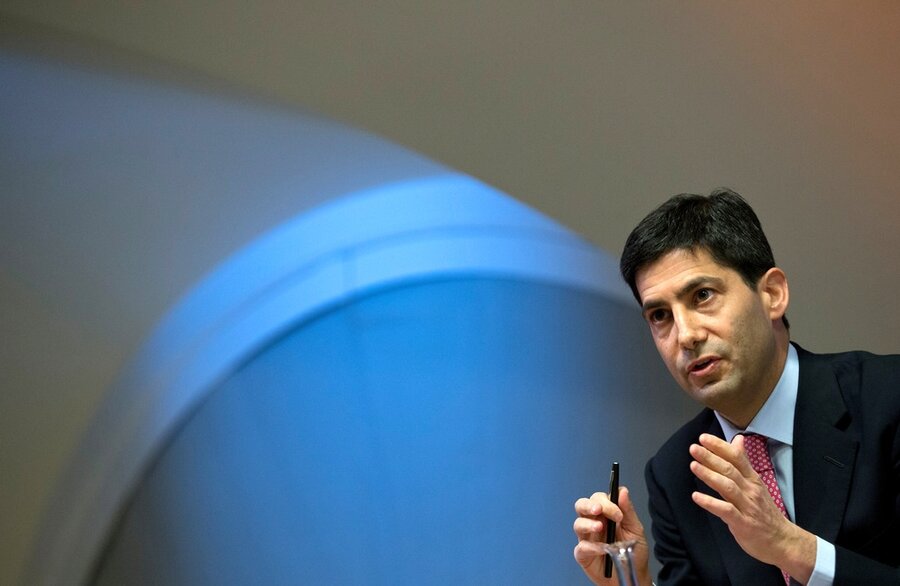
The U.S. Senate will soon grill Kevin Warsh as President Donald Trump’s nominee to head up the nation’s central bank starting in May. The position is one of the most powerful in Washington. The Federal Reserve, with its mandate from Congress to ensure stable prices and full employment, helps steer both the American and world economy, mainly by setting interest rates.
Given that the Senate easily approved the former Wall Street lawyer two decades ago to sit on the bank’s board – as the Fed’s youngest-ever governor – it might not probe him hard on one of his most intriguing yet disputed ideas.
Yet, it should.
Mr. Warsh, a graduate of Stanford and Harvard, maintains that the American people – in their curiosity, ingenuity, freedom, equality, and collaboration – are as important as the Fed in keeping inflation low. How? Their dynamism and adaptability to failure will keep economic productivity at such a high level that it will sustain wage growth and act as a disinflationary force.
During his adult life, Mr. Warsh has seen the internet and computers, then mobile phones, and now artificial intelligence help drive efficiency in private business and make the economy more competitive. He says the Fed should focus more on keeping interest rates low for small and medium-sized companies to drive such innovation. The bank, he says, has slipped into a role beyond its mandate: subsidizing high government spending and debt.
His optimism on AI’s potential is not widely shared. Its effects in destroying and creating jobs has yet to be seen. He admits the productivity gains will be uneven. But the United States is still ahead of China in adopting and perfecting AI, he says, allowing it to ride a “productivity wave” for the next five years.
AI is special, he claims, because it has reduced the cost of curiosity to zero. The ease of finding and formulating ideas with AI will speed up discoveries in industry and science.
“What country is most likely to benefit most from the cost of curiosity being zero and the fruits of knowledge being as large as ever? I think it’s the United States,” Mr. Warsh told the financial technology company Aven.
Breaking an inflationary mindset requires that individuals be curious and inventive in finding solutions. As he said in a 2009 speech during his last tenure at the Fed: “I have not lost confidence in the inherent innovation, creativity, and dynamism in the U.S. economy. Nor have I lost confidence in the inherent good sense of our citizens.”