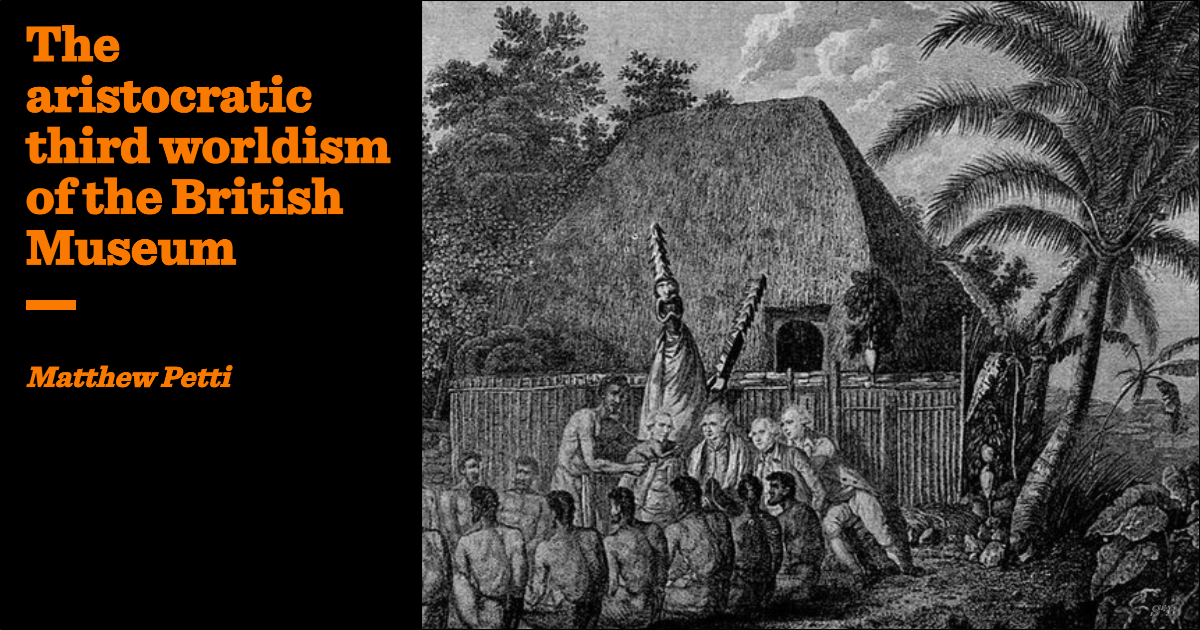
It has become fashionable to talk about decolonising museums and using them to challenge hierarchies. And at first glance, the British Museum’s new exhibition on the Kingdom of Hawai’i looks like that sort of exercise in wokeness. The descriptions speak in the familiar language of collaborating with indigenous artists, respecting the ancestors, and promoting “resistance, resilience and coexistence.”
But look closer, and the British Museum is doing something quite different. The exhibit is a celebration of traditional hierarchy. It mourns the loss of monarchy and oldtime religion in Hawai’i — which orthodox leftists denounced as a “feudal” and “primitive class society” — and tries to revive those traditions. Rather than being a villain, the British Empire is a tragic hero that failed to live up to its noblesse oblige to the Hawaiian nation.
“Seeking alliance, Kamehameha l asked protection for the Hawaiian Kingdom from foreign powers. The letter and cloak took two years to reach England,” reads one description, which notes that the display was designed with respect for the taboo on royal garments touching the ground. “By then, George IV was ruling as Prince Regent. With the gift of this cloak, responsibility for the relationship between these two kingdoms passed to him.”
The elephant in the room is, of course, the later American conquest of Hawai’i. In 1893, a republican coup d’etat backed by American business interests overthrew the Hawaiian monarchy and immediately invited U.S. Marines onto the islands. The British Crown, which had previously protected Hawaiian sovereignty from its own rogue officers, “chose not to intervene, declaring that the fate of the Hawaiian Kingdom was ‘in the hands of the Almighty,’” the exhibit notes with more than a twinge of regret.
Woke Americans often focus obsessively on bygone European empires to obscure the impact of our own present-day empire. Take the movie Black Panther, which famously showed the antihero Killmonger breaking the Benin Bronzes out of the British Museum, in a scene clearly meant to be an epic anticolonial comeuppance. Without a hint of irony, the film then goes on to show a CIA officer saving the fictional nation of Wakanda with the power of airstrikes.
The Hawaiian exhibition inverts that story into a sort of aristocratic Third Worldism. The natural ally of indigenous civilization is the British monarchy, with its Old World sense of honor and lineage. The vulgar American libertine, on the other hand, wants nothing more than to dismantle history for spare parts, flattening traditionally farmed lo’i terraces to make way for industrial sugar plantations. Indeed, decades of statehood in the American republic have done what protection by the British Empire never could: it made ethnic Hawaiians a minority in their own homeland.
In 2023, the historic Hawaiian capital of Lāhainā was burned by deadly wildfires on the island of Maui. The fiasco that followed symbolizes the relationship that locals have come to resent. While authorities fumbled their duty to protect locals, tourists continued to party inside gated resorts. Aggrieved Hawaiians begged visitors to stop flying into Maui on holiday while reconstruction efforts were still underway, yet Maui cannot afford to do away with tourism for too long, because of the relationship of dependence it is locked into.
The exhibition maintains a subtle sense of British-Hawaiian aristocratic solidarity against the crass rabble
The old British desire to turn the world into a museum is perhaps not so bad in comparison. Even as it apologises for the less savoury aspects of the relationship, the exhibition maintains a subtle sense of British-Hawaiian aristocratic solidarity against the crass rabble. When Kamehameha II and his entourage visited Britain in 1824, “[t]heir official welcome was dignified, but they faced public racism and ridicule,” the exhibition notes on a display of unflattering press depictions of the Hawaiian delegation. Only a real nobleman recognises a fellow nobleman.
Indeed, the exhibit ends with a video of children from the Kamehameha Schools — a private school founded, of course, by the old royal family — reciting a nationalist poem.
Beyond defending the Hawaiian monarchy, the exhibition actually embraces its most reactionary form. Premodern Hawai’i was a strictly hierarchical society. The sacred system of kapu (a variation on the Polynesian word “taboo”) separated nobles from commoners and men from women. These rules were ordained by the gods and enforced on penalty of death. Shortly after taking power in 1819, Kamehameha II and his mother Ka’ahumanu moved to abolish them.
Kamehameha II’s cousin Kekuaokalani led a doomed rebellion of the priesthood against these changes; three months after his death, Christian missionaries serendipitously arrived in Hawai’i, offering what would become a final replacement to the old Hawaiian religion. The exhibit admiringly calls Kekuaokalani “defender of the faith”. And it attempts to carry on his legacy, placing some statues of the old gods behind a physical veil while speaking of their enduring power.
This traditionalist stance is not out of the ordinary for Hawaiian nationalists. While the Hawaiian sovereignty movement may seem at home on the Left, speaking the language of racial and environmental justice, it has a profoundly conservative sensibility. Beyond their grievances with economic exploitation and military domination, Hawaiian nationalists mourn an ancient spiritual order whose loss ended their self-sufficient way of life.
If the British Crown were the first outsiders to recognise Hawaiian political sovereignty, then the British Museum is not a bad place for Hawaiians to seek cultural sovereignty. The obituaries for the Age of the Museum may have been premature.