This article is taken from the March 2026 issue of The Critic. To get the full magazine why not subscribe? Get five issues for just £25.
The United States has asserted its primacy in Greenland but cannot control its own far north in Minnesota. As the 250th anniversary of the American revolution approaches, the conflict between empire and republic is explicit, yet the flexing of foreign policy reach and the federal government’s uncertain domestic grasp are interlocking aspects of the same question. Inside and outside, the American system is struggling to manage entropic disorder. This disorder does not only come from the challenges of rivals. It comes from within. Donald Trump is merely the latest and most florid effusion of a founding American principle.
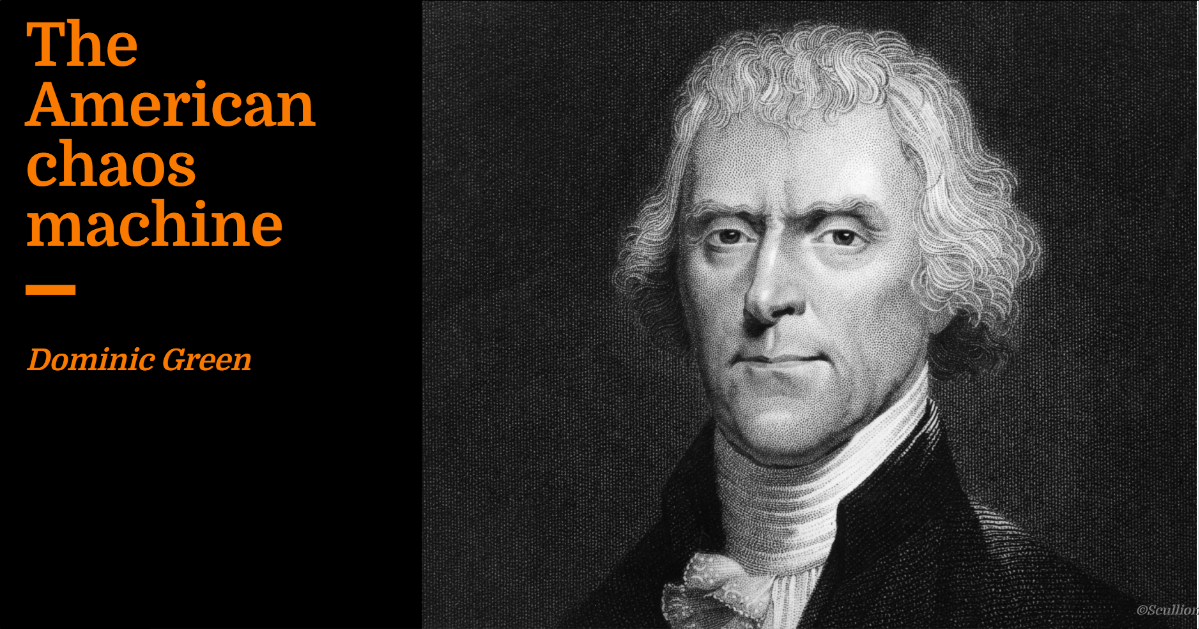
America is a disrupter by birth and constitutional design. When Thomas Jefferson sought to stretch the virtues of yeoman democracy to a historic break with their English sources, it was not just to form a new society. He also sought to unleash the first post-colonial nation’s potential as a counter-empire.
Jefferson first used the phrase “Empire of Liberty” on Christmas Day, 1780. The survival and scope of the new American people were still uncertain, but Jefferson was already looking over the horizon. An “American union,” he wrote to the Virginian militia leader George Rogers Clark, would be a “barrier against the dangerous extension of the British Province of Canada,” and the commerce of America’s “extensive and fertile Country” would convert “dangerous Enemies into valuable friends”.
Later, in 1809, Jefferson advised George Madison, his successor as president, to exploit the war between Britain and Bonaparte’s France by expanding the United States’s borders to “the Southernmost limit of Cuba” and fighting Britain for “the North”, meaning Canada.
When Madison initiated the war of 1812, Jefferson thought securing American sovereignty over the North American continent would be a “mere matter of marching” into Canada. That was more than 200 years before Donald Trump mused about taking Greenland by force. This kind of lawless impulse created the United States. It resurfaces at times of geopolitical stress and will do so as long as the territory of the USA is not the same as the map of North America.
★
In Greenland, America’s unfinished domestic empire coincides with the Thucydidean “security dilemma”. The post-1776 campaign to conquer North America meets the post-1945 marathon of great-power necessity. Warmer oceans and a longer Arctic “melt season” have opened what China calls a Polar Silk Road, a new sea route between the Atlantic and Pacific. Russian and Chinese vessels and companies are circling Greenland’s reserves of rare earth elements and the “critical minerals” that an executive order from the first Trump administration declared “essential to the economic and national security of the United States”.
It is not just the Russians and Chinese who have intruded into the American continent. In November 2023, the European Union and Greenland signed a “strategic partnership” on developing “sustainable raw materials value chains”. The EU called Greenland’s resources “strategically important for Europe’s industry and the green transition”. They include gold, zinc, iron, oil, gas, critical minerals and 1.5 million tonnes of rare earth deposits, the world’s eighth-largest reserves. Three months later, in February 2024, Greenland’s semi-autonomous government announced the goal of full independence from Denmark.
“Look, we have to have it,” Trump said of Greenland on 19 January 2026 before flying to the World Economic Forum in Davos. But the USA has always assumed a proprietary interest in Greenland. Its expression has tracked the expansion of the federal government’s domestic reach.
Empires bring order, but a bow wave of chaos ripples out from their advance
In 1867, the year that the Reconstruction Act was imposed on a defeated South, President Andrew Johnson’s administration bought Alaska from Russia and considered making an offer for Greenland. The idea resurfaced in 1910, when federal capacity was expanding under the progressive agenda of President William Taft. The further expansion of the federal state in FDR’s New Deal preceded the military occupation of Greenland in 1941. The Truman administration offered $100 million in gold in 1946 before securing a nuclear base at Thule in 1950.
The Wall Street Journal reported in 2017 that Trump was talking “with varying degrees of seriousness” about making an offer Greenland couldn’t refuse. The same year, he issued an executive order on critical minerals. Since then, the federal government has extended its reach by investing in domestic mining.
At Davos, Trump’s private meeting with NATO’s secretary-general Mark Rutte elicited what Rutte called the “framework of a future deal”. European officials suggested this included Greenland ceding sovereignty over military bases and granting mining rights to American corporations.
That would align domestic and foreign policies on controlling resources essential to America’s competition with China. But stabilising American interests has destabilised its allies and spun the piqued leaders of Canada, Britain and France towards Beijing. Empires bring order, but a bow wave of chaos ripples out from their advance.
★
In his Farewell Address of 1796, George Washington invoked a vision of “one People, under an efficient government”. This was too much to ask. Americans are too various. America is too large. America is a revolutionary society, founded on sectarian violence and highly tolerant of risk. After the Louisiana Purchase of 1803, Thomas Jefferson told the English radical Joseph Priestley he didn’t think it “very important” whether Americans remained “in one confederacy” or formed into “Atlantic and Mississippi confederacies”. The federal state was barely half-built, and Jefferson was already prepared to let it blow up.
When the colonial compact with London broke down, the future Founders imported a failed revolutionary ideology — the republicanism of the 17th century English and Scottish civil wars — turned it into a doctrine of resistance and rode it to victory on new ground.
Eighty years later, in 1861, these sectarian inspirations, the unfinished business of slaveholding and the sheer scale of the American republic caused further breakdown and the Civil War. Another 80 years, and the state reformulated itself as FDR’s behemoth amidst economic crisis and a world war. Eighty years on, and Americans are again fighting out another redefinition of the Republic. The idea that Americans were fine and dandy until Donald Trump stirred them up is nonsense. This is how they roll. This is how they like it.
The clipping of Trump’s ear by an assassin’s bullet in a Pennsylvania field in July 2024 and the shooting of Charlie Kirk on a Utah campus last October confirm that America has entered another era of revolutionary violence. Primed by a decade of media incitement and class conflict, America’s chaos machine has kicked into high gear. The inner empire of the federal system is supposed to contain political differences and foster democratic amity. Instead, it has incubated its enemies.

In the decayed spirit of American radicalism, the radical left has imported a failed revolutionary ideology, this time from the sectarian zealots of the Middle East, and turned their muqawama into a doctrine of “resistance” against state power. The current frontline of the #Resistance is the northern state of Minnesota in a battle over deporting what the Trump administration calls “criminal illegal aliens convicted of murder, child rape and more”. As usual, the Trump administration was offered the high ground but chose the mud.
As with the Greenland crisis, the administration revelled in a vengeful brutality. Between July 2025 and early January 2026, agents of U.S. Immigration and Customs Enforcement (ICE) fired at or into civilian vehicles 13 times. They shot eight people, killing two of them. Five of those shot were US citizens. Only one was armed, with a weapon that was never drawn. Trump, haplessly adopting muqawama-speak, promised to “de-escalate”.
★
As with Greenland, the assertion of federal power masks panic. The federal government’s reach now extends into every aspect of American life, but its grasp is sclerotic and its judicial touch is partisan. The shoddy vetting and training of ICE recruits is part of this administrative decay.
We are used to seeing masked agents of rough justice dishing it out in Mexico, so Minnesota is a new low. Trump and his supporters are torn between destroying the state that humiliated them and saving it from people like themselves.
The unfurling empire of disorder is America’s national destiny. Somewhere, the ghost of Lord North is laughing.