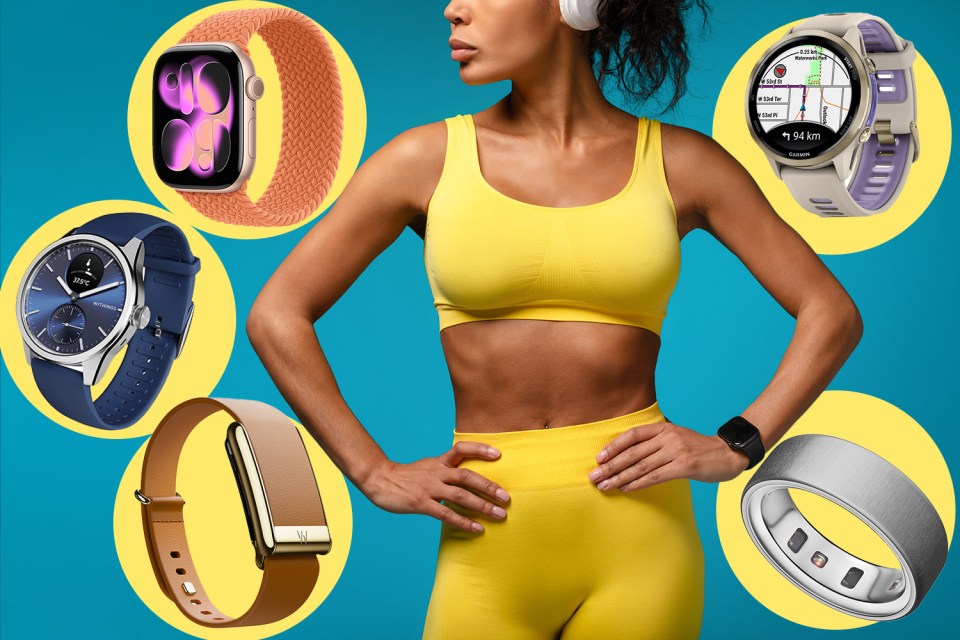
THEY used to be called fitness watches.
Now, they’re better known as “wearables”, giving you real-time access to your health data.
Most of them track steps, heart rate and sleep duration, and some have the added benefit of being a smartwatch – so you can call or text, too.
But what makes the Whoop different to a Garmin, or should you just play it safe with an Apple watch?
If you’re feeling overwhelmed, don’t worry, we’ve got the answers.
For Tracking Ageing
Cristiano Ronaldo described his Whoop device as a “doctor on my wrist”.

It’s been a long-time fave of elite athletes and bio-hackers, thanks to its recovery and performance focus, but increasingly, we’re spotting it in the gym, too.
To look at, it’s just a band on your wrist with no clock or interface. Data, primarily on sleep, strain and recovery, can be found in the brand’s app.
So far, so standard, but the standout feature is the Healthspan Whoop age.
Fabulous’ Assistant Head of Health Vanessa Chalmers, 30, who has the Whoop LeatherLuxe Band, £99, says: “After putting Whoop’s personalised tips into action, it’s amazing to see my biological age drop from 29 to 26 in three months.”
With a subscription-based membership from £169 per year, it tells you your biological age by analysing metrics across sleep, stress and fitness, so you can check it tallies with your actual age and how to reduce it.
She adds: “You can also track intake of alcohol, sugar and protein.”
For Sleek Style
Find health trackers unsightly?
Try Withings – its wearables look like traditional analogue watches and are stylish, too.
The Withings ScanWatch 2, £319.95, has a 35-day battery life – its biggest brag over competitors.
It’s less fitness-focused, but does have medical-grade heart sensors that can spot rhythm disorders with ECG.
Users can even be alerted to potential signs of illness or their upcoming period.
Fabulous’ Health Features Writer Eliza Loukou, 28, says: “I’ll be on the lookout for alerts that I’m getting ill, now winter viruses are rife.
“I chose a grey band with silver hardware to match my jewellery, which looks stylish.
“I didn’t want a tracker overwhelming me with alerts, but this has a small, digital window I can quickly check my steps, body temperature and sleep quality on.
“For a more detailed picture, you have to go into the app, and if you upgrade to Withings+ for £89.50 per year or £8.95 per month, it combines these for you in a Vitalité score, with suggestions for improving.”
For optimal Sleep
When the likes of Jennifer Aniston and Prince Harry started wearing the Oura ring, it quickly became a status symbol.
The brand – which charges £69.99 for a yearly membership, or £5.99 monthly – claims tracking from the finger, rather than the wrist, is scientifically more accurate.
Fabulous’ Health Features Editor Alice Fuller, 31, tried the Oura Ring Gen3, from £349, and rated it top over other smart rings on the market, including RingConn and Ultrahuman.
“It’s considered an industry leader for sleep tracking, which I find invaluable as an insomniac.
“It tracks how long you spend in each sleep stage and your blood oxygen saturation levels.
“It was great for planning my workouts, motivating me when I’d had good sleep and warning me when I should slow down.
“I also love that Oura tracks workouts automatically, so there is no faffing with inputting data.
“Plus, it’s comfy and looks great!”
Oura Membership is required for Gen3 and newer models, though, in order to access all the features.
For Simplicity
Already wrapped in the Apple ecosystem?
If you’ve got an iPhone and other devices, the Apple Watch, £369, probably seems like the logical wearable.
User-friendly and familiar, it easily integrates with your devices, putting calls, texts and Apple Pay on your wrist.
But it also has some high-grade standout medical features.
It can detect irregular heartbeats, falls (automatically calling 999) and the newest, Series 11, can alert users of chronic high blood pressure.
As many as 5 million adults in the UK have undiagnosed high blood pressure, so this could be life-saving.
Fabulous’ Head of Health Lizzie Parry, 42, who has used an Apple Watch for years, says: “It’s the Holy Grail when it comes to tech.
“I’m a big fan of the new feature where you can dismiss messages or alerts with a satisfying flick of your wrist.
“It’s particularly useful for those who want notifications, but without immediate action.
“I love that you can track even hidden health issues, such as high blood pressure – it’s music to the ears of us hypochondriacs!”
For Serious Trackers
For those who love outdoor adventures or multi-sports, look no further than Garmin.
Models are on the more expensive side, but it’s worth it for features essential for such things as marathon training.
Built-in GPS (and a large display screen) gives the most accurate data and means you can safely head out phone-free.
Many models have a distinctive rugged or military appearance, but Fabulous’ Senior Health Reporter Isabel Shaw, 29, tried the new and sleeker Garmin Forerunner 970, £629.99, with Triathlon Coach training plans and PacePro – pacing guidance for race days.
“My absolute favourite feature is the colourful map, which works offline when you don’t have signal,” she says.
“You can preload your route before you head out, which is super-convenient, as I don’t like getting my phone out mid-run.
“On the flip side, it’s rather clunky.”