Everyone is suddenly a patriot. From the Liberal Democrat conference to the lampposts of Epping, the country seems ever more enveloped — or entangled — in the Union Jack. Nevertheless, as the messages of Kemi Badenoch and Keir Starmer, or Nigel Farage and Zack Polanski, sound more and more alike, their ideas grow further and further apart. Both sides appeal to a sense of national community that is deemed to be lacking, but in this act of definition reveal a country split in two. As Britain scrambles to define itself as a political community, I think I’ve found the answer — although it might not be where you expect. You won’t find it in a secluded chapel, nor a mist-covered hillside, not even in the stars. All you have to do is phone 03717 22 33 44 — it’s time for Britain to call into TalkSport.
“What does it mean to be British?” is a dangerous question for most politicians. On the left, Zack Polanski’s vision of the British people dominates. It is a Volney-style parade — the 18th-century French philosopher imagined all the peoples of the world casting off kings and priests to embrace natural reason — of post-colonial Britain’s diverse peoples against a despotic billionaire class. On the right, the answer to who the British people are is a far more dangerous topic. Gradations go from muscular liberalism to full-on ethnonationalism, and an ever more widespread Justice Potter Stewart–style “I know it when I see it.” TalkSport Nationalism resolves this dilemma. All the station’s conversations are bound by a clear sense of British sporting culture. The massed crowds gathered outside stadiums at 3pm on a Saturday collide with the ritual of the builder on his way to work or the accountant working from home. TalkSport is the promoter of a spiritually anchored nation which seems impossible to recognise politically — the visceral power of the phone-in, tempered by the hierarchy of the tribunes, and the collective power of Britain’s sporting world.
This is the philosophy of TalkSport Nationalism — expertise kept in check by … righteous common sense
The station presents an ideal vision for a Reform UK government. Many of the callers are driving to and from work, be it at the depot or on-site (the 10–1 slot is sponsored by Selco Builders Warehouse). Still, the nature of modern sport means this is not a place without sophistication. The Premier League is now a global business, and commentary has to reflect this. Every fan knows about their club’s almost inevitably international owners and how their side is faring against the league’s Profit and Sustainability Rules. This combination of the common sense of the site, mixed with the high-level business of the Premier League and the belonging of the beautiful game, is the best that could be hoped for from Nigel Farage’s party in power. In its own way, TalkSport is a living example of French political thinker Georges Sorel’s theory (via Vico) of the fury of the proletarian classes keeping the bourgeoisie honest and thus curtailing decline. This is the philosophy of TalkSport Nationalism — expertise kept in check by the righteous common sense of those calling in, and a ruthless chase for ratings.
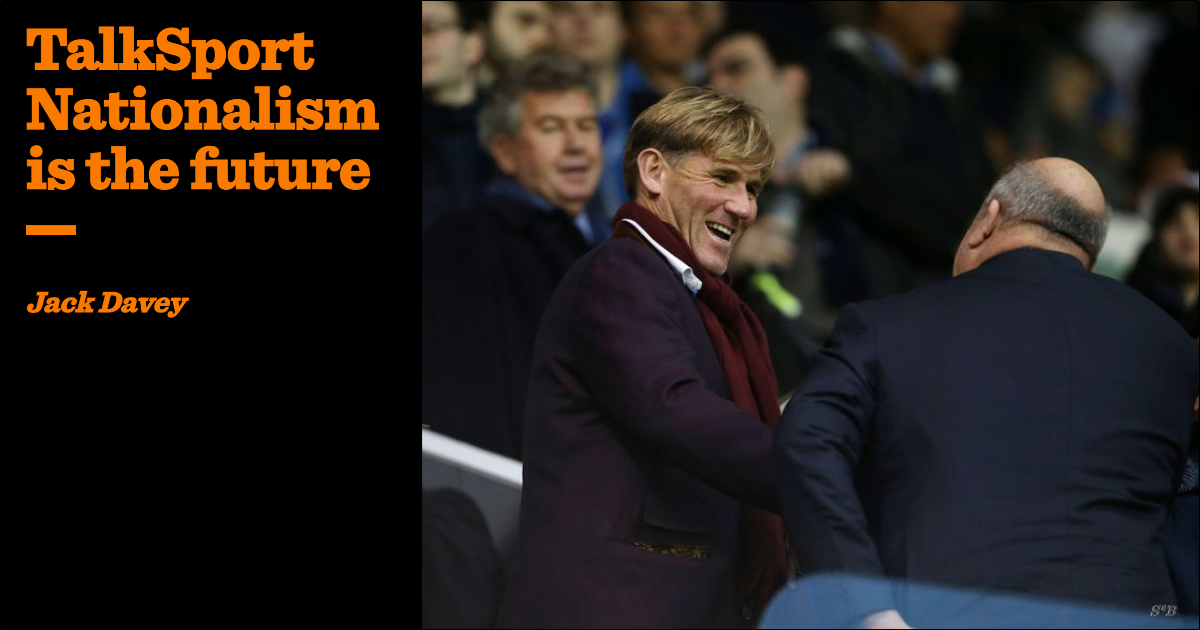
TalkSport Nationalism is in many ways the ideal blueprint for Reform UK. No man better represents the links between the station and the party its star Simon Jordan. The former Crystal Palace owner turned sports pundit has risen to become the station’s most viral performer thanks to his breathlessly confident style. He most recently hit the headlines for his attack on Gary Neville, following the former Manchester United player blaming “angry middle-aged white men” for division after the Manchester Synagogue attack. Jordan called Neville a “champagne socialist and a coward” criticising the Sky Sports pundit for attacking the very men who work in the hotels he owns. The ex-Crystal Palace owner went further saying the “real issue is about radical Islamist extremism and he [Neville] doesn’t have the balls to call it out.” In this guise Jordan is the tribune for the views of the working class as expressed by Reform. He fights against the cultural establishment of which Neville is a part, but is also part of a hierarchy removed from the anarchic fan channels which have characterised football media over the last 15 years.
For many, the story of Britain’s growing nationalism has been an English one. TalkSport, you will be unsurprised to hear, is already all over this debate. Ahead of the Ryder Cup, could the home of British identity feel patriotic about Team Europe? Jordan began strongly, after a dig at Scots who “would travel anywhere for a pound” he said, “My pride is in being English, not in being European.” Former Liverpool player Danny Murphy alongside him was less England-focused. Considering himself “British,” he added “I don’t think anyone would ever look at me and think I’m European.” Despite this disagreement, and Jordan’s irritation at the lack of Scottish and Welsh support for England in international competitions all three men backed Team Europe and were delighted with the side’s away win against their American rivals. Here lies a lesson for the future of Reform. Despite its Anglo-centric core of Farage, Tice and co, its version of nationalism will be defined by what it finds itself opposed to.
Reporting from one anti-migrant hotel protest in Canary Wharf, I was not only surrounded by British flags, but some wore Rangers shirts and even played Simply the Best. It was as if I were in the Govan Stand — Rangers are a frequent topic on TalkSport reflecting the power of a club and culture often forgotten in other media. While many have pointed to the Ulsterisation of English politics marking a new political age, the sectarian nationalism of Northern Ireland, and by extension Scotland, is the mythology any nascent national movement in Britain will be pushed toward. Although this may seem far away from the Englishness of Nigel Farage, soon Reform UK will be a significant player in both England and Wales, with Unionism, alongside immigration, one of its key drivers of success. Indeed, of all the UK parties, Reform has been most closely intertwined with Northern Irish unionists. It has a pact with the Traditional Unionist Voice, and Nigel Farage personally endorsed two DUP candidates at the last election. Though Nigel Farage has said he is a “radical not a revolutionary”, he hasn’t discounted the Reformation.
Sport is the only significant tool for integration the UK still has
This is no new thing either. Presbyterian Scotland has long been the breeding ground for revolutionary politics in Britain. There is no Cromwell without the Covenant, or Labour Party without Keir Hardie. In this vein, Thomas Carlyle compared the Scots to the Jacobins, although for him the “Old-Saxon Hebrew-Presbyterian way” was far superior to the French’s “excitability and effervescence.” The first use of the word “nationalism” in the House of Commons was related to Ireland, and this legacy is destined to survive through the 2020s. While TalkSport Nationalism may be built on the back of the sectarian power of Britain’s periphery, it also provides a platform which can accept the reality of a modern, collective Britain moving into the future.
Sport is the only significant tool for integration the UK still has. While we in Britain sneer at the national anthem being played before NFL games, that is one way of instilling confidence and belonging in the state. In today’s UK, the only similar ritual on Sundays would be throwing a “keep calm and carry on” tea towel into the washing machine — a rather damp squib. TalkSport, like British sport, is a fairly diverse space with Black and mixed-race hosts, many of whom are ex-footballers. Establishing a collective spirit or will is a bit like everyone being part of the same team — and the goal should be the same: winning. As Reform looks for a formula which can satisfy the people’s desire for representation amid a crisis of political community, it will face similar conundrums to the managers whose decisions are debated on the airwaves. People and organisations that aren’t contributing to the team will be dropped or made to join the community. There will no longer be a division between the state and society — the team and the players are ultimately one and the same. For Reform’s government, like the discussions on TalkSport, everything will be about winning.