My hometown has a particularly nice Polish sandwich shop on the street just opposite the railway station. Or more accurately, the two railway stations; the modern one, and the wonderfully restored station for the Severn Valley steam heritage line. The Severn Valley station occasionally hosts events themed around the Second World War, with vintage vehicles and people in costume, and school children dressed as evacuees. The slogan of one such recent event was “Step Back into the 1940s”, and I happened to be in the Polish sandwich shop when a volunteer wearing a t-shirt emblazoned with that slogan crossed the road and walked in. I could only stand there and imagine what a singularly unappealing invitation that would be for a Polish person. “Do you have literally any other decade?”
I’ve been reminded of Britain’s uniquely sentimental relationship with the Second World War in recent weeks, as various figures from within and around the government have suggested that we need to prepare for another conflict on that scale, against Russia. British politicians have long sought to distill and bottle the scent of 1940, especially when their political fortunes in the real world were dwindling, but specifically stating that a conflict on the scale of the world wars is imminent is not something we are used to hearing. Whilst the public understood the risks of annihilation inherent in the calculations of the Cold War, governments of that era tended to try to cool rather than excite popular anxieties.
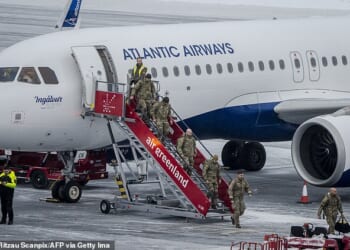
Lately, it has not just been British figures making such remarks. NATO’s Mark Rutte, Germany’s Chancellor Friedrich Merz have joined Britain’s Minister of State for the Armed Forces Al Carns, and Air Chief Marshal Sir Richard Knighton in alluding to the risk of open warfare on the scale of 1939-45. Previously, World War II was only invoked by continental European leaders as a spectre to be avoided at any cost, and usually by everyone else doing what was in their own countries’ immediate interest. But now, they seem to be suggesting that it is something that we must be ready for, and to some extent, up for, in a far more Anglo-American way.
Taken at face value, the British and European public might have cause to be alarmed by all of this, especially given the Trump Administration’s clear signal that Europe should be prepared to defend itself without American backing. The Independent’s John Rentoul weighed in to comfort us with the claim that, while such a conflict would be cause for trepidation, Britain would assuredly win by virtue of our having a GDP twice the size of Russia’s. A positive thought, albeit one that’s so wide of the mark that it’s not even wrong.
Under the communist regimes of Eastern Europe, dissident campaigners and artists would engage in satire that was so oblique and ironic, it was impossible for censors or the secret police to investigate them seriously without making themselves look ridiculous. In Poland, the Orange Alternative underground group would stage demonstrations dressed as gnomes. As SB interrogators would have to ask questions like “were you present at the gnome incident?”, the regime was made to appear as small and pathetic as it really was. Understandably, the goons often chose to look the other way.
Now, as we try to make sense of Britain’s Sensible Faction solemnly preparing to lead us to war with Russia, it is our turn to choose between dissecting the absurdity, or just ignoring them. Alas, the Sensibles are not a dissident group; they are in fact in charge of pretty much everything, including for the time being, Britain’s foreign policy and armed forces. Which to some extent obliges us to at least pretend to take the things they say seriously.
Fortunately for me, Maurice Cousins has already done that, setting out in these pages the practical realities of why the concept of Western European countries going to war with Russia is a straightforward and unquestionable absurdity. Drawing on work by Rian Whitton for the Prosperity Institute, Cousins sets out how the energy policies of Western Europe, and especially Britain, have undermined fundamental industries that are essential to running any industrial economy, let alone a war economy. Steel, chemicals, fertilisers, and materials technology have atrophied or escaped, and with them a myriad of sub-sectors and expertise. This leaves me free to consider the politics behind it with the derision they call for.
What type of war is it that British and European elites imagine we might be fighting? A dynamic campaign dominated by armoured divisions and air forces, fought over a continental-scale battle space? Or a vicious, tactical fight around narrowly defined objectives relying on special forces? What will trigger it — a Ukrainian collapse that sees the Russians spill over into Central Europe, or perhaps a Russian incursion into the Baltic states or even Scandinavia? All of this discussion of war seems oddly untethered from such questions. What kind of fight will it be, and why?
They haven’t got that far, and they’re not going to. They are not thinking about specifics or strategy or objectives. Despite the ongoing war in Donbas, with the trenches and the freezing mud and the death; our governing class is still not interested in thinking about war as a material reality. Instead, they are talking about war as a vibe. It is a political setting that they think they can turn on, and everybody will be obliged to be very serious. Stony-faced press conferences will be given, and television schedules will be changed to accommodate them. Partisan differences will be set aside; the nation will come together and ascend to hitherto unimagined levels of unity. It will be like the days in the run up to the Queen’s funeral, but even more so.
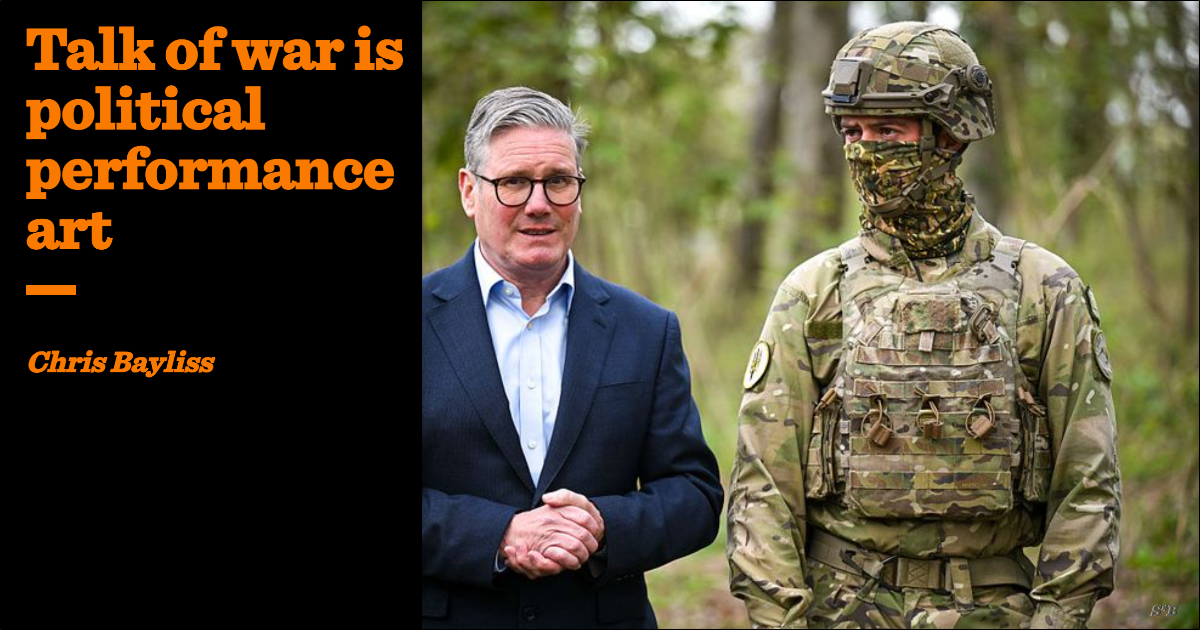
To be clear, even this hypothetical “war with Russia as a state of mind” is not a realistic prospect given the intolerable risks it would entail. But we are being asked to stop for a moment, and imagine that it could be; at some point, and for some reason. This is a piece of political performance art, and like all art we should try to appreciate it for its own sake. Even in eliciting a sense of mild irritation and inducing Maurice and I to write articles like these, it is making us feel something. Cousins says that these warnings “should be taken deadly seriously”, and this is the one point I have to disagree with him on. They are just winding us up, and to some extent, it is working.
The appeal of all this for an unpopular government like our own is obvious; if war is imminent, we really ought to stop taking the mickey out of Keir Starmer, and unite behind our wartime leader. He would have us imagine him intoning those solemn words in his monotonous, whiny voice; “This morning the British Ambassador in Moscow handed the Russian Government a final Note stating that, unless we heard from them by 11 o’clock that they were prepared at once to wind their necks in, a state of war would exist between us.” Personally I think his favourite line would be the “I have to tell you now” before he told us that no such undertaking had been received. He may have the body of a weak and feeble barrister, but we should have no doubt that he has the heart and stomach of a tool maker, et cetera.
If this seems frivolous or glib, let us pause to consider how a responsible government might be acting if they genuinely believed that an existential war of survival was in the offing. Let us ignore for one moment the physical preparations and public contingencies in case of a nuclear attack, which would be the most urgent response to elevated risk of conflict between nuclear powers. There would need to be a hurried programme of works to shore up the resilience of critical sectors, most obviously energy, but also steel and chemicals.
We would expect to see the government negotiating lines of credit with the United States to place major contracts for the supply of stocks of basic materiel, ammunition, armour etc. We would expect to see the passage of legislation to ensure that all young men other than those in essential roles could be afforded leaves of absence from employment to undertake basic training, to be followed by reserve status with regular camps. This would be mirrored by reforms to the armed services along the lines of to prepare for a potential influx of a large number of inductees from the reserves and civilian life.
Think of the preparations that were instituted across the British army from 1937 onwards under Leslie Hoare-Belisha — not only the reorganisation of the top brass across the services to remove those who were unprepared for the new era, but also improvements to the conditions and pay of servicemen. Barracks were upgraded and made more comfortable, pay was increased and peacetime leave was made more generous in order to encourage as many to join on a volunteer basis as possible. The Ministry of War was well aware that lingering memories of the trenches and the slaughter of the Great War, especially among the parents of those reaching military age, meant that they could not rely on the natural enthusiasm of a whole generation that had allowed the British to create that largest ever purely volunteer army in history by 1915 — but they could make army life a more appealing prospect.
Preparing the country seriously for a major war would mean reversing every political and economic change that the likes of Keir Starmer and Ed Miliband have favoured
Our government today is doing absolutely none of these things, and neither are those of any comparable Western European country. In fact, in most of these spheres, they are doing the precise opposite. We are redoubling our efforts to reduce carbon dioxide emissions as fast as possible, and installing intermittent power generation capacity that is completely incompatible with an industrial economy. The Government continues to allow critical industrial facilities to close, and maintains a strict moratorium on the exploitation of key domestic energy sources. Meanwhile, the fact that the army still cannot meet its authorised strength — extremely low by historical standards — barely seems to register as a concern among ministers. The recent increase to the Defence budget barely amounted to a rounding error, compared with the trebling or quadrupling we would expect to see in the case of urgent rearmament.
Preparing the country seriously for a major war would mean reversing every political and economic change that the likes of Keir Starmer and Ed Miliband have favoured over their entire lives. It would require them to preside over the diametric opposite of everything they want to do. Reindustrialisation, recarbonisation, and most importantly, a vast reduction in social and welfare spending in order to finance military rearmament. I will concede for a moment that there is something plausible about Starmer being forced to dismantle his own political life’s work. But he wouldn’t do it over anything historically momentous; he would do it over something trivial and embarrassing, like a non-binding suggestion from a multilateral NGO masquerading as a court.
They are insubstantial people whose entire worldview is informed by a fundamental softness and delicacy
They are not preparing for war because they do not see it as a realistic prospect. If the Russians decided to make an attempt to attack Western Europe, we would largely be forced to turn to the Americans for support. But it is extremely unlikely, because the Russians take the threat of nuclear war seriously. Our leaders perhaps are hinting that they are prepared to raise the stakes themselves and escalate Europe’s response in Ukraine. But nothing that they have ever done lends credibility to the idea that they would go through with this. They are insubstantial people whose entire worldview is informed by a fundamental softness and delicacy, and everybody knows it, including the Russians. They have no bollocks.
What they are trying to do is to goad their domestic opponents — populists and conservatives — into stating that Britain or Europe as it is currently ruled isn’t worth fighting for, and that they wouldn’t put themselves forward to die on the orders of the current government. This then allows their own supporters to question their opponents’ patriotism and courage, and to paint them as sympathisers of Vladimir Putin. It will have absolutely no effect at all on levels of support for conservative or populist opposition to the regime, here or on the continent, because most won’t pay it any attention. But it is mildly entertaining for the otherwise utterly demoralised supporters of the exhausted post-national consensus politics during the remaining months or years of its twilight.
That is literally all there is to it. It’s a sort of mirror to the tendency of some conservatives to try to cast the Left as being “the real racists/sexists/homophobes”, in that it’s fun sometimes to wind up our opponents by stealing their favourite clothes. The only difference is that progressive pseudo-militarism involves suggesting you will send other people’s children to die in battle whilst theoretically having the authority to do so. It is tempting to say that we oughtn’t give them the satisfaction of hearing that nobody would bother dying for their regime, not even themselves. But then we must remember that there are still a few tens of thousands of souls, poorly paid and poorly housed, who are already signed up and in uniform, notionally at the beck and call of this trivial and insubstantial class of people.