This article is taken from the February 2026 issue of The Critic. To get the full magazine why not subscribe? Get five issues for just £25.
Does cinema suffer from seasonal affective disorder? Summer blockbusters tend to be joyous affairs, full of light and explosions. Meanwhile the first big film of 2026, Hamnet, was about grief, and I’m afraid the theme continues into February. I promise that this reflects the films I’m being offered, rather than a personal trauma.
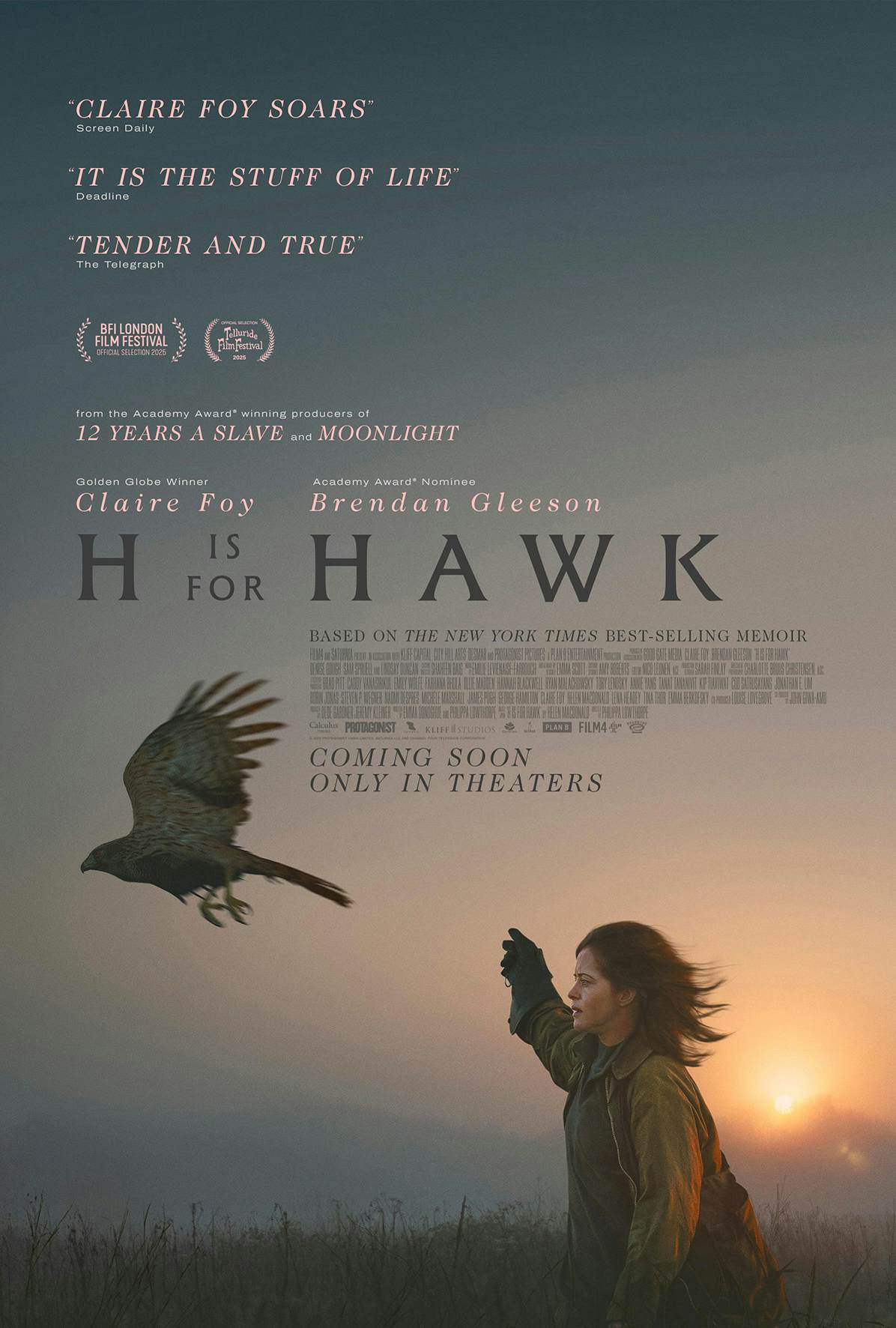
Asked by a student in H is for Hawk what she gets from watching her goshawk hunt, academic Helen Macdonald replies: “An honest encounter with death.” That’s the mission statement of this moving adaptation of Macdonald’s bestselling 2014 memoir.
Lost and despairing after the sudden death of her father, a newspaper photographer, Macdonald decides to train a goshawk. She names her Mabel, on the grounds that the more feminine a bird’s name, the more vicious the hunter they will be.
Hawks are, Macdonald explains, a “non-affectionate species”. As Macdonald, played with perfect restraint by Claire Foy, withdraws from human society, her hawk is the only creature she can engage with.
It is a testament to Cambridge University’s ability to cope with the neurodivergent that there is almost no resistance to her new habit of pottering about the college with a bird of prey. (Neurodivergence is a never-acknowledged theme of the film. When Macdonald reveals that her autodidact father, played with great charm by Brendan Gleeson, insisted on wearing a suit to work every day whatever the job, and indeed gardened in one, the puzzle pieces start to fall into place.)
This is a beautiful but unflashy film. The camera moves slowly over Mabel’s feathers and Foy’s face, her lips almost blue as if she too were departing the world. Although there is a certain amount of Cambridge, director Philippa Lowthorpe and cinematographer Charlotte Bruus Christensen seem more interested in the fens around the city, caught at dawn and dusk as Macdonald takes Mabel out to hunt. These scenes are electric, a moment to be grateful for cameras that can chase the bird as she closes on her prey.
Although Macdonald has little time for squeamish undergraduates who wish that hawks could be trained to hunt tofu, she is less honest with herself when it comes to accepting that in the midst of human life we are also in death. Her grief is tangible, but her relationship with Mabel allows her, eventually, to start to move forward.
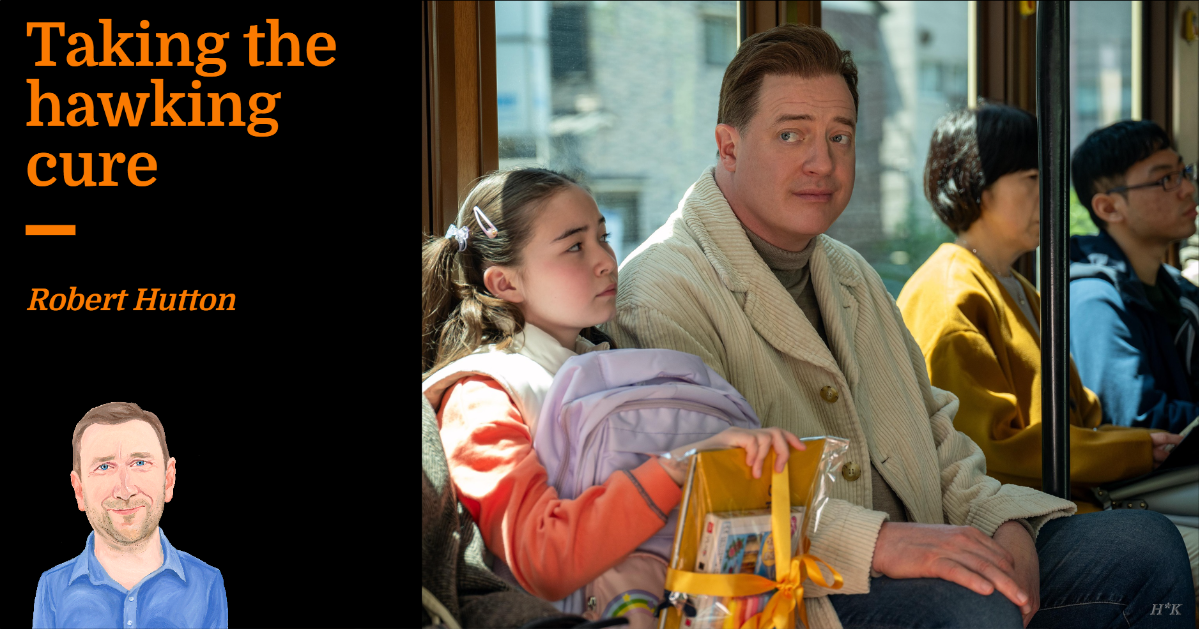
Rental Family also begins with mourning, although in a comic frame. Brendan Fraser plays Phillip, an American actor in Tokyo who finds himself working for an agency that supplies actors for real-life situations, starting with a gig as a mourner for a depressed man who wants to experience his own funeral.
After years of tiny roles and silly costumes, Phillip suddenly finds himself playing big parts, albeit for audiences of one. To one man he’s a best friend. To an ageing actor he’s a journalist working on a profile. Most dangerously, to a small girl he’s an absent father, returned.
Are rental families a real thing?
I don’t want to know. I like the way that, even in a super-connected world, Japan still functions for many of us as a place where anything might happen. The film is a gentle comedy about finding family, a meditation on the value of genuine connections: having opened with a fake funeral, the film closes with a real one.
What is cinema for? To entertain, to move, to inspire. But also to connect us, to take us into another life. The President’s Cake is a story about something that is at once small and everything. Lamia is a schoolgirl in Iraq in 1990, living with her grandmother at the edge of a marsh.
Saddam Hussein being who he was, every class has to bake a cake to celebrate his birthday, even though sanctions and the collapsing economy mean that the most basic ingredients are impossibly scarce. Lamia’s is the name drawn out of the hat, sending her on a quest that flits easily between comedy and peril, with tragedy always close by: as she and her friend Saeed continue their adventure, it’s hard to escape the thought that no Iraqi child in 1990 had a great future ahead of them.
Director Hasan Hadi uses the children’s eyes to take us into life inside a dictatorship. The presence of Saddam is everywhere, his picture on every wall, his vanity in demanding this tribute matched by the failures as a leader that make the quest seem impossible.
Finally, back to grief. It’s more than 30 years since I read A Pale View of the Hills, Kazuo Ishiguro’s first novel, and I could recall little about it, except a feeling that I hadn’t quite understood it. In that sense at least, this film is a successful adaptation.
Like The Remains of the Day, a more popular book adapted into a very popular film, this is a story in two time periods, with a narrator whose memory may not be reliable. In the 1980s, middle-aged Etsuko, widowed and mourning the suicide of one daughter, tells her other daughter about her life as a young woman in post-war Nagasaki.
It is a visually beautiful film, with excellent understated performances from the whole cast, that finishes with as many dangling threads and questions as answers. One to watch with someone who will want to discuss it with you afterwards.