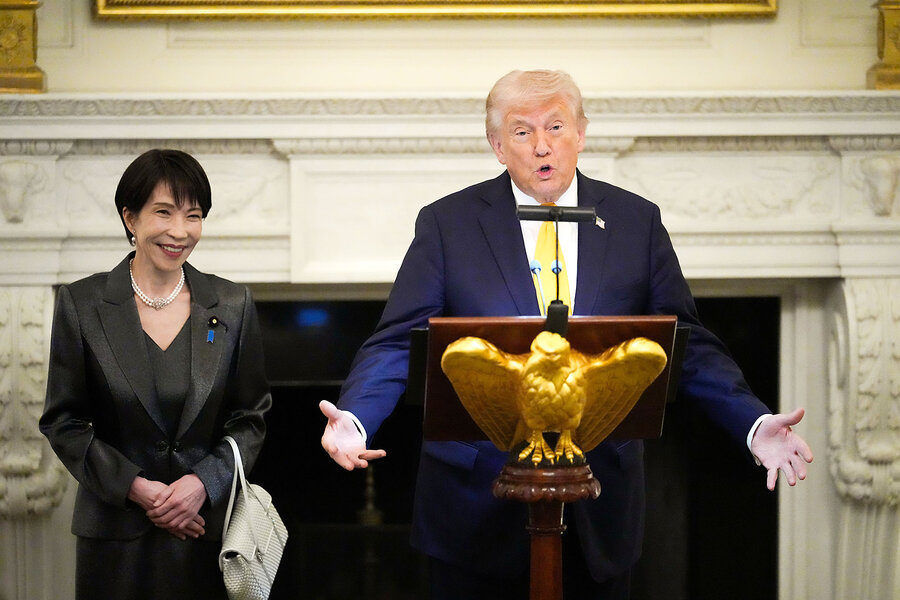
Wrapping tough talk in flattery, Japanese Prime Minister Takaichi Sanae skillfully navigated a high-stakes summit with U.S. President Donald Trump on Thursday, steadying America’s most critical alliance in Asia amid the turmoil unleashed by the Iran war.
Sporting a signature blue suit and pearls fashioned after her idol, the late British stateswoman Margaret Thatcher, Ms. Takaichi warned Mr. Trump sternly that “the global economy is about to experience a huge hit” from the Mideast conflict.
Even so, she added, “I firmly believe it is only you, Donald, who can achieve peace across the world.” Mr. Trump smiled broadly.
Why We Wrote This
Tokyo relies on the U.S. to safeguard its interests in the Indo-Pacific – there is no plan B. Although Japan’s prime minister skillfully navigated a high-stakes meeting in Washington this week, concerns remain about the reliability of the U.S. partnership long term.
Yet beneath the surface of the cordial White House meeting, unease is growing in Tokyo over the strength of the U.S. strategic commitment to Asia – anxiety deepened by a recent shift of U.S. military assets out of the Indo-Pacific to the Middle East.
U.S. naval ships, Marine Corps units, and air defense equipment have reportedly moved or are moving to support the war on Iran. So far, the shift out of Asia is manageable, says Tsuneo Watanabe, a senior fellow with the Sasakawa Peace Foundation in Tokyo. But a larger redeployment, particularly of ground troops, would be “a big concern,” he says.
Japan has no feasible plan B for its defense outside of the U.S. security umbrella, experts in Tokyo say.
That makes it imperative for Tokyo to work to safeguard the alliance, even as the U.S. focus has shifted under Mr. Trump – most recently to Iran, but also more broadly to the Western Hemisphere.
“They are looking to see how [effectively] he will use American power … and how he will think about the alliance with Japan,” says Sheila Smith, senior fellow for Asia-Pacific studies at the Council on Foreign Relations.

Specifically, Ms. Takaichi and her team are struggling to discern the new contours of U.S. foreign policy, including its geographic focus, its stance on China, and the U.S. president’s military interventions.
Tokyo is questioning how much the second Trump administration is “moving away from global leadership and focusing instead on hemispheric priorities,” says Dr. Smith. “Venezuela was unsettling. Iran is even more unsettling.”
All of this plays into Japan’s overarching concern, which is “the credibility of the alliance, and the reliability of the U.S. over the long term,” says Christopher Johnstone, partner and chair of the Defense & National Security Practice at The Asia Group, a Washington-based business consultancy.
A delicate situation
On her U.S. trip, the first since she took office, Ms. Takaichi’s most immediate goal was enhancing her personal chemistry with Mr. Trump.
By all accounts, she succeeded. Mr. Trump praised the conservative Ms. Takaichi as “a very popular, powerful woman,” hailing the historic victory of her Liberal Democratic Party in a snap lower-house election in February.
Ms. Takaichi also came bearing gifts of investment and increased economic and trade cooperation: up to $40 billion in Japanese investment to build small modular reactor power plants in the U.S., and up to $33 billion in natural gas generation facilities in Texas and Pennsylvania, according to a White House fact sheet. They agreed to cooperate on commercial development of deep-sea critical minerals including rare-earth muds, as well as missile production.
The Japanese leader kept things friendly, even while walking a tightrope between Mr. Trump’s demands for Japan to use its military to help reopen the Strait of Hormuz, and the Japanese public’s overwhelming opposition to the Iran war.
“It’s a very delicate situation, and my first impression is she managed to walk through this minefield unscathed,” says Jeffrey Kingston, Asian studies professor at Temple University in Japan.
Mr. Trump praised Ms. Takaichi for “stepping up to the plate,” even as she offered no concessions on Japanese deployments, citing restrictions in Japan’s pacifist constitution. After the war ends, Japan could dispatch naval minesweepers to help clean up the strait, a critical chokepoint through which Japan’s and much of the world’s oil supply flows, says Mr. Johnstone.
Tokyo is eager for Washington to wrap up the conflict, which is damaging Japan’s economy by pushing up energy and food prices, while forcing the government to release strategic oil reserves.

But in a further source of concern within the alliance, Tokyo lacks clarity on Mr. Trump’s endgame for the war – whether to decapitate the leadership, or install a more friendly regime. “Hopefully Trump has a realistic goal,” says Dr. Watanabe. Japan has long maintained diplomatic relations with Iran.
About 80% of Japanese oppose the war, polls show. “Public opinion is now realizing belatedly that giving a blank check to the U.S. in the name of the alliance, and putting all the eggs in the U.S. basket, is probably not very wise,” says Nakano Koichi, professor of Japanese politics at Sophia University.
China contingencies
Yet China – not Iran – was Ms. Takaichi’s top geopolitical priority coming into the White House meeting. Her visit originally fell just before Mr. Trump’s scheduled early April trip to Beijing, but that trip has since been delayed.
Mr. Trump has been noticeably silent on major frictions that erupted between Beijing and Tokyo after Ms. Takaichi stated Japan could intervene on behalf of the U.S. were China to attack the democratic island of Taiwan, over which Beijing claims sovereignty.
As China unleashed a torrent of punitive economic measures against Japan, Mr. Trump did not speak up for Ms. Takaichi, apparently because he was prioritizing a trade deal with China, experts say.
“The fact he remained silent certainly did cause anxiety here,” says Dr. Kingston. “It reinforces the image of the alliance being unreliable under such a president.”
For Japan, the “worst case scenario” would be a U.S.-China partnership that left out Japan, says Dr. Nakano. At their meeting Thursday, Mr. Trump declined to speak on what he called “edgy” relations between Beijing and Tokyo, although he pledged to praise Japan when he meets Chinese leader Xi Jinping.
“We are in this moment where we think of China as a revisionist power, but the U.S. is starting to look like a revisionist power, too,” says Dr. Smith.
As America’s “excursion” in Iran – as Mr. Trump calls it – ties up aircraft carriers, munitions, and troops, it is cutting into U.S. combat power in Asia. “The principal concern for the Japanese is about American distraction and what it means for the U.S. focus on the Indo-Pacific,” says Mr. Johnstone. “How much can Japan rely on the U.S.?”
Partly in response, Japan is engaged in a major military buildup, increasing its defense spending to more than 2% of gross domestic product.
It is also strengthening defense ties with other regional partners – from Australia to India, and the Philippines to South Korea. Still, even collectively the scope of these ties pales compared with the U.S.-Japan military alliance.
“Plan B,” says Mr. Johnstone, “is not something Japanese security planners have a clear concept of.”