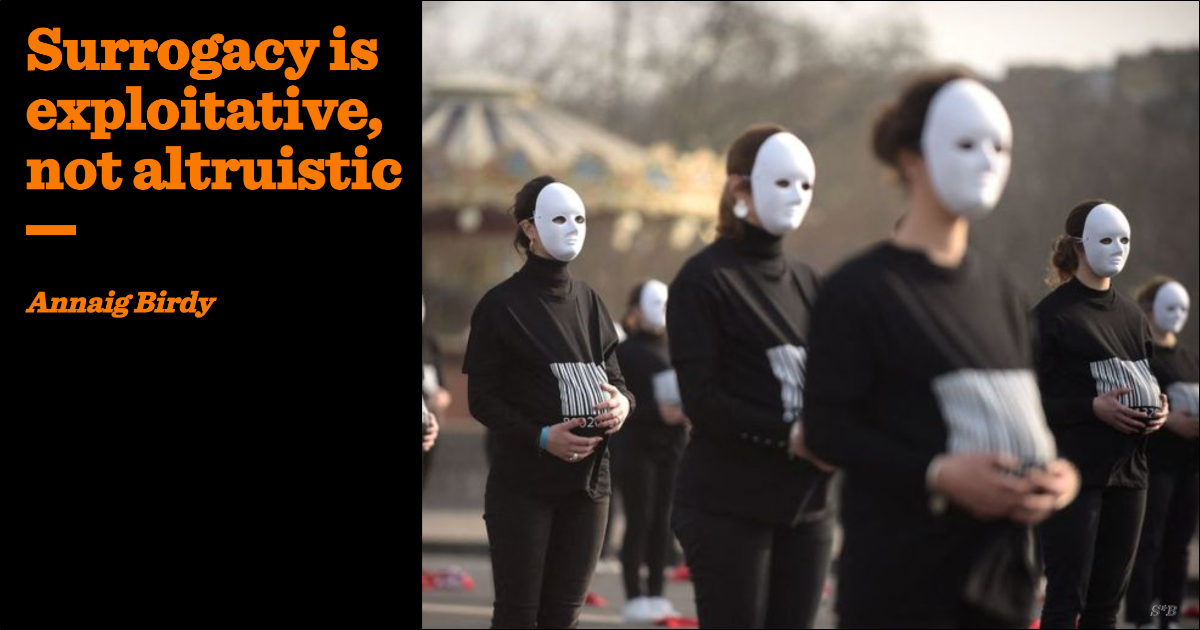
Ireland has a long and, shall we say, rich, history of abuse and subjugation on women and children — Mother and Baby Homes, Magdalen Laundries, the death of Ann Lovett, the creation of symphysiotomies in Holles Street Hospital, Catholic Church sex abuse scandals, the unnecessary death of Savita Halappanavar, the Cervical Check scandal, and so much more. It is not lost on me that most of these abuses relate to the abuse, exploitation and neglect of women’s sexual and reproductive bodies.
For many women’s rights campaigners and feminists, myself included, this history makes one thing painfully clear: when men are granted power, whether by wealth, social standing, ideology, sexuality, religion or culture, many will exploit it. And they will exploit women’s bodies, sexually and reproductively, because women’s bodies have long been treated as buyable, consumable, inanimate objects for male desire, entitlement and control.
And yes, there are women who aid and abet this system: women who are perfectly willing to treat other women’s bodies as commodities if it benefits them personally.
We saw this logic laid bare again this week in Holyrood, when Ash Regan MSP’s Unbuyable Bill was summarily shut down. We were told, without irony, that the way to “protect” women in the sex trade is to fully legalise the purchase of women’s bodies by punters and pimps — to treat women as consumer goods. This argument was made even as Ms Regan read aloud the degrading “reviews” written by men about the women they had bought: language dripping with entitlement, ownership and dehumanisation. There was no empowerment there. Only consumption.
This belief, that women’s bodies exist to be bought, sold, used and controlled, is everywhere, yet it is relentlessly disguised and protected by those who wish to benefit most. It is routinely cloaked in the language of “choice”, “consent”, “progress” and “empowerment”. And nowhere is that disguise more effective than in the push to normalise the commodification of women’s reproductive labour through surrogacy.
This logic reached its most naked form in elite sexual exploitation networks — like that of Jeffrey Epstein — where women and girls are treated as entirely disposable — trafficked, violated, and where useful, pressed into reproductive services. Surrogacy does not interrupt this system; it completes it, converting the exploitation of women’s bodies into legitimate, contract-bound markets.
You would think, given Ireland’s dark history, we might have learned something. You might think that after unshackling ourselves from the Catholic Church’s grip on the State, we might have moved on from treating women as vessels rather than whole human beings. But alas, Ireland has enacted some of the most permissive surrogacy laws in the world.
Under Ireland’s new framework, affluent couples — and single men — are free to commission women in Colombia, Kenya and Ukraine to produce children on their behalf. The Minister for Health insists that commercial surrogacy is prohibited, yet the legislation explicitly allows for “reasonable expenses” — expenses that routinely exceed an average Irish monthly salary, and amount to three times the average annual income of Colombian women. This has been routinely framed as an issue of “consent”, but consent is not borne of financial desperation, coercion, or living in a conflict zone. If this was truly “altruistic” we would see celebrities, politicians, and wealthy women offering up their wombs and risking their health and even lives, for poorer women.
Despite our history of Mother and Baby Homes, where babies were quite literally sold to wealthy American couples before birth, the Irish State has decided to continue this tradition under a more palatable name. Babies are still being bought. Women are still being used. Only the paperwork and activist framing of it has improved.
What makes this even more damning is what the State cannot do. More than a year after passing the legislation, the government has still been unable to establish a regulatory authority for surrogacy. Why? Because of unresolved legal issues — concerns serious enough that no one is willing to assume responsibility. That fact alone should have stopped this legislation in its tracks.
During Seanad debates in 2024, a now-former senator actively objected to and dismissed a proposed amendment — one that would have explicitly barred convicted sex offenders, particularly those convicted of offences against children, from accessing surrogacy. That amendment was dismissed. Not debated. Dismissed.
In recent months, the Minister for Health openly declared that regardless of what the United Nations and the UN Special Rapporteur on Violence Against Women and Girls had concluded — namely, that surrogacy constitutes a form of violence against women and children — Ireland would be proceeding anyway. International human rights warnings were noted, and then ridiculed as “unprogressive” and “conservative”, and ultimately ignored.
This is not progressive. It is the same old contempt for women, and entitlement to their bodies
Contrast this with Chile, which last week moved to ban surrogacy in its entirety, acknowledging the harms to women and children inherent in this billion dollar industry. Or Kazakhstan, which has restricted surrogacy to domestic arrangements only, recognising the trafficking risks created by cross-border reproductive markets. Ireland, meanwhile, is racing in the opposite direction.
This is not progressive. It is the same old contempt for women, and entitlement to their bodies, repackaged as modernity.
Once again, women’s bodies are treated as things to be rented, bought and controlled. Once again, children are treated as products. Once again, the State insists it knows better — even as it refuses to build the safeguards it admits are necessary.
Ireland’s history shows us exactly where this road leads. What we are finally being forced to confront is not a series of isolated failures or abuse, but a patriarchal system that has always understood women’s bodies — and the children they produce — as buyable.