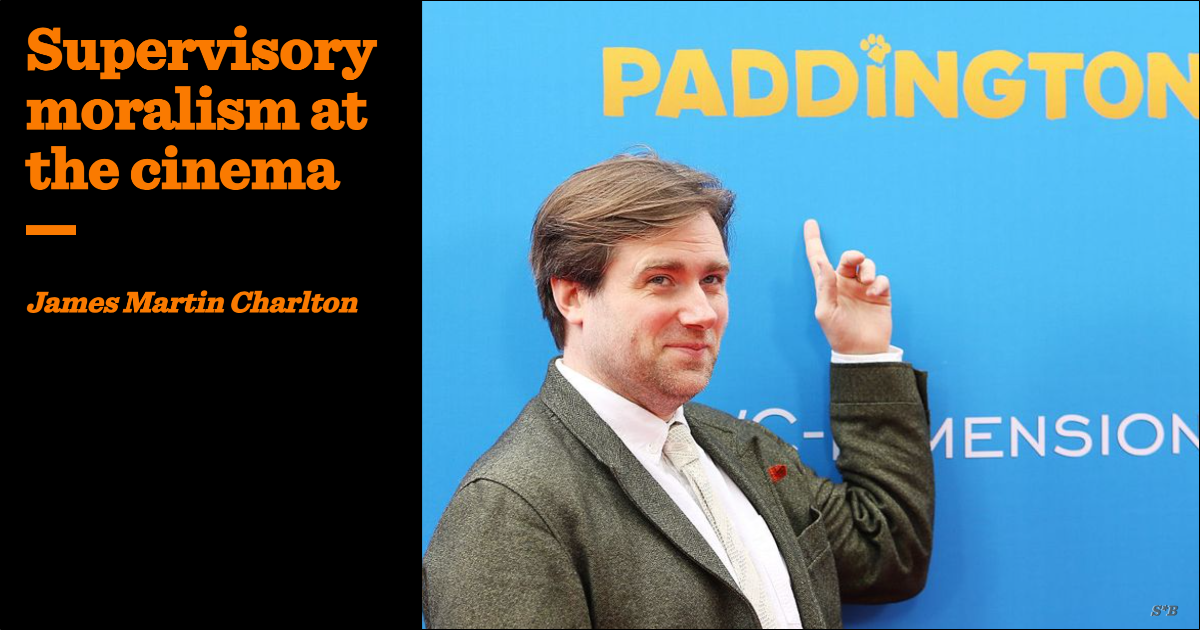
The films of Paul King manage thorny political problems through children’s fantasies
For my generation, the name Paul King conjures images of a big-chinned nitwit in Doc Martens singing Love & Pride. But for those who look at the credits of recent blockbuster kids’ movies, Paul King is a director whose films have been seen by hundreds of millions of viewers, have made upwards of $1.13bn at the box office, and have earned countless BAFTA nominations. His third film held a vanishingly rare 100 per cent approval rating on Rotten Tomatoes.
Yet until this Christmas season, I hadn’t seen a single one of his films. A visit from a nephew put paid to that, and within a few days I’d been treated to two Paddington movies and one Wonka.
As the films unfolded and the young one chuckled in delight, my critical faculties kick-started. For there is a lot of ideological matter flowing alongside the cuteness and spectacle of these movies — movies which, moreover, have a tendency to play the same card again and again. Yet a cursory browse suggests that there is little extant critical examination of this wunderkind’s oeuvre.
The screenwriter Lorenzo Semple Jr. held that there are only two plots — Odd Couple and Fish Out of Water. Paddington occupies the latter as confidently as the Russians do Crimea. Michael Bond based the bear on his memories of seeing childhood evacuees during the Second World War. Paddington, like Blanche DuBois, relies on the kindness of strangers: he is found at the titular railway station and taken in by the über-middle-class Browns.
His page and small-screen adventures typically involve him getting into small-stakes trouble with petty authority figures who disapprove of his tendency towards cultural misunderstanding — he being, you know, a bear, and from Peru.
Paul King’s initial Paddington ups the ante. Paddington is painted not simply as an anthropomorphic teddy bear found as lost property, but as a fully-fledged refugee. Within the first ten minutes, on-the-nose references are being made to the Kindertransport and Britain’s reputation for welcoming migrants. The Browns are British hospitality made flesh, and characters like the xenophobic (and ironically monikered) Mr Curry are ruthlessly ribbed.
Oddly, none of this is necessary for the film’s main plot, which has a mean-spirited taxidermist attempting to stuff our ursine hero. King clearly feels that the children’s film is the time and place for a lesson.
Having helmed two Paddington films, King’s next project was Wonka, an origin story for the chocolatier in Charlie and the Chocolate Factory. A young Willy Wonka comes to a dream-like pan-European town and attempts to sell his brand of chocolate. These attempts are thwarted at every turn by a cartel of confectionery monopolists who have the town’s legal and religious institutions in their pocket.
Along the way, Wonka gathers a surrogate family around him, his closest connection being a prepubescent girl. This is safe, because Wonka himself displays no adult characteristics. Like Paddington, he has been placed on some fantastical puberty blocker. Of course, Willy the entrepreneur triumphs and gets to establish the factory, complete with Oompa-Loompa labour.
King’s signature tendency is to use prepubescence as a kind of moral solvent
Here it becomes obvious that King’s signature tendency is to use prepubescence as a kind of moral solvent, in which ethical complexity is not confronted but dissolved by routing it through figures who are childlike but not children. The Paddington films don’t wrestle with problems of migration, integration, and borders so much as boil them into gloop, like oranges in marmalade. Wonka does not deal with issues of labour, corporate monopoly, and lacking cultural capital so much as magically turn them into sickly confectionery. I certainly felt distinctly nauseous after devouring three King films.
Not that these movies aren’t eminently watchable and able to pack emotional wallops. For the latter, King relies on repeated re-enactments of the mother-and-child reunion: Paddington finds home and family with Mrs Brown and her brood in the first film; welcomes his maternal Aunt Lucy to London in the second; and Wonka reunites with the spirit of his departed mother as his team comes together and their chocolate business booms.
These climactic moments, though unquestionably affecting, rely on reducing audiences to a state of infantile longing, which is hardly surprising in children’s fantasy cinema. Yet, because the films have also presented us with very adult problems, something akin to the Lacanian Real keeps intruding, an unwelcome guest at the cinematic concession stand feast.
Paddington 2 is haunted by its predecessor’s didacticism. Hugh Grant’s vain actor villain is incapable of working with others, condemned to solo performances, in contrast to the Windsor Crescent community, which is ostentatiously diverse and rallies — with the sole exception of Mr Curry — around Paddington.
Paddington himself thrives as a window cleaner. The film never asks whether he has displaced anyone who previously held the round, or whether he is undercutting them — an odd omission given that the first film explicitly encouraged us to recognise Paddington as an analogue for an actual migrant. Nor are we meant to dwell on the fact that Paddington is later sentenced to ten years in prison for theft — a punishment that, in a post-2014 Britain, feels implausibly severe for any offender, let alone one coded as an asylum seeker.
This creates a tension the film cannot resolve. Paddington 2 cannot escape the national morality tale framing. Actors, of course, are among those most enthusiastic about promoting the idea that asylum seekers are “just like Paddington”. Yet, as a character acidly observes, “Actors are some of the most evil, devious people on the planet. They lie for a living.” (The celebrity campaign for the Egyptian dissident Alaa Abd el-Fattah may leave today’s viewers nodding along.)
A small joke in the end credits unobtrusively exposes the contradiction. Mrs Brown, established as training to swim the Channel, is shown successfully reaching France — only to have to swim back again because she has forgotten her passport. After two films insisting that crossing borders without documentation is unproblematic, and that anyone who objects is cast as Paddington’s Judas, this jokey coda unconsciously undercuts the posture. The film betrays itself.
So does Wonka. The Oompa-Loompas were an abrasive presence in Dahl’s work. King’s denouement — in which Wonka’s colonial-coded raid on the Oompa-Loompas’ cocoa store is forgiven by converting them into factory labour — cannot escape the associations of exploitation and slavery the film otherwise strains to deplore.
Most ironically, King’s blockbusters sits within a corporate franchise context that depends for its distribution and optimised profit on the very things his stories’ scruples reject — borders, cartels, institutions. Producers and distributors negotiate separately for each market; casting syndicates tightly control which talent can be deployed. King himself works within a narrow, carefully bounded circle of preferred performers.
Bunny and the Bull was King’s self-consciously stylish feature debut — and a flop. Aimed squarely at a coterie audience of hipsters, it concerns itself entirely with the solipsistic problems affecting its university-educated male protagonist. There is no preaching about kindness to others, corporate cartels, or xenophobia — though the characters treat borders like saloon doors. No one needs to be taught anything. But when King is faced with a mass, mixed, ideologically untidy audience — children and parents of all classes, critics, educators, international markets — his films implement moral legibility. The audience must be managed.
This explains why auteur theory has not fixed on King’s oeuvre. He has not realised an artistic vision so much as become a senior manager. His films bring together three things on which the professional classes rely: supervisory moralism — the belief that large publics must be guided towards the correct feelings; professional mediation — values preached through culture rather than argued about openly; and infantilisation — adult disagreement displaced by childlike consensus.
Seen in this light, Paul King’s films are systems for managing moral response, not opportunities for raising questions of whether kindness or factory labour are good and in what context, but machines for delivering the answers the lanyard class requires.